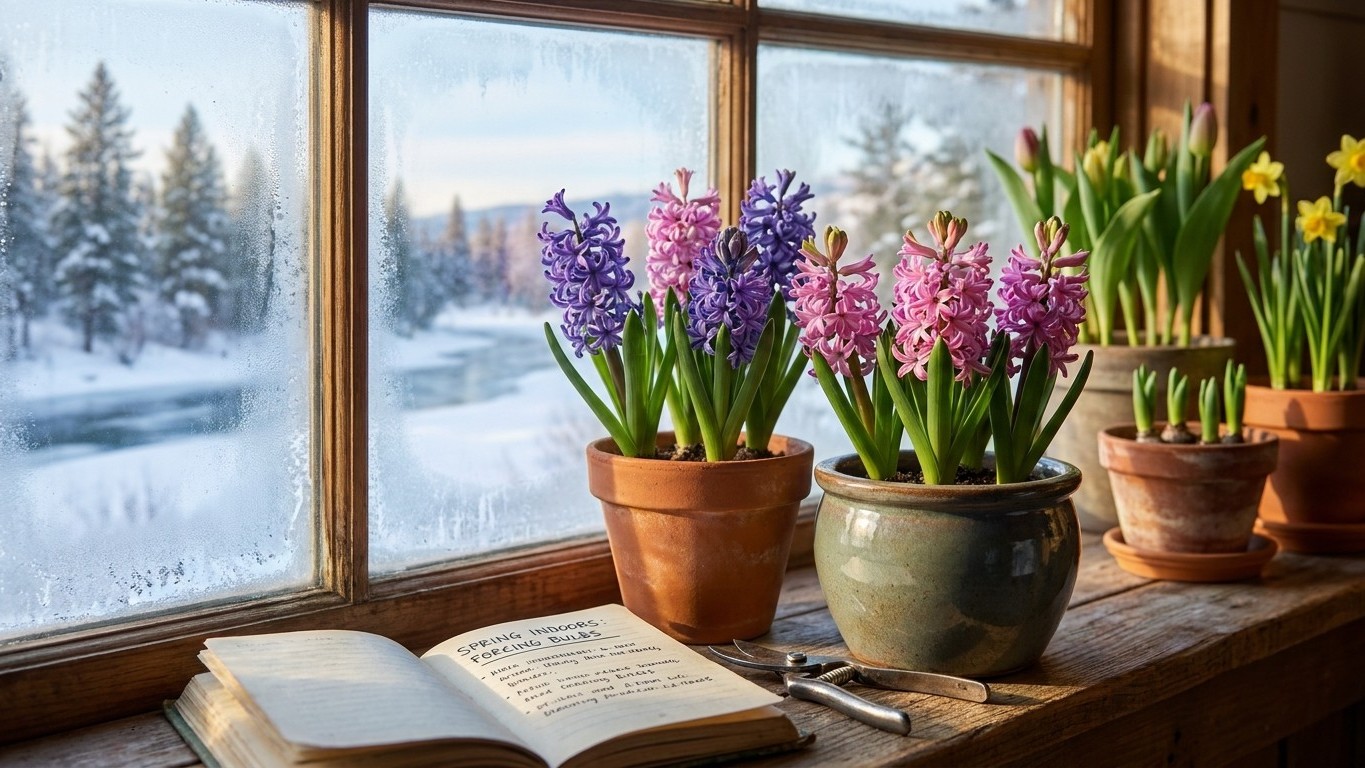

Growing Spring Bulbs in Containers works across Idaho, but two separate problems hide behind that one sentence. Indoors, forcing brings bloom weeks before the garden wakes up. Outdoors, a potted bulb faces a colder threshold than the same bulb planted in the ground, since a container freezes solid where garden soil only crusts at the surface. Idaho’s own numbers decide which problem a gardener is actually solving.
Why this matters in Idaho

Start with the number that settles the question: 25.4F, the average daily minimum temperature for the coldest month, measured at the Boise reference station over the 1991-2020 period (NOAA NCEI Climate Normals). That figure sits well below the 45F ceiling a spring bulb needs to cross before it can bloom on schedule, and it stays there for months, not weeks. Forcing exists to manufacture cold in places where winter never gets cold enough, long enough, for a bulb to satisfy its chilling requirement in the ground. Boise’s winter does not have that shortage. A bulb planted directly in Idaho soil gets its twelve to fourteen weeks below 45F without any help from a gardener, refrigerator drawer, or unheated garage.
So forcing here is a scheduling choice, not a rescue. A gardener forces bulbs in Idaho to have hyacinths blooming on a windowsill in February, not because the yard is too warm to do the job on its own.
Containers are a different story, and this is where the state’s range matters. The USDA Plant Hardiness Zone Map places Idaho anywhere from zone 3b to zone 7b, one of the widest spreads found in a single state, built entirely on the average annual extreme minimum temperature. Boise sits toward the milder end of that range; the mountain valleys and higher basins sit toward the colder end. A bulb rated hardy for ground planting in a 6b pocket near Boise can still die in a container in that same pocket, because a pot has no thermal mass around it. Garden soil below the frost line stays buffered above freezing all winter. A container exposed on a patio or a porch has nothing buffering it at all, and it freezes through, roots and bulb together, at temperatures the same bulb would shrug off in a bed. The zone printed on a bulb bag was written for ground planting. In a pot, treat that number as roughly two zones too optimistic.
How to do it here
The steps below cover both jobs: forcing a container for indoor bloom, and keeping a container of bulbs alive outdoors through an Idaho winter. Follow them in order.
- Pot the bulbs root end down in ordinary potting mix, in a container with drainage holes, sometime in mid-fall while the bulbs are still dormant and firm.
- Water once to settle the mix around the roots, then hold off on further watering beyond keeping the mix from drying out completely during the cold period.
- Move the pot to a space that holds steady between roughly 35F and 45F for the full chilling period. An unheated attached garage often works in Idaho, since it typically stays above freezing even during a coldest month whose average daily low, per NOAA NCEI’s Boise normals, runs around 25.4F outdoors.
- If no cold garage or cellar is available, use the produce or crisper drawer of a refrigerator instead of the main compartment, and never a drawer holding ripening apples or pears. Ripening fruit gives off ethylene gas, and that gas will abort the flower bud forming inside the bulb before it ever gets the chance to open.
- Track the chilling period on a calendar rather than by guesswork. Most spring bulbs need twelve to fourteen weeks below 45F before they’re ready to bloom.
- Once the chilling period is complete, bring the pot into a cool room, around 60 to 65F, out of direct sun, for the first week. Increase light and warmth gradually as shoots green up.
- For a container left outdoors instead of forced indoors, treat the pot as roughly two USDA zones colder than the ground beneath it. Push it against a heated wall, sink it to the rim in garden soil, or wrap it in insulating mulch for the winter.
- Check the drainage in that outdoor container before committing bulbs to it. A pot standing in a saucer of frozen water is the fastest way to lose a bulb that the cold alone would never have killed.
Which bulbs are worth it
Not every bulb pays back the effort of forcing or of protecting a winter container, and the reason usually comes down to two plant traits: how short the chilling requirement is, and how tall the finished stem grows. A short chilling requirement forces faster and more predictably. A tall stem often topples in a pot, where there’s no surrounding planting to lean on.
Bulbs that force reliably in a container:
- Paperwhite narcissus, which needs no chilling period at all and blooms on the shortest timeline of any forced bulb.
- Crocus, short-stemmed and stable, with one of the shorter chilling windows among true spring bulbs.
- Hyacinth, reliable and fragrant, with a stem short enough to stay upright without staking.
- Grape hyacinth (muscari), compact and sturdy, well suited to a small pot.
- Dwarf iris reticulata and miniature daffodils like tête-à-tête types, both bred short specifically for container display.
Bulbs that tend to sulk in a pot:
- Tall hybrid tulips, which need a long chilling period and grow a stem heavy enough to fall over once it flowers. Since many tulip varieties decline sharply after their first bloom in a home garden anyway, forcing them costs nothing in the long run, they were a one-season purchase either way.
- Large trumpet daffodils, whose tall stems have the same toppling problem as tulips.
- Large ornamental alliums, which need an extended chill and take up more root depth than most containers offer.
- Fritillaria, sensitive to temperature swings and easily thrown off by an inconsistent cold period.
What goes wrong, and when you can still fix it
Leaves but no flower
This means the chilling period ran short. The bulb had enough stored energy to push up foliage, but the flower bud never finished forming without the full twelve to fourteen weeks below 45F. There’s no fixing it this season. Note how long the pot actually spent in the cold, and extend that period next time.
A flower on a stem too short to see
This one comes from warming the pot too fast after the chilling period ended. The bud was ready, but the stem never got the gradual transition it needed to elongate before opening. The bloom that shows up is what the plant has to give this season, there’s no rescuing more height from it now. Next time, hold the pot in a cool, dim room for a full week before moving it into bright warmth.
Rot in the pot
Soft, discolored, foul-smelling bulb tissue almost always traces back to standing water, either from a clogged drainage hole or a saucer that never got emptied through a freeze-thaw cycle. A rotted bulb cannot be saved. Check the remaining bulbs in that same pot immediately: any that still feel firm can be lifted, rinsed, and repotted in fresh mix with working drainage, which can still save the rest of the season’s display.