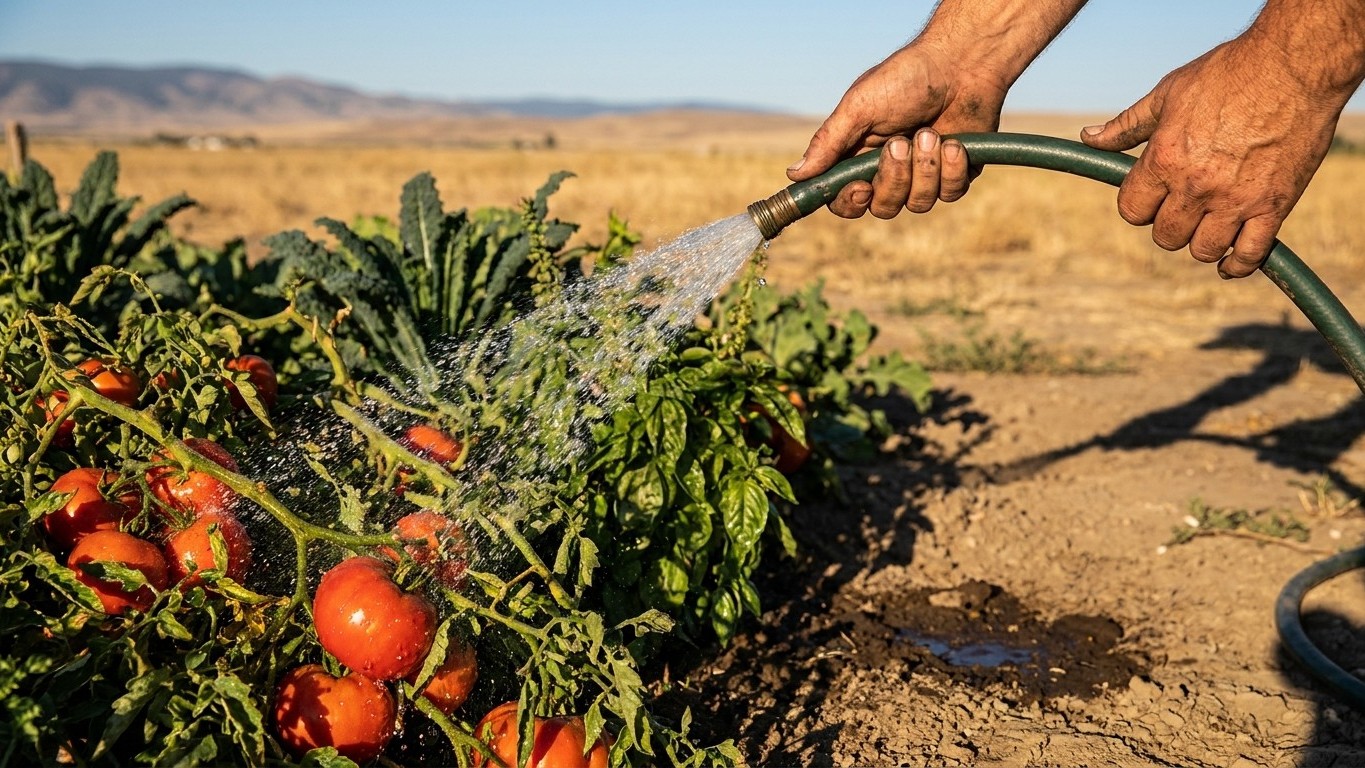

Idaho gardens face a real dry stretch each summer: just 0.17 inches of rain falls in August, the driest month, while the region sees an average of 47.5 days a year at or above 90F. That combination means almost every drop a garden gets between June and September has to come from a hose, not the sky, and timing that water correctly matters more than the total amount.
What changes here

Two numbers set the terms for every Idaho garden: 0.17 inches of rain in August, the driest summer month, and 47.5 days a year that reach 90F or hotter. Read together, they say something specific: the month when plants need water most, because heat is pulling moisture out of soil and leaves fastest, is also the month the sky offers almost nothing. A garden bed generally wants about an inch of water a week to keep roots supplied. Spread that 0.17 inches evenly across August’s roughly 4.3 weeks, and the sky is contributing something on the order of 0.04 inches a week. That leaves the gardener to supply nearly the entire inch by hand or by irrigation, week after week, for the driest stretch of the season.
The gradient across summer tells the same story with a slope. June brings 0.75 inches, July drops to 0.21 inches, and August bottoms out at 0.17 inches. Total summer rainfall across those three months comes to about 1.1 inches, against 11.5 inches for the full year, which means Idaho gets the bulk of its annual moisture outside the growing season, when plants can’t use it. By the time August arrives, a garden that hasn’t been watered on a schedule is already running a deficit that a single storm won’t fix.
Soil texture changes how far that inch goes, even though the exact composition varies by yard and by neighborhood across the state. On sandy ground, water drains through quickly and needs replacing sooner but in smaller amounts. On heavier clay, the same inch sits in the root zone for days, which sounds like an advantage until the ground stays wet long enough to starve roots of oxygen. Neither soil type changes the 47.5-day heat load or the 0.17-inch August rainfall. What changes is how often the gardener needs to step in to make up the difference, and that’s the question the next section answers directly.
How to water when it matters
The method that works with Idaho’s climate isn’t complicated, but it runs against instinct. Deep, infrequent watering at the base of the plant, done in the morning, beats a daily sprinkle every time, and each part of that sequence has a reason behind it tied to how a plant actually pulls water from the ground.
Watering deeply means the moisture reaches down where roots live, several inches below the surface, which trains the plant to grow roots downward instead of clustering near the top where the sun bakes them dry within hours. Watering at the base, rather than overhead, keeps leaves dry and sends water straight to the soil instead of losing a share to evaporation in midair, which matters more on a day pushing toward 90F. Morning watering gives the soil hours to absorb before the day’s heat peaks, and it lets any leaf splash dry out before evening, when a wet leaf sitting overnight becomes an invitation for fungal disease.
Checking the soil before watering beats checking the calendar. Push a finger about two inches into the ground near the plant’s base, or use a trowel for a quick core sample. If it’s dry at that depth, water. If it’s still damp, wait, even if it’s been a few days. Sandy soil dries out at that depth faster and calls for shorter, more frequent sessions, while heavy clay can hold a week’s worth of water and needs a full dry-down before the next soak, or roots start to rot.
Here’s a sequence to start from, adjusted against your own soil once you’ve watered it a few times:
- Check soil moisture two inches down with a finger or trowel before deciding to water at all.
- Water early in the morning, before the day’s heat sets in, aiming for the base of each plant rather than the leaves.
- Apply enough to soak the top 6 to 8 inches of soil, which for most garden beds means a slow, deep soak rather than a quick pass.
- On sandy soil, plan to repeat every 2 to 3 days during the hottest stretch; on clay, stretch that to once a week and confirm with the finger test before each round.
- Add a 2 to 3 inch layer of mulch around plants to slow evaporation between waterings, especially through August.
That schedule is a starting point, not a rule. The only way to know it’s right for a specific yard is to check the soil at root depth a day or two after watering and see how it held up.
What goes wrong
“I water a little every day, just to be safe”
This is the most common mistake in a state where August delivers 0.17 inches of rain and heat pushes past 90F nearly 48 days a year. A light daily sprinkle wets only the top inch of soil, which trains roots to stay shallow and close to the surface. Those roots then sit in the exact layer that dries out and heats up fastest under an afternoon sun, leaving the plant more vulnerable to stress than if it had been watered less often but more deeply.
“I water in the evening, after work”
It feels convenient, but overhead evening watering leaves leaves wet through the cool overnight hours, which is exactly the window fungal diseases like powdery mildew need to take hold. Morning watering gives the same moisture time to soak in and any splashed foliage time to dry before nightfall.
“It rained yesterday, so I skipped watering”
A passing summer shower often wets only the top half-inch of soil before running off, especially on the compacted or clay-heavy ground common in parts of Idaho. That thin layer can look convincing from the porch. The finger test, two inches down, settles it in ten seconds rather than trusting a five-minute cloudburst to have done the job.
“I didn’t bother with mulch, it’s just extra work”
Bare soil left exposed to 90-degree afternoons loses moisture straight back into the air within hours of watering. A few inches of mulch around the base of plants slows that evaporation significantly, which matters most in a state where the driest month offers next to nothing in return.
Local help
For soil-specific guidance and current planting advice, the University of Idaho Extension is the state’s land-grant resource. Watering restrictions vary by city and water district and change from year to year, so check with your local water provider for current rules before setting an irrigation schedule.
Common questions
How much should I water my garden each week in Idaho?
Most beds want about an inch of water a week total. In August, the driest month, the sky supplies roughly 0.04 inches of that on average, leaving nearly the full inch to be added by hand or irrigation.
What time of day should I water in Idaho’s summer heat?
Morning, before the heat of the day sets in. It lets water soak down before evaporation picks up and keeps any wet foliage from sitting damp overnight, which lowers the risk of fungal disease.
Does Idaho’s soil type change how often I should water?
Yes. Sandy soil drains fast and needs shorter, more frequent watering, while clay-heavy soil holds moisture longer and needs a full dry-down between waterings to avoid drowning roots. The finger test at two inches deep tells you which schedule your yard needs.
Can I rely on rain to water my garden during an Idaho summer?
Not through June, July, or August. Combined, those three months average about 1.1 inches of rain, a small fraction of the state’s 11.5-inch annual total, so supplemental watering carries most of the load during the growing season.