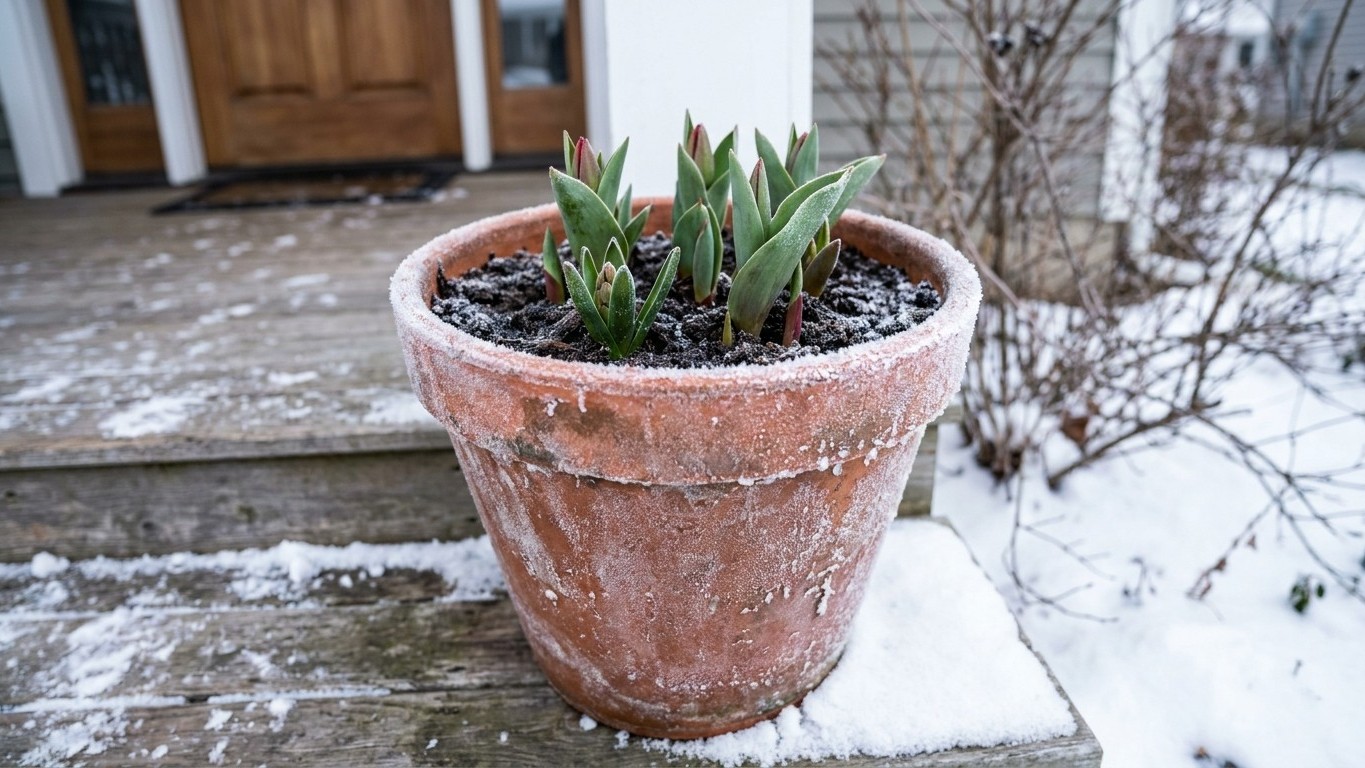

Spring bulbs grow fine in containers in Illinois, but the pot changes the rules. Ground here gets more cold than any bulb needs, insulated below the frost line. A container has no such buffer: it freezes clear through, roots included. The fix is either moving the pot somewhere that stays above freezing, or choosing a container built for cold two zones tougher than the bulb inside it.
Why this matters in Illinois

Chicago’s coldest month averages a daily low of 18.8°F, according to NOAA NCEI climate normals covering 1991 through 2020. That single figure decides what happens to a bulb sitting in a pot on a porch step through January. It also tells you Illinois doesn’t have a chilling shortage: 18.8°F sits nowhere near the 45°F ceiling a spring bulb needs to break dormancy, and that cold holds for months, well past the twelve to fourteen weeks most bulbs ask for. Ground-planted bulbs in this state get more chilling than they know what to do with.
That’s why forcing, the practice of manufacturing missing cold in a refrigerator drawer or a dark garage, isn’t really an Illinois problem for bulbs planted straight into the yard. Gardeners in milder states force tulips and hyacinths because their ground never gets cold enough for long enough. Illinois ground handles that job on its own.
Containers flip the logic entirely. A garden bed freezes from the top down; soil below the frost line hovers close to 32°F even in the sharpest cold snap, because dirt insulates and the earth beneath carries residual warmth. A pot has none of that mass. Surrounded by air on every side, a container’s soil tracks the outdoor air almost exactly, which means a bulb inside can drop well past what it can survive, especially in a thin plastic or unglazed clay pot. The USDA Plant Hardiness Zone Map, built on the 1991-2020 average annual extreme minimum, places Illinois across a 5a to 7b range statewide, but that rating describes ground temperature. A bulb pot left exposed outdoors doesn’t get that benefit; it behaves as though it’s sitting closer to two zones colder than the map suggests for that spot.
The real hazard here, then, isn’t a shortage of cold. It’s an oversupply landing directly on a bulb with nothing between it and the winter air except a few inches of potting mix and a wall of glazed clay or plastic. A daffodil that shrugs off an Illinois winter in the ground can turn to mush in that same winter sitting in an eight-inch pot on a deck rail. Conditions vary across the state’s hardiness range, so a pot in the southern tip of Illinois has more margin than one in the Chicago area.
How to do it here
Two separate goals hide inside growing Bulbs in Containers in this state: forcing bulbs indoors for bloom ahead of the outdoor season, and keeping potted bulbs alive outdoors through an Illinois winter. The steps below cover both, since the early ones apply to any forced bulb and the later ones are what changes once winter settles in at 18.8°F.
- Pick a bulb and check how many weeks of cold it needs before it will bloom. Most spring bulbs want twelve to fourteen weeks below 45°F. Hyacinths and crocus tend toward the short end; large-flowered tulips run longer.
- Pot the bulb in a container with drainage holes, using a fast-draining mix. Set the bulb with its shoulder near the soil surface and water once after planting.
- Give it the cold. An unheated garage that stays above freezing but below 45°F works, and so does a spare refrigerator drawer, provided it stays away from ripening fruit. Apples, pears, and bananas give off ethylene gas, and ethylene kills the flower bud forming inside the bulb before it ever opens.
- Track the weeks on a calendar taped to the pot. Twelve weeks is a floor, not a target; lean toward fourteen if you’re not certain which bulb you’re working with.
- If the pot is staying outdoors all winter instead of in cold storage, treat the container as though it belongs two hardiness zones colder than the ground beneath it. In a state spanning zones 5a to 7b, that means sinking the pot into a garden bed and mulching heavily over the rim, or moving it into an unheated garage or shed for the coldest stretch.
- Bring the pot into a cool, dim room first, not straight to a warm windowsill. A few days at 50 to 60°F let the stem start stretching before the leaves take over.
- Move to bright light and normal room warmth once color shows at the tip of the bud, and water as the soil dries between waterings.
Which bulbs are worth it
Not every spring bulb repays the twelve weeks of storage space it takes up. Some force fast and stay compact in a pot; others take their time and then flop over the rim the moment they bloom.
Paperwhite narcissus skip the cold requirement entirely, which makes them the easiest bulb to force. Illinois winters mean nothing to them either way: sold and planted as a one-season purchase, paperwhites aren’t hardy in Illinois ground, so nothing is lost by using the whole bulb up indoors. Hyacinths force reliably and finish at a height that stays upright in a standard pot. Crocus and grape hyacinths are short by nature, so a tipped pot is about the worst that can happen. Standard tulips force well too, as long as the cold period runs the full stretch; cut it short and they still grow leaves, just no flower.
- Paperwhite narcissus
- Hyacinths
- Crocus
- Muscari (grape hyacinth)
- Standard tulips
On the other side, tall trumpet daffodils, the kind with foot-long stems, tend to lean and topple once the flower’s weight shifts past the pot’s center of gravity, especially in a lightweight plastic container. Fritillaria imperialis needs a longer, fussier chill and resents being disturbed, a poor match for a bulb that gets moved in and out of cold storage. Large ornamental alliums put a tall stem on a small bulb base and are built for open ground, not a pot that gets bumped or caught by wind.
- Tall trumpet daffodils
- Fritillaria imperialis
- Large ornamental alliums
A bulb’s cold requirement roughly predicts how much trouble it will cause. A short requirement means a shorter wait and less chance something goes wrong in storage. A long one leaves more weeks for a garage to warm past 45°F or a refrigerator drawer to pick up a stray apple.
What goes wrong, and when you can still fix it
Leaves but no flower
The plant grows normal green leaves, sometimes for weeks, and never produces a bud. That points to a cold period that ran short, most likely under the twelve-week floor. The flower bud forms during chilling, not after, so a bulb that never got enough time below 45°F has no bud to open. Nothing brings one back this season. The bulb itself is usually still viable and can go through a full twelve to fourteen weeks of cold next fall.
A flower stem too short to see
The bud opens, but it stays buried down in the foliage instead of standing above it. This happens when the pot moved from cold storage straight into full warmth and bright light, skipping the cool, dim transition. The stem never got the days it needed to elongate before the leaves raced ahead of it. This season’s bloom stays short, and there’s no way to stretch a stem after the fact. Next time, hold the pot at 50 to 60°F in low light for several days before moving it to a bright, warm spot.
Rot at the base of the bulb
The bulb turns soft and dark, often with a sour smell, and the leaves yellow from the bottom up. That’s standing water: a pot without a drainage hole, or a saucer that never got emptied, kept the roots sitting wet long enough for rot to take hold. Once the bulb has gone soft, it won’t recover this season and isn’t worth planting out. The fix is entirely preventive: drainage holes in every pot, a fast-draining mix, and an emptied saucer are what stop this from happening the next time around.