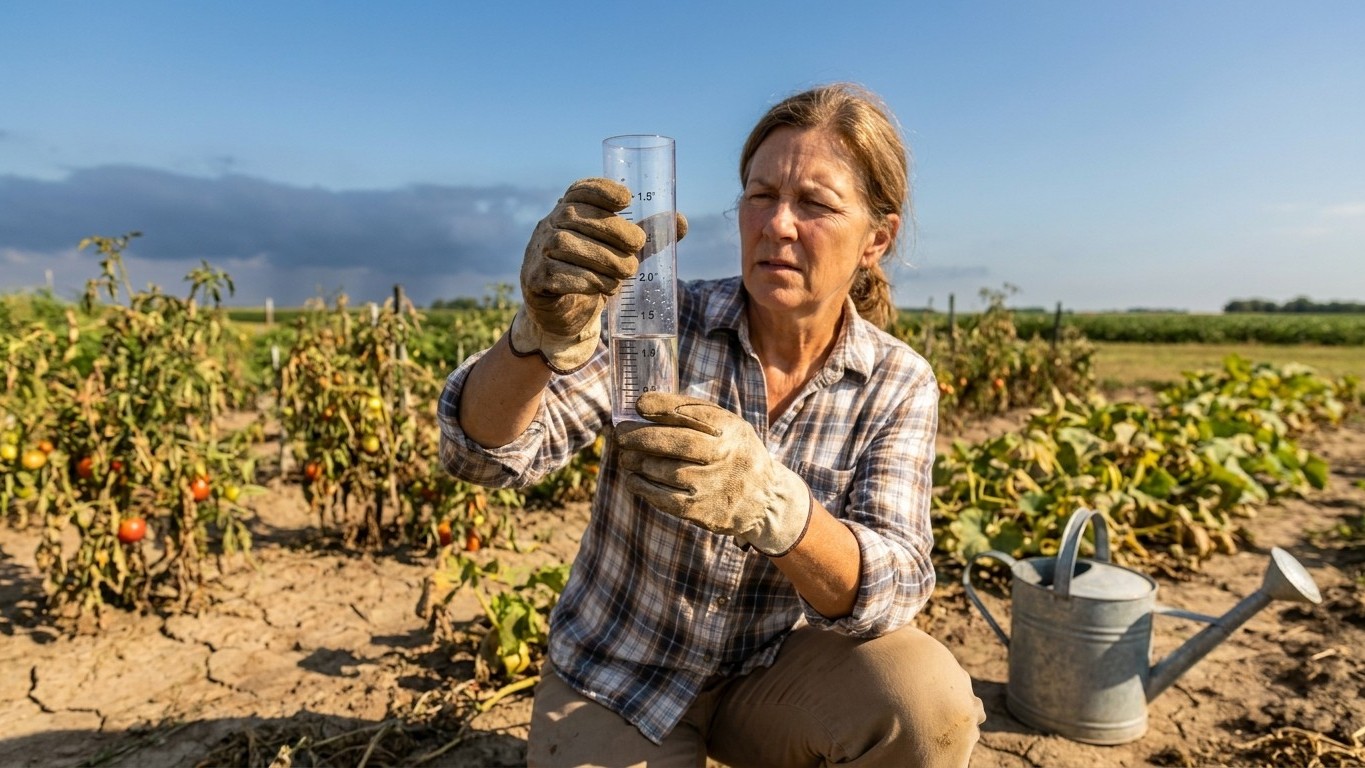

Iowa’s driest summer month, July, averages 3.82 inches of rain, and the region sees 18.4 days a year at or above 90°F. Together those numbers mean the sky covers most of a garden’s needs in a normal July, but the hottest stretches of that month can still leave beds thirsty between storms. A rain gauge on your own plot settles the rest.
What changes here

Start with the two numbers that matter most for a watering schedule: 3.82 inches of rain in July, the driest of the summer months, and 18.4 days a year that hit 90°F or higher. Read together, they say something a gardener can actually use : Iowa’s summer isn’t parched, but its hottest days push evaporation hard enough that even a decent rain month can leave gaps a plant feels.
Do the arithmetic and it gets more specific. A vegetable bed or a young perennial wants roughly an inch of water a week. Spread July’s 3.82 inches evenly across its 31 days and roughly 4.4 weeks, and the sky is delivering about 0.86 inches in an average week that month. That’s most of the inch a bed wants, but not all of it, and rain almost never arrives evenly. A single July thunderstorm can drop half an inch in twenty minutes and then nothing for ten days. The monthly average is real, but the week-to-week gap is what a gardener actually manages.
Soil texture decides what happens to that gap. On sandy ground, water moves through the root zone within a day, so a garden can look fine after a storm and be dry again by the weekend, the soil simply doesn’t hold what it’s given. On heavy clay, common across much of Iowa’s row-crop country, the same rain can sit in the top foot of soil for the better part of a week, which is good for stretching between waterings but risky if a gardener adds more before that reserve has drained. Neither figure from NOAA changes because of soil, but soil decides how far that rain actually goes once it lands.
None of this is a forecast. These are 1991-2020 normals from the reference station cited by NOAA, not a promise about this particular July. A slope, a sandy pocket, or a spot next to a heat-holding driveway will all shift the real number on a given lot away from the regional average.
How to water when it matters
The method that works in Iowa’s climate isn’t complicated, but it runs against habit. Deep, infrequent soakings beat a daily splash because they train roots to grow down toward moisture instead of staying shallow where the top inch of soil bakes off fast on the region’s 90°F days. Watering at the base rather than overhead keeps leaves dry, which matters more in a humid Midwestern summer than people expect, since wet foliage overnight is exactly what fungal disease needs to take hold. Morning watering wins over evening for the same reason: it gives foliage hours to dry in daylight, and it gets water into the root zone before the day’s heat starts pulling moisture back out through the leaves.
Checking the soil beats guessing every time. A finger pushed two inches down, or a trowel pulled up for a quick look, tells you whether the root zone is actually dry, the surface can look bone-dry an hour after watering while the two inches below stay damp, and the reverse happens just as often after a light rain that never made it past the mulch layer.
Here’s a sequence to start from, adjusted against what your own soil tells you:
- Check soil moisture two inches down with a finger or trowel before watering at all, rather than watering on a fixed calendar.
- Water deeply enough to soak the top six to eight inches of soil, aiming for roughly one inch of water per session on established beds.
- On sandy soil, shorten the interval and water more often, since the same inch drains through in about a day.
- On clay soil, stretch the interval and let the bed dry partway between soakings, since clay can hold a week’s worth of moisture and drown roots if watered too soon.
- Water at the base of the plant, not overhead, and do it in the early morning before the day’s heat sets in.
- Recheck at two inches after each watering to confirm the water actually reached root depth rather than running off or evaporating first.
One inch a week is a starting point, not a rule, a raised bed, a container, or a spot in full afternoon sun on one of Iowa’s 18.4 annual 90°F days will all ask for more than that baseline suggests.
What goes wrong
A little water every day
Daily light sprinkling feels responsible, but it keeps roots shallow because the water never travels past the first inch or two of soil. Those roots then sit exactly where July’s heat hits hardest, and the plant becomes more drought-sensitive over time, not less.
Watering leaves at night
An evening soak that wets the foliage leaves it damp for eight or more hours in warm, still air, which is close to ideal conditions for fungal disease. Iowa’s humid summer nights make this worse than it would be in a drier climate.
Trusting the sky after a storm
A loud summer thunderstorm can feel like it solved the water problem, but a fast, heavy rain often sheds off the surface or wets only the top half-inch of soil before it stops. This is the mistake that costs the most in Iowa’s climate, precisely because storms here are dramatic enough to fool a gardener into skipping the finger test that would show the root zone never got touched.
Skipping mulch in the heat
Bare soil left uncovered on a 90°F day gives back a good share of whatever water was just applied, straight to the air through evaporation. A two- to three-inch mulch layer slows that loss and buys a garden real time between waterings, especially on the sandier soils that already drain fast on their own.
Local help
For soil testing, plant-specific guidance, and local growing conditions, Iowa State University Extension and Outreach is the state’s land-grant resource. Watering restrictions during dry spells vary by city and water district and change from year to year, so check with your local water utility for current rules before setting an irrigation schedule.
Common questions
How often should I water my garden during an Iowa dry spell?
Start by checking soil moisture two inches down rather than watering on a fixed schedule. On clay soil that often means once a week with a deep soaking; on sandy soil it can mean every two to three days.
Is Iowa’s summer rainfall usually enough for a vegetable garden?
July, the driest summer month, averages 3.82 inches, which covers most but not all of the roughly one inch a week a bed typically needs, especially during stretches with several 90°F days in a row.
Does mulch really matter that much in Iowa’s climate?
Yes. On the days that reach 90°F or above, which happens about 18.4 times a year on average, bare soil loses moisture to evaporation fast, and mulch measurably slows that loss.
Should I water my lawn or garden in the evening during a heat wave?
Morning is better. Evening watering leaves foliage wet overnight in warm, humid air, which raises the risk of fungal disease more than it helps the plant.