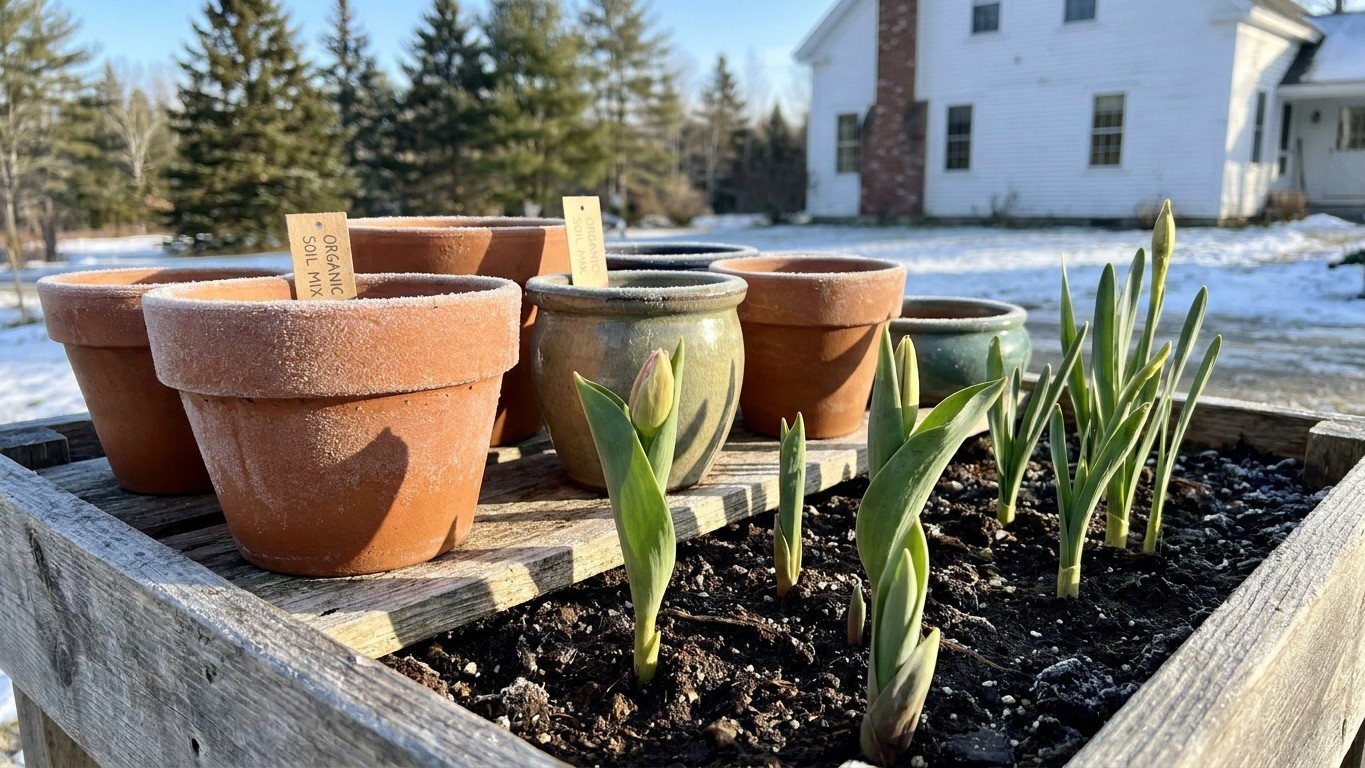

Container-grown bulbs in Maine face a different threat than bulbs planted in a garden bed: the pot itself freezes solid, roots and all, while the ground insulates what’s planted directly in it. That single fact changes how you plant, where you overwinter the pot, and which bulbs are worth the trouble at all.
Why this matters in Maine

The coldest-month average low at the Portland reference station sits at 15.6°F, according to NOAA NCEI Climate Normals for 1991-2020. That number matters because it tells you Maine winters deliver far more cold than any spring bulb needs to bloom. A tulip or daffodil requires roughly twelve to fourteen weeks below 45°F to set its flower bud. At an average low of 15.6°F for the coldest month alone, that requirement is met and then some, well before spring even starts to think about arriving.
So forcing, in the sense of manufacturing missing cold, isn’t the problem here. Maine doesn’t lack winter. What it has in abundance is exactly what creates the container problem: cold severe enough to freeze a pot straight through, killing roots that would have survived the same temperature if they’d been six inches down in garden soil instead of sitting in a plastic or ceramic container above ground.
This is where the USDA Plant Hardiness Zone Map becomes relevant, and where it gets misleading if you’re not careful. Maine spans USDA zones 3b through 6a, a range wide enough to cover the difference between coastal Portland and the interior north. That’s built on one variable, the average annual extreme minimum temperature, and it’s a statewide range, not a single number you can apply anywhere in the state. Portland itself sits in the milder end of that range. A bulb rated hardy for zone 5 will generally survive winter in a Portland garden bed. Put the same bulb in a container and leave that container sitting on a deck or porch all winter, and the effective exposure is closer to two zones colder, because the pot has no soil mass around it to buffer the swings.
That’s the practical takeaway for anyone gardening in containers here. The question isn’t whether Maine gets cold enough for spring bulbs. It does, easily. The question is whether the container you’re using can survive that cold with the bulb still alive inside it, and for most of the state, the honest answer is no, not without help.
How to do it here
Whether you’re forcing bulbs indoors for an out-of-season bloom or simply trying to keep a planted container alive through a Maine winter, the steps are concrete and checkable. Nothing here depends on guesswork.
- Choose bulbs suited to the goal. For indoor forcing, pick species with a shorter cold requirement and a compact stem, since tall growth in a small pot tends to flop. For an outdoor container meant to overwinter in place, pick bulbs rated hardy for a zone at least two steps colder than Portland’s zone, since the pot will expose the bulb to conditions colder than the surrounding ground.
- Pot with drainage as the priority. Use a container with holes in the bottom and a mix that drains fast. Standing water around a bulb through a freeze-thaw cycle is the single most common cause of loss, more than cold itself.
- Provide the twelve to fourteen weeks below 45°F that most spring bulbs require. An unheated garage that stays reliably above freezing works well for this, since it’s cold enough to satisfy the requirement without freezing the bulb outright. A refrigerator drawer works too, but it has to be kept away from ripening fruit. Fruit releases ethylene gas, and ethylene damages the flower bud inside a chilling bulb, so a bulb stored next to apples or pears can come through the cold period looking fine and never flower.
- Decide the container’s winter location before the first hard freeze. If the pot is staying outdoors, the bulb inside it needs to be rated at least two hardiness zones hardier than Portland’s zone, or the pot needs to move into an unheated but enclosed space, such as a garage or shed, and get wrapped or buried in mulch to slow the freeze.
- Bring the pot into light and cooler room temperatures once the cold period is complete. Sudden warmth after weeks of cold triggers the bloom; a gradual move from cold storage to a bright, cool spot, then to normal room warmth, gives the most reliable flowering.
Which bulbs are worth it
Not every spring bulb rewards the effort of container growing or forcing, and the difference usually comes down to two plant traits: how much cold the species needs before it will flower, and how tall and top-heavy the stem gets. A short cold requirement means faster, more predictable forcing. A tall stem in a small pot is a balancing act that often ends with the flower tipped over on the counter.
It’s also worth remembering that some bulbs, paperwhite narcissus in particular, aren’t hardy in Maine at all and were never going to survive to bloom again next year regardless of what you did with the pot. Forcing those costs nothing in the long run. You get a bloom, then you compost the bulb, exactly as you would have anyway.
- Crocus, small and quick to respond to cold, reliable in a shallow container.
- Grape hyacinth (muscari), short stem, forces predictably.
- Hyacinth, strong bloomer indoors after a standard cold period.
- Paperwhite narcissus, needs no cold period at all and blooms in a matter of weeks.
- Dwarf tulip varieties and small daffodil types, compact enough to stay upright in a pot.
- Tall Darwin-type tulips, prone to toppling once the flower opens on a full-height stem.
- Large trumpet daffodils, same top-heavy problem as tall tulips.
- Alliums, both a longer cold requirement and a tall, heavy flower head.
- Fritillaria, finicky about moisture and cold timing, inconsistent results in a container.
- Tall lily varieties, generally better suited to a garden bed than a pot.
What goes wrong, and when you can still fix it
Leaves but no flower
This means the cold period ran short, whether that’s weeks in the garage or weeks in the refrigerator. The bulb had enough energy to push foliage but never got the signal to set a flower bud. There’s no fix within the same season. The bulb needs a full cold cycle next winter, timed correctly from the start.
A flower on a stem too short to see
If the bloom opens low, almost hidden in the foliage, the bulb was likely warmed too quickly after cold storage. The flower formed correctly but didn’t get the gradual transition needed to stretch the stem before opening. This one isn’t reversible once it’s happened. Next time, move the pot through a cooler, dimmer room for a week or two before it reaches full warmth and light.
Rot in the pot
Soft, mushy bulbs almost always trace back to drainage, not cold. Water sitting around the bulb through repeated freeze-thaw cycles breaks down the tissue from the inside. A rotted bulb is not salvageable this season. The fix is for the next planting: a container with real drainage holes and a mix that doesn’t hold standing water through winter.