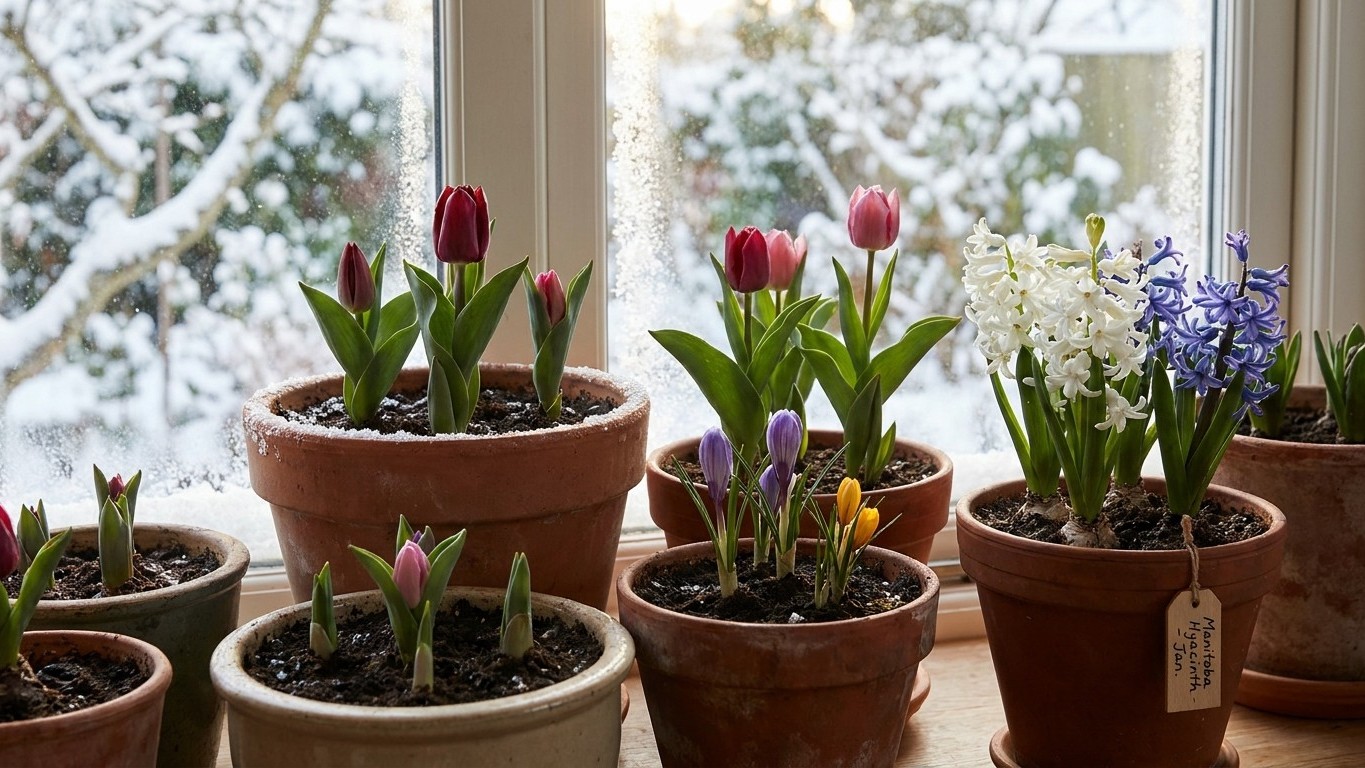

Forcing bulbs indoors works in Manitoba season after season, and the numbers behind the local climate explain why. The reference station (Winnipeg) sits in Canadian hardiness zone 3b, with a coldest-month average daily low of -6.6°F. That’s colder, for longer, than any spring bulb needs to break dormancy. The obstacle here isn’t a shortage of cold. It’s what happens to a container left out in it.
Why this matters in Manitoba

Start with the figure: -6.6°F, the mean daily minimum of Manitoba’s coldest month, measured at the Winnipeg reference station under the 1981-2010 Canadian Climate Normals. That number places the province in Canadian hardiness zone 3b under the 1991-2020 normals published by Natural Resources Canada. Neither figure is a USDA zone, and neither converts cleanly to one; the Canadian system runs on seven climate variables, the American one on a single value, and NRCan itself warns that a single Canadian zone can span nine different USDA zones. Keep the two systems apart when you read plant tags.
What that -6.6°F figure tells a gardener is simple: outdoor ground in Manitoba delivers far more than the 12 to 14 weeks below 45°F a tulip, hyacinth, or crocus needs to complete its cold requirement. There’s no shortage of chill here. If anything, there’s an oversupply.
The problem forcing actually solves in this province is a different one, and it’s a container problem, not a chill problem. A bulb bed cools from the top down; the mass of surrounding soil buffers the roots even as the surface freezes. A pot has no such mass. Once ambient temperatures sit near or below -6.6°F for weeks at a stretch, a container left outdoors freezes clean through, roots and bulb tissue alike, and the bulb dies. A hardiness zone rating that describes a bulb surviving in a garden bed says nothing about that same bulb surviving in a pot exposed on a deck or porch.
That’s the situation this territory is in: outdoor ground chill is abundant, but outdoor container culture is not viable through the coldest months without extra insulation or an indoor cold space. Forcing indoors, using a fridge or an unheated but frost-buffered garage, sidesteps the freeze-through risk entirely while still meeting the bulb’s chill requirement on a schedule the gardener controls. It’s less about manufacturing cold that winter withholds and more about giving the bulb the cold it needs somewhere the pot itself won’t freeze solid.
How to do it here
The sequence below is built around what’s actually available in a Manitoba household through the winter: a garage, a refrigerator, and a south-facing window once the cold period ends.
- Pot the bulbs in early fall, in a well-draining mix, with the shoulders of the bulb near the soil surface. Water once, thoroughly, right after potting.
- Choose the cold space. An unheated garage works only if it reliably stays above freezing through the coldest stretch; given a -6.6°F outdoor monthly minimum, an unheated garage attached to the house or partially below grade is far safer than a detached, uninsulated one. Leave a thermometer in the space and check it, rather than guessing.
- Or use a refrigerator drawer, set aside from any ripening fruit. Apples, pears, and bananas release ethylene gas as they ripen, and ethylene damages the flower bud forming inside a chilling bulb, even though the leaves may still emerge normally later.
- Hold the pots in the cold for 12 to 14 weeks, watering just enough to keep the mix from drying out completely. This window is what satisfies the bulb’s chill requirement regardless of species; some need the low end, some the high end.
- Check for roots around week 10 by tipping the pot slightly and looking at the drainage hole. A web of white roots showing through means the chill period is nearly satisfied.
- Move the pot into a cool, dim room, around 60°F, for about a week once shoots reach an inch or two, then shift it into bright light and normal room temperature to finish flowering.
If the plan is to leave a potted bulb outdoors through winter instead of forcing it indoors, the pot needs to be rated at least two Canadian hardiness zones hardier than the bulb itself, since the container offers none of the insulating mass a garden bed provides. Short of that, the safer move is bringing the pot into an unheated but frost-buffered space and mulching heavily around it, which is effectively the same cold-storage principle as the garage step above.
Which bulbs are worth it
Not every bulb pays back the effort of potting, chilling, and babysitting through twelve-plus weeks of cold. Two things decide it: how short the chill requirement is (shorter means a faster turnaround to bloom), and how tall the stem grows relative to the pot (a top-heavy stem topples once it’s indoors without a garden bed to anchor it).
Bulbs that force reliably in this setup:
- Crocus, which has a short chill requirement and stays low enough to never topple
- Grape hyacinth (muscari), similarly short and compact
- Hyacinth, tall but with a stem sturdy enough to stand on its own
- Dwarf tulip cultivars, bred short specifically for pot culture
- Dwarf narcissus cultivars, which finish well below the height of standard daffodils
- Snowdrops (Galanthus), among the fastest to finish once chilling ends
Bulbs that tend to sulk or fail in this setup:
- Tall trumpet daffodils, which grow too top-heavy for a small pot
- Standard Darwin and single late tulips, prone to toppling once in bloom
- Alliums, which need an unusually long chill period and then grow well past pot-friendly height
- Fritillaria, which is notoriously inconsistent under artificial chilling
One detail worth keeping in mind: most forced bulbs, tulips and hyacinths especially, are spent after blooming indoors and are unlikely to perform as reliable perennials in a zone 3b garden bed regardless. Since the bulb was effectively a one-season purchase either way, forcing it costs nothing in the long run. It was never going to come back with the same vigor outdoors.
What goes wrong, and when you can still fix it
Leaves, but no flower
This means the chill period ran short. The bulb has enough stored energy to push foliage regardless of how much cold it received, but the flower bud inside only finishes forming once the full chill requirement is met. There’s no fix for this season; the bulb has already committed its energy to leaves. Next season, track the weeks in cold storage more carefully and don’t warm the pot early out of impatience.
A flower stalk too short to see over the leaves
This is the opposite mistake: the pot was moved into warmth before the chill period finished. Warmth triggers the flower to open, but the stem hasn’t had the signal to elongate yet, so the bloom stays buried in foliage. This can’t be corrected once it’s happened; the plant will finish its bloom short-stemmed regardless of what happens afterward. It’s a scheduling error to note for the next attempt, not something to fix mid-season.
Rot at the base of the bulb
Rot means water sat against the bulb instead of draining away, usually from a mix that’s too dense or a pot without a real drainage hole. Caught early, while only the outer layer feels soft, the bulb can sometimes be saved: pull it from the wet mix, trim away the soft tissue, let the cut surface dry for a day, and repot in a genuinely well-draining mix. Once the bulb is soft and dark all the way through, it’s finished, and the only fix is starting fresh next season with better drainage from the first watering on.