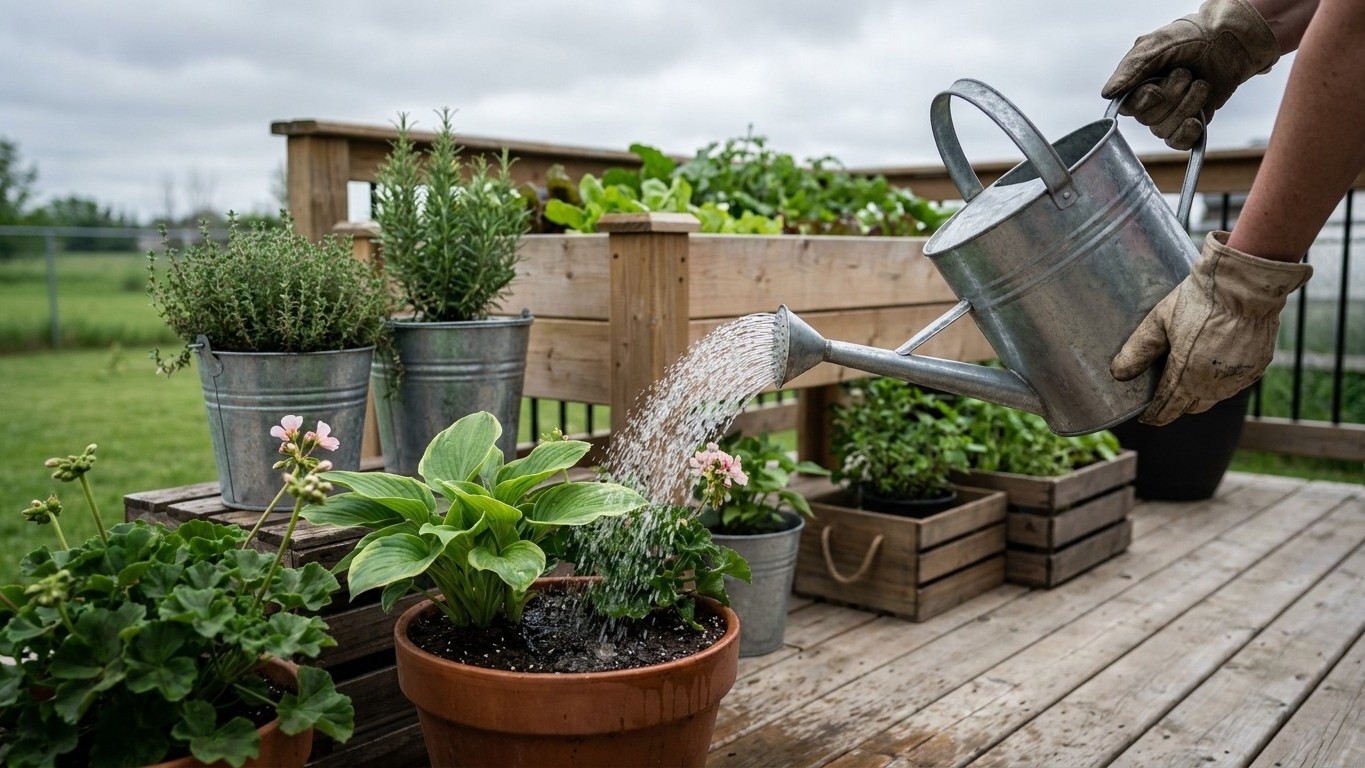

Manitoba gardens ask for roughly an inch of water a week, and the driest summer month, August, delivers 3.03 inches on average, well below what a full month of that weekly demand would need. Add a climate with zero days a year reaching 90F, and the picture changes: this isn’t a territory where heat drives constant evaporation, so the water problem here is timing and depth, not simply volume.
What changes here

Two numbers set the terms for watering in Manitoba. The driest summer month, August, brings an average of 3.03 inches of rain, and the reference station records 0.0 days a year at or above 90F. Together they describe a garden that rarely faces the scorching afternoons that pull water out of soil fast, but also can’t count on a steady, reliable drip from the sky through the driest stretch of summer.
Run the arithmetic on that August figure. Spread 3.03 inches across a 31-day month and it works out to about 0.098 inch a day, or roughly 0.68 inch over a seven-day week. A bed that wants an inch a week is short by about 0.32 inch once August turns dry, and that gap has to come from a hose or a can, not from waiting on the forecast. In a wetter month like June, at 3.54 inches, the math tilts the other way, and the deficit narrows to under a tenth of an inch a week.
What softens the size of that August shortfall is the absence of real heat stress. With 0.0 days a year climbing to 90F or beyond, Manitoba doesn’t lose water to the kind of aggressive daytime evaporation that hits gardens in hotter provinces and states. That means the 0.32-inch weekly gap in August is a real number to plan around, not one inflated further by heat pulling moisture out of the top layer of soil before roots ever reach it. How fast that gap turns into stress on a given plot still depends on the soil underneath it: sandy ground lets water pass through in hours, while heavy clay holds onto it for days, so the same rainfall total can mean two different watering schedules depending on what’s under the mulch.
How to water when it matters
The method that works in Manitoba isn’t complicated, but it runs against instinct. Deep, infrequent soakings at the base of the plant, done in the morning, beat a daily sprinkle every time, and each part of that routine does a specific job. Deep watering pushes moisture down where roots actually grow, so roots follow it and grow deeper themselves. Infrequent watering lets the topsoil dry out between sessions, which is what pushes roots downward instead of letting them linger near the surface. Watering at the base keeps leaves dry, cutting the chance of fungal disease. Morning watering gives the soil surface time to dry before evening, when damp leaves overnight become an invitation for mildew and rot.
Knowing when to water starts with checking the soil, not the calendar. A finger pushed two inches into the ground, or a trowel pulled up for a quick look, tells the real story: if it’s dry at that depth, it’s time to water, and if it’s still damp, it can wait another day or two. Surface dryness alone is misleading, especially after one of Manitoba’s brief summer downpours that wets the top half-inch and nothing below it.
A reasonable starting point for most Manitoba beds is one to two deep waterings a week, delivering close to an inch total, adjusted up or down as the soil check dictates. That number is a place to begin, not a fixed rule, since sandy patches will dry out faster and need shorter, more frequent sessions, while heavier ground holds water longer and punishes a schedule that doesn’t wait for it to drain.
- Check soil moisture two inches down with a finger or trowel before deciding to water at all.
- Water at the base of the plant, not overhead, using a soaker hose, drip line, or watering can aimed at the soil.
- Water in the early morning, giving foliage and soil surface the day to dry out.
- Aim for one to two deep sessions a week totaling close to an inch, then recheck soil depth before the next one.
- Adjust the frequency based on how fast that two-inch depth dries out on your own plot, not by the calendar alone.
What goes wrong
A little water every day
Daily light watering feels responsible, but it keeps moisture in the top inch of soil and never pushes it down where roots need to follow it. Roots stay shallow, close to a surface that heats and dries fast, and the plant ends up more vulnerable to any dry stretch, not less.
Watering leaves in the evening
Wetting foliage after dinner leaves it damp all night, and damp leaves overnight are exactly the conditions fungal spores need to take hold. Morning watering avoids this because the sun gets a chance to dry everything off within a few hours.
Trusting a passing summer shower
A quick thunderstorm can look generous and still leave the ground dry an inch down, since a hard, fast rain often runs off before it soaks in. The only way to know is the same finger check used before any scheduled watering, not a glance out the window after the clouds clear.
Skipping the mulch
Bare soil gives back to the sun and air what was just watered in. A couple of inches of mulch around the base of a plant slows that loss down considerably, which matters most in a month like August, when the sky is already coming up short on its own.
Local help
For soil, planting, and watering guidance suited to Manitoba conditions, Manitoba Agriculture is the province’s extension service. Watering restrictions, where they exist, are set by individual municipalities and water utilities rather than the province as a whole, so check with your local water provider for any current rules before setting a schedule.
Common questions
How often should I water a Manitoba vegetable garden in summer?
One to two deep waterings a week is a reasonable starting point, adjusted based on a soil check two inches down rather than a fixed calendar.
Does Manitoba get enough rain to skip watering in summer?
Not reliably. August, the driest summer month, averages 3.03 inches of rain, which falls short of the roughly one inch a week most garden beds want, so supplemental watering fills the gap.
Is heat stress a big concern for Manitoba gardens?
Less than in hotter regions. The reference station records 0.0 days a year at or above 90F, meaning evaporation from intense heat plays a smaller role here than the timing of rainfall itself.
Can I rely on a single rain shower instead of watering by hand?
Only if it soaked the soil past the top half-inch. Check with a finger or trowel two inches down before skipping a scheduled watering, since a hard summer shower often runs off rather than soaking in.