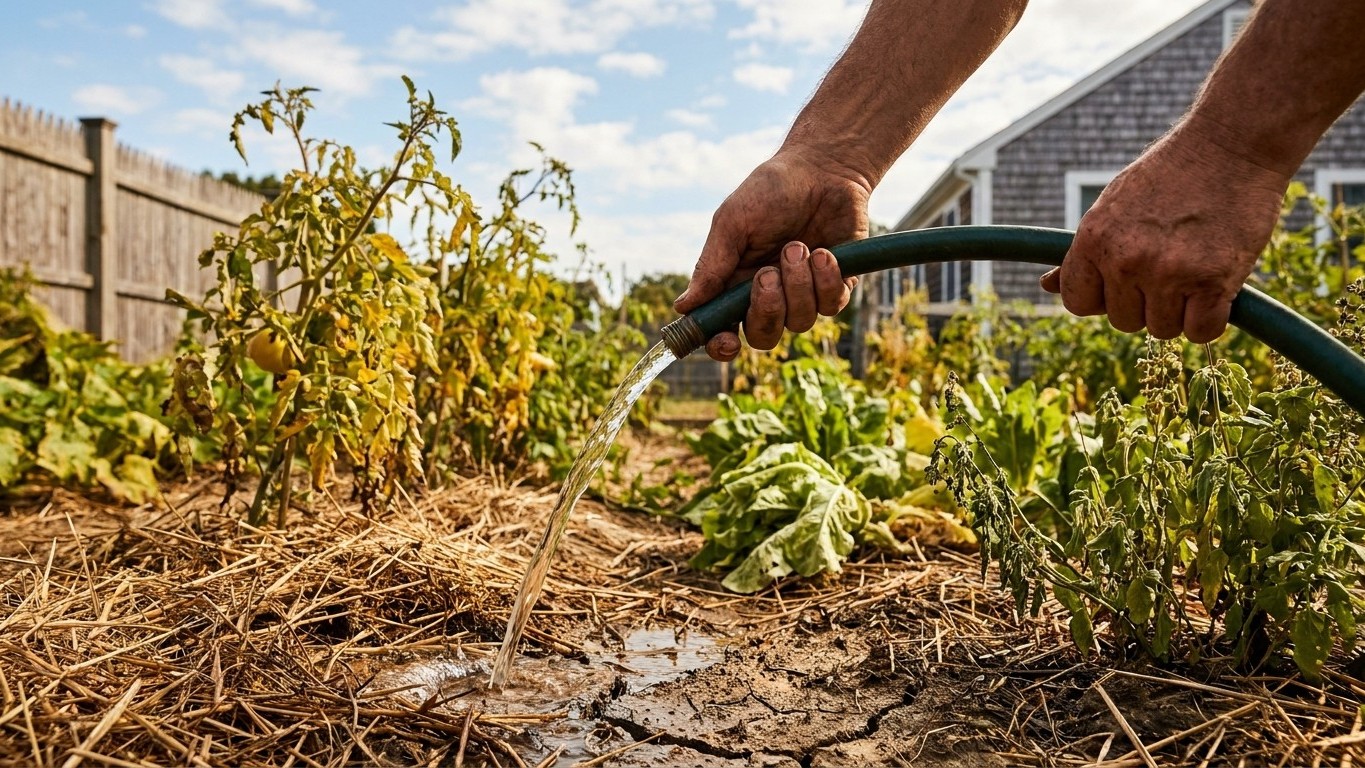

The short answer: Massachusetts gardens face a real but manageable dry stretch each summer, driest in August, with just enough heat days to push plants past their limit if watering habits don’t adjust. Get the rhythm right and most beds sail through; get it wrong and you’ll see wilting by the Fourth of July.
What changes here

Two numbers set the terms for every Massachusetts garden. The driest summer month, August, averages 3.23 inches of rain. And the reference station used for these normals logs 10.2 days a year at or above 90F. Put together, that’s a state where rain doesn’t disappear entirely in summer, but where a modest stretch of real heat lands right when the sky is giving the least.
Do the arithmetic and the picture sharpens. A vegetable bed or a young perennial planting wants roughly an inch of water a week to keep growing without stress. Spread August’s 3.23 inches evenly across the month’s 31 days, and you get about 0.10 inches a day, or roughly 0.73 inches for an average week. That leaves a gap of about a quarter-inch a week that has to come from a hose or a sprinkler, not the clouds. It sounds small, but that gap doesn’t arrive evenly. Massachusetts summer rain tends to fall as scattered thunderstorms rather than steady soakers, so a week can go by with zero rain, followed by an inch and a half in one evening that mostly runs off a hard, dry surface instead of sinking to root depth.
June and July aren’t far behind. June averages 3.89 inches and July 3.27 inches, both a step above August but still under the one-inch-a-week benchmark most weeks.
| Month | Average rainfall | Weekly average |
|---|---|---|
| June | 3.89 in | ~0.91 in |
| July | 3.27 in | ~0.73 in |
| August | 3.23 in | ~0.73 in |
Soil texture decides how far that inch actually goes. A sandy, fast-draining lot along the Cape or the Connecticut River sandplains lets water pass through within a day, so the same weekly total needs splitting into two or three shorter sessions. Heavier clay-loam soils common in parts of central Massachusetts hold that inch for the better part of a week, which means less frequent watering but a real risk of drowning roots if it’s applied before the ground has had a chance to dry. Neither soil is wrong; each just asks for a different schedule built around the same target volume.
How to water when it matters
The method that works here isn’t complicated, but each piece does a specific job. Watering deeply and infrequently pushes roots downward, chasing the moisture front as it sinks. Watering at the base rather than overhead keeps that moisture where roots can use it instead of losing it to leaf surfaces and wind. Watering in the morning gives plants a full day to take up what they need before the heat of a 90F afternoon pulls it back out through the leaves, and it lets any incidental leaf splash dry before nightfall.
Checking the soil beats guessing every time. The surface can look bone dry an hour after watering while the root zone below stays damp, and the reverse happens too, a crusted top layer hiding moist soil underneath after a storm.
- Push a finger or a small trowel two inches into the soil near the root zone; if it’s dry at that depth, it’s time to water, regardless of how the surface looks.
- On sandy ground, water in two to three shorter sessions per week, since the profile can’t hold a full inch at once without draining past the roots.
- On clay-heavy ground, apply the full weekly inch in one or two sessions, then wait until the two-inch check comes up dry again before repeating.
- During any stretch with several days at or near 90F, add a mid-week check even on a normal schedule, since evaporation accelerates fast once temperatures climb.
- Apply water slowly, at the base, letting it soak in rather than run off, especially on sloped beds or compacted lawns.
Use the roughly 0.73-inch weekly rainfall figure for August as a starting point for how much supplemental water to add, not a fixed rule. A raised bed, a container, or a spot under an overhang will dry faster than that average suggests, and only a finger in the actual soil settles it.
What goes wrong
A little water every day
Light daily sprinkling feels responsible, but it wets only the top inch of soil. Roots follow the moisture, staying shallow and close to the surface, where the next hot afternoon bakes them. Deep, less frequent watering trains roots to grow down toward cooler, steadier moisture instead.
Watering the leaves in the evening
Overhead watering at dusk leaves foliage wet through the night. Fungal diseases like powdery mildew and blight thrive in exactly that combination of moisture and darkness, and a Massachusetts summer’s humidity doesn’t help matters. A base-level soak in the morning avoids the problem entirely.
Trusting a passing shower
A ten-minute thunderstorm can look like a soaking rain from the porch while wetting only the top half-inch of soil, especially on compacted lawns or hard clay where runoff dominates. The two-inch finger check catches this every time; the sky’s appearance doesn’t.
Skipping mulch
Bare soil under a summer sun loses moisture fast, undoing a morning’s watering by mid-afternoon. A two- to three-inch layer of mulch slows that evaporation and keeps the root zone more stable between waterings, which matters more here on the stretches that push toward 90F than it does in a cool, cloudy week.
Watering too often on clay
Where the mistake in a hot, sandy garden is under-watering, the opposite failure shows up on heavier clay soils: watering on schedule without checking, even though the ground hasn’t dried from the last session. Roots sitting in saturated clay suffocate for lack of oxygen, a slower but just as damaging failure as drought stress.
Local help
For soil testing, plant-specific guidance, and current growing conditions across the state, the UMass Amherst Extension is the primary resource. Watering restrictions are set locally and change through the season, sometimes tightening fast during a dry August, so check with your own water provider or municipality before assuming any citywide schedule applies to your address.
Common questions
How often should I water my garden in a Massachusetts summer?
Aim for the equivalent of about an inch of water a week, adjusting for what August’s 3.23 inches of average rainfall already supplies and for your own soil’s drainage speed.
Is August really the driest month in Massachusetts?
Yes, according to the 1991-2020 normals: August averages 3.23 inches, just below July’s 3.27 and further below June’s 3.89.
Do I need to water differently during a 90-degree stretch?
Check soil moisture more often during those days. With about 10.2 such days a year on average, they’re not constant, but evaporation speeds up sharply while they last.
Are watering restrictions common in Massachusetts?
Rules vary by town and water district and can change quickly in a dry summer. Confirm current restrictions with your local water provider rather than assuming a fixed statewide policy.