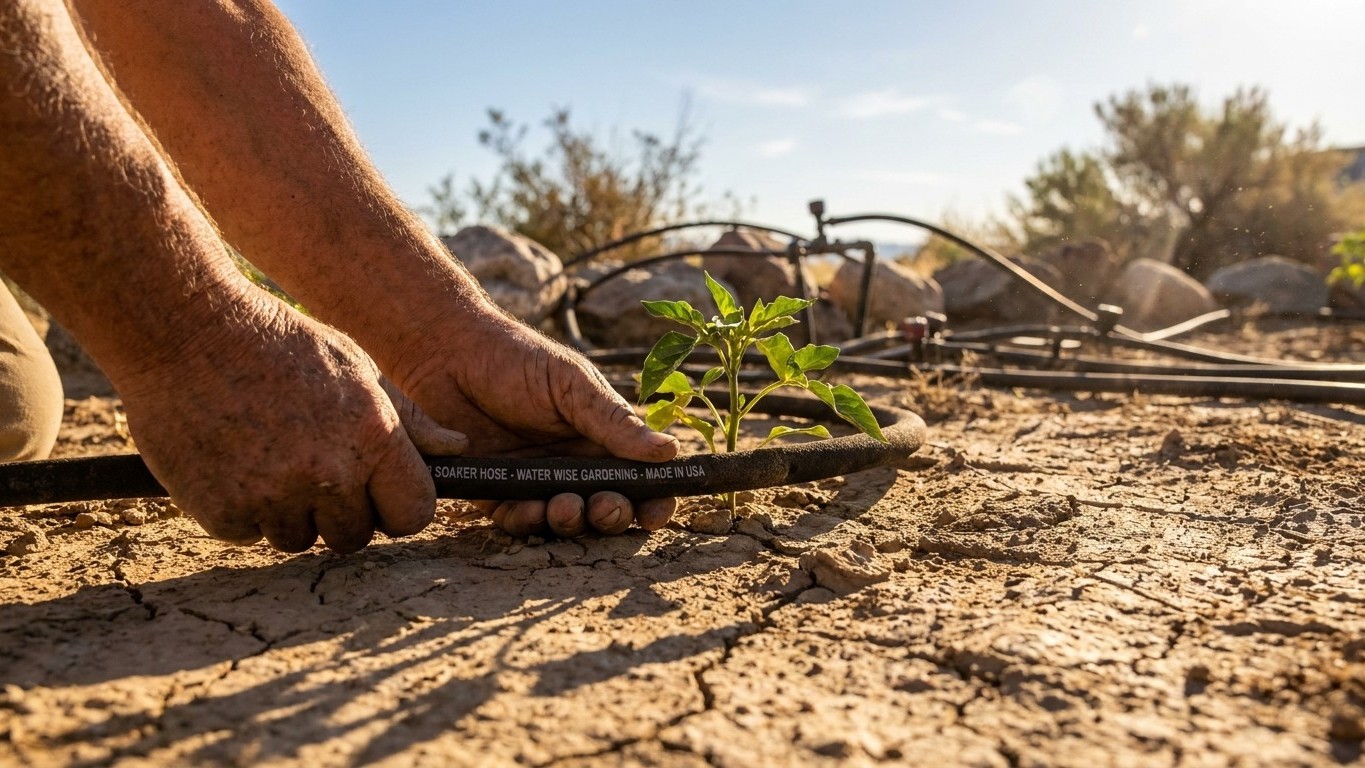

Nevada gardens face one of the toughest combinations in the country: barely a trace of summer rain and more than four months’ worth of days hot enough to bake exposed soil. The short answer is deep, infrequent watering at the base of plants, done in the morning, timed to how dry the soil actually is rather than to a calendar. June brings just 0.04 inches of rain, so nearly the entire weekly water budget falls on the gardener, not the sky.
What changes here

June, the driest summer month across Nevada’s reference station, averages just 0.04 inches of rain. In the same stretch of the year, that station logs 131.3 days at or above 90F. Put those two numbers side by side and the message is blunt: the hottest, thirstiest days of the year arrive exactly when the sky is giving back almost nothing.
A vegetable bed or a young shrub generally wants somewhere near an inch of water a week to keep growing without stress. Spread June’s 0.04 inches evenly across that month’s four-plus weeks and the sky is contributing roughly 0.01 inch a week, a rounding error compared to what the plant actually needs. That leaves the gardener responsible for something close to the full inch, week after week, for the entire month. July and August ease off slightly, at 0.38 and 0.32 inches for the whole month, but even those totals work out to under a tenth of an inch a week, still a fraction of what a growing bed asks for.
The gap looks even starker against the annual picture. Nevada’s reference station averages 4.2 inches of rain a year, yet only about 0.7 inches of that falls across all of June, July and August combined. Roughly six percent of the year’s already thin rainfall arrives during the three months when 131.3 days of 90-plus heat are pulling moisture out of the ground the fastest.
None of this tells you how long water actually stays available to roots on your own lot. Sandy ground lets a summer shower disappear within hours; heavy clay holds the same amount for several days before it dries out. The rainfall normals describe the sky, not what’s underfoot, so a rain gauge and a look at your own soil after a storm settle the question a climate average can’t.
How to water when it matters
Deep, infrequent soakings beat frequent light ones because they push moisture down where roots actually live, training the plant to grow downward instead of clustering near a surface that dries out within hours in 90-degree heat. Watering at the base rather than overhead keeps that moisture where roots can use it instead of losing a share to evaporation before it ever reaches the ground. Morning watering matters for a similar reason: the plant gets a full reservoir before the day’s heat load builds, and any water that lands on foliage has hours to dry before nightfall.
Checking soil moisture at root depth, not just at the surface, is what actually tells you when to water. The surface can look bone dry within an hour of the last soak even though the root zone below is still holding plenty. Push a finger or a small trowel about two inches down; if it’s still cool and slightly moist, the plant can wait.
Soil texture changes the rhythm more than almost anything else. Sandy ground holds little water at a time, so it calls for shorter, more frequent soakings rather than one big weekly dose. Heavy clay can hold a week’s worth of moisture, but watering it again before it has had a chance to dry invites root rot rather than growth. A reasonable starting point for many home gardens is about 1 inch of water a week, split into two sessions, but treat that as a baseline to check against your own soil rather than a fixed rule.
- Check soil moisture two inches down with a finger or trowel before watering at all; skip the session if it’s still cool and moist.
- Water at the base of the plant, not overhead, using a soaker hose, drip line or watering can aimed at the root zone.
- Water early morning, before the day’s heat sets in, so moisture soaks in rather than evaporating off wet leaves.
- Apply roughly 1 inch of water per session on sandy soil, split across two shorter waterings a week rather than one long one.
- On heavier, clay-leaning soil, water less often but more deeply, letting the top few inches dry between sessions to avoid waterlogging roots.
- Reapply a 2 to 3 inch layer of mulch around the base after watering to slow evaporation between sessions.
What goes wrong
Watering a little every day
A quick daily sprinkle feels responsible, but it only ever wets the top inch or so of soil. Roots follow the moisture, staying shallow and close to the surface instead of reaching down where conditions stay cooler and more stable. With 131.3 days a year hitting 90F or above, that shallow root system is left exposed exactly when the ground it’s sitting in heats up the fastest, and the plant wilts even though it was “just watered.”
Watering the leaves in the evening
Wetting foliage after sundown feels efficient, but the water sits on the leaf surface all night instead of drying off in a few hours of morning sun. That prolonged dampness is exactly the environment fungal disease needs to take hold, turning a watering routine meant to help the plant into a slow setup for leaf spot or mildew.
Trusting the sky after a rain shower
A summer thunderstorm can look like it solved the watering problem, but with June averaging only 0.04 inches for the entire month, a single storm often wets only the top half-inch of soil before running off hard-baked ground. Check with a finger two inches down before skipping a scheduled watering; if it’s dry there, the storm didn’t do the job it looked like it did.
Skipping the mulch
Bare soil left exposed after watering gives the sun a direct path to pull moisture right back out of the ground. A layer of mulch slows that loss, and in a territory logging over four months of 90-degree days a year, that difference decides whether a soaking lasts three days or six.
Local help
The University of Nevada, Reno Extension offers region-specific guidance for gardeners working with Nevada’s soil and climate. Watering restrictions and allowed days vary by water district and change from year to year, so check current rules with your local water provider before setting an irrigation schedule.
Common questions
How much should I water a Nevada garden in June?
With June averaging just 0.04 inches of rain, expect to supply nearly the entire weekly water budget yourself, generally working toward about 1 inch a week split across two sessions, adjusted for your soil type.
Is it enough to water once a week?
It depends on soil texture. Heavy clay can hold a week’s worth of moisture, but sandy soil dries out faster and usually needs shorter, more frequent waterings rather than one weekly soak.
Why does watering time of day matter so much here?
With 131.3 days a year reaching 90F or higher, morning watering lets moisture soak in before heat drives evaporation, while evening watering on foliage leaves leaves damp overnight, inviting fungal problems.
Can I skip watering after a summer rain shower?
Check first. A single storm often wets only the top half-inch of soil in a month as dry as June, so push a finger two inches down before assuming the rain did the job.