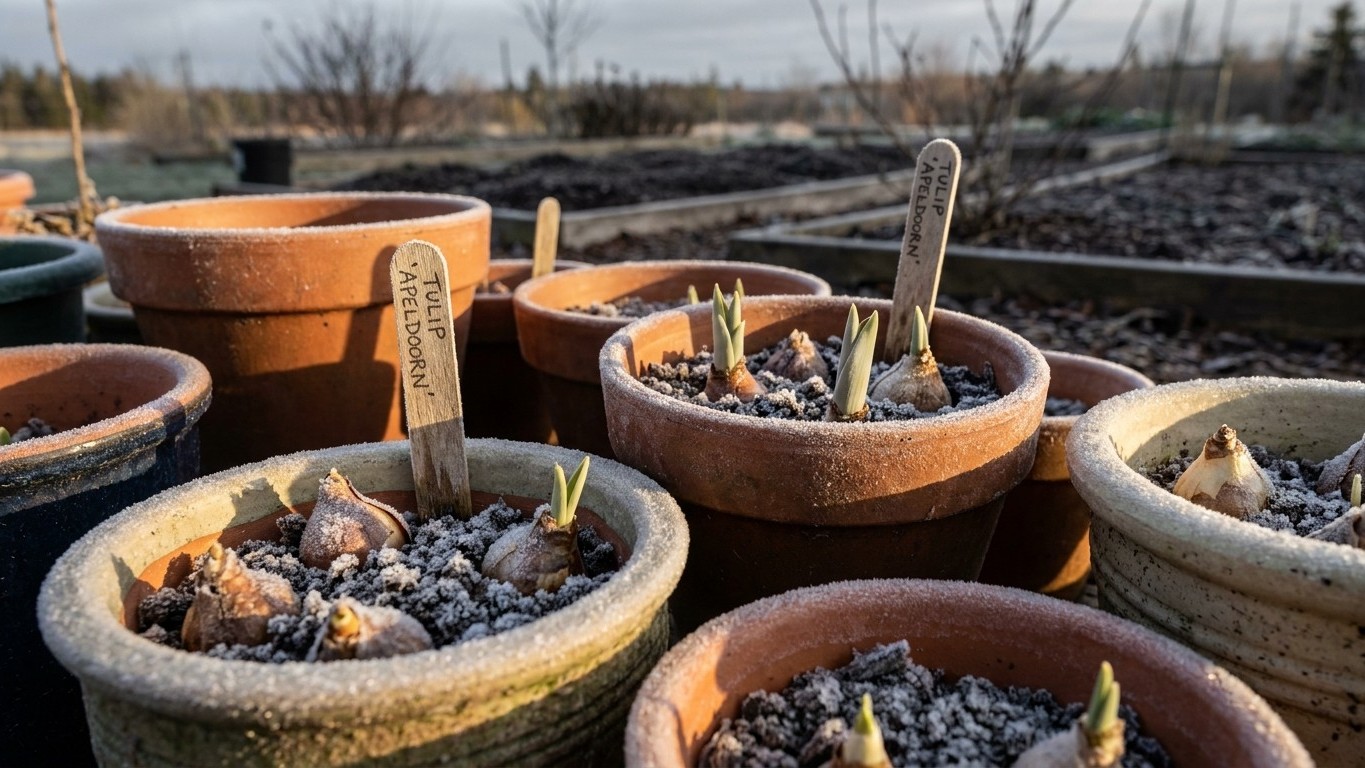

Yes, you can grow Spring Bulbs in Containers here, but the pot changes the rules the ground never applies. New Brunswick’s winter delivers plenty of cold, so most spring bulbs get their chilling for free. What kills them in a container is the container itself: it freezes solid, roots and all, when the same bulb in a bed would barely notice.
Why this matters in New Brunswick

The number that decides everything is 6.9°F. That’s the mean daily minimum temperature of the coldest month here, using the reference station at Moncton, per Environment and Climate Change Canada’s 1981-2010 Climate Normals. It corresponds to a Canadian Plant Hardiness Zone of 5a for the same reference city, based on Natural Resources Canada’s 1991-2020 normals. Two things follow from that figure, and they push a container gardener in opposite directions.
First, forcing indoors to fake a winter this region doesn’t need to happen for chilling purposes. Forcing exists for gardeners whose ground never gets cold enough, long enough, for a bulb to complete its underground chilling. With a coldest-month minimum sitting nearly 40 degrees below the 45°F chilling threshold, garden soil here has no trouble supplying twelve to fourteen weeks of adequate cold. If your bulbs are going into a bed, you are not fighting a shortage of winter.
Second, and this is the part that trips up container gardeners specifically, a pot does not behave like the ground. Soil in a bed freezes from the surface down and rarely penetrates more than a foot or two before insulating itself; a container has cold air on every side, so the root ball can freeze through completely. That’s why nurseries and extension guides commonly advise treating a potted bulb as if it needs a hardiness zone two steps colder than the same bulb planted in soil. A bulb rated hardy in Canadian Zone 5a in the ground is, in effect, being asked to survive something closer to Zone 3a when it’s sitting in a pot above grade all winter.
So the honest framing for this territory isn’t “how do I force bulbs because winter is too mild.” It’s “how do I keep a container from turning a hardy bulb into a dead one.” Everything below follows from that distinction, and it’s why the method section treats insulation and placement as the real work, not the forcing calendar.
How to do it here
The sequence below assumes you’re growing bulbs in containers you intend to keep outdoors through winter, whether for spring bloom where the pot sits or for an early indoor display. Follow it in order.
- Pick bulbs rated for a Canadian hardiness zone at least two zones colder than 5a if the container will stay outside and unprotected. That means shopping for bulbs listed hardy to Zone 3a or colder, since the pot effectively strips two zones of protection compared with planting the same bulb in the ground.
- Pot up in fall, using a container with drainage holes and a well-draining mix. Skip this step and every later one becomes moot, because standing water around a chilled bulb rots it regardless of temperature.
- If the goal is forcing for an indoor bloom, the bulb still needs its twelve to fourteen weeks below 45°F, delivered in the container rather than in open ground. An unheated garage that stays above freezing works, provided you’ve actually checked it with a thermometer rather than assumed; a refrigerator’s crisper drawer works too, but it must sit away from any ripening fruit, because the ethylene gas fruit gives off kills the flower bud forming inside the bulb before you ever see it.
- If the goal is a container left outdoors all winter, don’t rely on the pot alone. Sink it into the ground up to its rim and mulch heavily over the top, or move it into an unheated space that never drops to freezing and won’t warm the bulb into early growth either.
- Group unsunk pots together against a wall if sinking isn’t practical. Clustering containers reduces the amount of cold air reaching each pot’s sides, which matters given how far below freezing that coldest-month minimum runs.
- Bring forced pots into warmth gradually once the chilling period is complete, starting in a cool, dim spot for a few days before moving to full light and normal room temperature.
Which bulbs are worth it
Not every bulb pays back the effort of potting and protecting it. The two traits that matter are how much cold the bulb demands before it will flower, and how tall and top-heavy the finished stem gets, since a pot offers far less anchoring than open soil.
Bulbs with a short chilling requirement force faster and tend to carry shorter, sturdier stems, both of which suit container life. Bulbs that are one-season purchases anyway, meaning they weren’t going to survive or rebloom regardless of treatment, cost nothing extra to force hard, since there’s no future bloom being sacrificed.
- Crocus, short chill requirement, low sturdy stem that rarely topples
- Grape hyacinth (muscari), short chill requirement, compact and stable in a pot
- Hyacinth, moderate chill requirement, thick stocky stem built for container weight
- Paperwhite narcissus, needs no chilling at all, and since it isn’t hardy here anyway, it’s already a one-season purchase
- Small species tulips, shorter and more stable than the larger hybrid types
- Tall Darwin and single late tulips, long chill requirement combined with a tall stem that topples in wind or a light pot
- Giant alliums, a heavy flower head on a tall stem is a poor match for container stability
- Camassia, tall growth habit works against it the same way
What goes wrong, and when you can still fix it
Leaves but no flower
This means the chilling period ran short. The bulb had enough stored energy to push leaves but not enough cold exposure to trigger a flower bud. There’s no fix this season; the bulb needs a full, uninterrupted chilling period next time, measured from when it goes into cold storage or the ground, not from when it was potted.
A flower on a stem too short to see above the foliage
This is the signature of warming a bulb too early, before its chilling was complete. The plant rushes to bloom on a stunted stem because it was pulled into warmth before it had finished the cold phase that normally builds stem length. Nothing brings that stem back up this year; note the date you moved it to warmth and push that date later next season.
Rot inside the pot
Soft, dark, foul-smelling bulb tissue means water sat around the bulb instead of draining away, whether from a container lacking drainage holes or a mix that stayed soggy through the cold months. That bulb is lost for this season and won’t recover. The only fix is prevention next time: drainage holes, a coarser mix, and a pot that isn’t sitting in a saucer full of standing water.