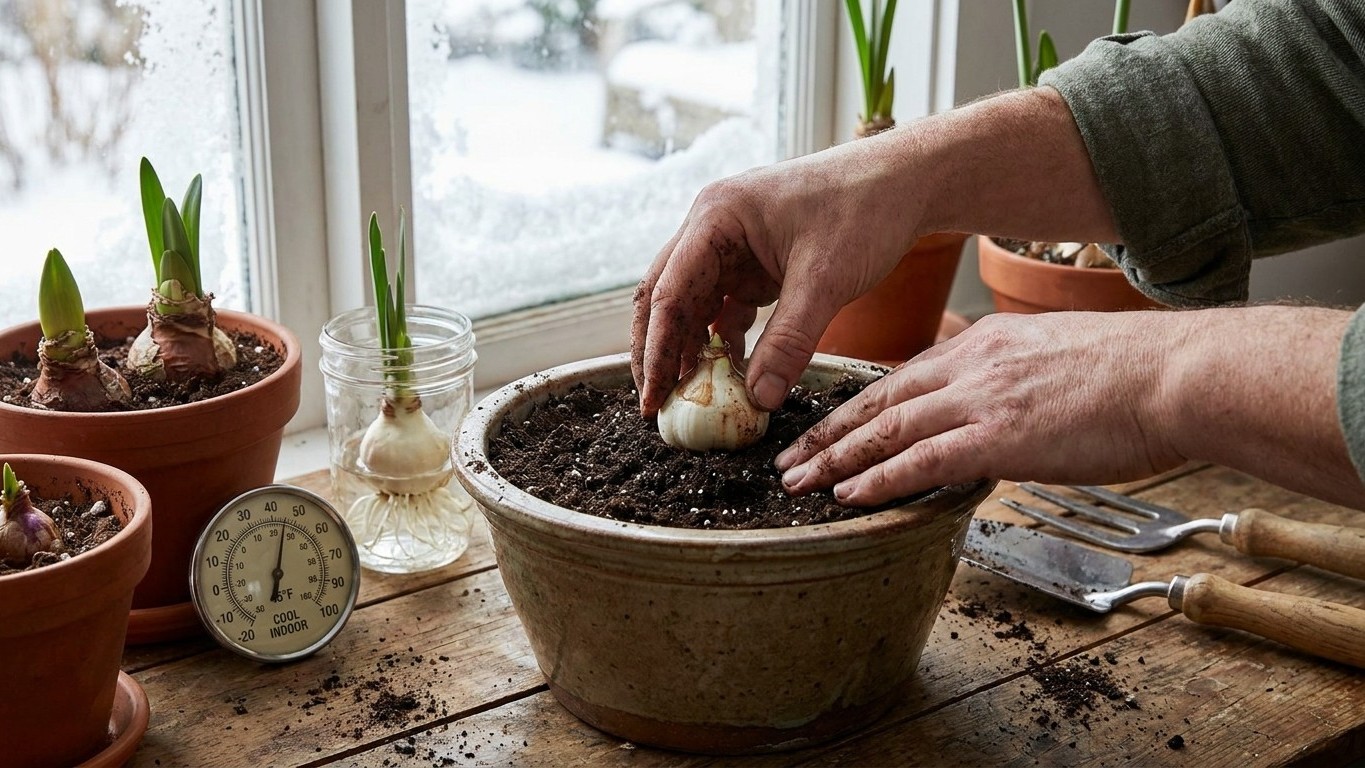

Forcing spring bulbs indoors works in New Jersey not because winters here lack cold, but because timing and containers create problems the ground never does. With a coldest-month average minimum of 25.5F, New Jersey soil delivers the chill any spring bulb needs on its own. Forcing lets a gardener move that bloom indoors on a different schedule, or rescue a potted bulb from a freeze the ground would never experience.
Why this matters in New Jersey

Newark’s coldest month averages a daily minimum of 25.5F, according to NOAA NCEI’s 1991-2020 Climate Normals. That number matters because a spring bulb needs twelve to fourteen weeks below 45F to complete the flower bud hidden inside it before it can bloom. A gap of 20 degrees below that threshold, sustained across December, January and often into February, means New Jersey’s ground supplies far more chill than any bulb requires. This is not a state where gardeners force bulbs to manufacture cold that winter withholds.
That changes what forcing is actually solving here. Two different problems get lumped under the same word. In places where winters run mild, forcing means putting bulbs in a refrigerator because the yard never gets cold enough, long enough. In New Jersey, the ground has that covered. The problem that remains is the container.
A pot behaves nothing like a garden bed in winter. Soil in the ground is insulated by the earth around and beneath it; only the top few inches freeze hard even in a severe month. A container has no such buffer. Cold reaches it from every side, and a pot left outdoors can freeze straight through, root ball and all, at temperatures the same bulb would shrug off if it were planted in a border. USDA rates New Jersey across hardiness zones 6a to 7b, a range built on the average annual extreme minimum temperature, and that range shifts noticeably from the colder northwest highlands to the milder coastal counties. A zone rating that keeps a tulip alive in a garden bed in Newark does not protect the same tulip sitting in a glazed pot on a porch through the same winter.
So the situation New Jersey gardeners actually face is the container problem, not the missing-chill problem. Forcing indoors becomes a way to control that risk deliberately, by moving the cold treatment into a refrigerator or an unheated garage on your own terms, rather than leaving a potted bulb outside to gamble against a freeze-through the ground was never going to inflict on it.
How to do it here
The sequence below assumes you’re starting with dry bulbs suited to forcing (see the next section for which ones) and want blooms on an indoor schedule rather than waiting for the garden.
- Pot the bulbs in a container with drainage holes, using a loose, well-draining mix. Set them close together, shoulder to shoulder, with tips just at or slightly above the soil surface. Water once, thoroughly, then let the pot drain fully.
- Give the pot twelve to fourteen weeks below 45F. An unheated, attached garage can work, but check it with a thermometer rather than assuming. With New Jersey’s coldest month averaging a minimum of 25.5F, a detached or uninsulated garage can dip below freezing on hard nights, which is colder than the chilling range a bulb needs and can damage the bud instead of developing it.
- If the garage runs too cold or too unpredictable, use a spare refrigerator instead. Keep the pot away from apples, pears, or any ripening fruit stored in the same space. Ripening fruit releases ethylene gas, and that gas can abort the flower bud inside the bulb before it ever opens, leaving you with leaves and nothing else.
- Check the soil every couple of weeks during the chilling period and keep it barely moist, never soaked. A pot with no drainage holes is the single most common cause of a bulb rotting before it ever gets the chance to bloom.
- Watch for the signal that chilling is complete: roots showing through the drainage holes, and a few inches of pale shoot growth from the top of the bulb. That’s the cue to move the pot, not a date on a calendar.
- Bring the pot into a cool room, around 60 to 65F, for about a week before moving it into full warmth and bright light. Skipping this step and jumping straight to a warm, sunny window is what causes floppy, weak stems.
- If you’d rather chill the pot outdoors instead of in a garage or refrigerator, the container itself needs to be rated at least two USDA zones hardier than the bulb, or it needs to be moved against a foundation wall and mulched heavily. Otherwise the pot freezes through in a way the ground planted with the same bulb never would.
Which bulbs are worth it
Not every spring bulb rewards the effort of forcing. Short chill requirements and compact stems make some varieties nearly foolproof indoors; long chill requirements and tall flower stalks make others a frustrating exercise in flopped stems and leaves with no bloom.
Bulbs that force reliably here
- Paperwhite narcissus, which need no cold period at all and can be forced in a shallow dish of water and pebbles
- Hyacinths, with a relatively short chill window and a sturdy, compact stem that holds up well in a pot
- Crocus, whose small stature keeps it from toppling and whose chill requirement runs on the shorter side
- Grape hyacinth (muscari), low-growing and forgiving of an imperfect chill period
- Compact daffodil varieties such as ‘Tete-a-Tete,’ which stay short enough to avoid the flop that taller narcissus suffer
Bulbs that tend to sulk
- Standard tall daffodil varieties, which need a longer chill and produce a stem too tall to stay upright indoors
- Most tulip varieties, which require a longer cold period and carry a top-heavy bloom that a container stem struggles to support
- Alliums, whose chill requirement and mature height work against a short, controlled indoor display
- Fritillaria, which is temperamental about moisture and light even under ideal outdoor conditions
Paperwhites are worth singling out for a separate reason. They aren’t hardy in New Jersey’s ground regardless of care, so a bulb bought for forcing was never a candidate for the garden anyway. Forcing it costs nothing in the long run; it was a one-season purchase from the start.
What goes wrong, and when you can still fix it
Leaves come up, no flower ever shows
This means the chill period ran short. A bulb can push foliage on less cold than it needs to finish developing the flower bud inside it, so green growth with no bloom is a sign the twelve-to-fourteen-week window was cut short. This isn’t fixable for the bulb already in hand this season. If the bulb is a hardy species, plant it in the garden and let it rebuild its reserves for next year rather than trying to force it a second time.
The flower opens low, hidden in the foliage
This happens when the pot moved from cold storage into warmth and bright light too fast, without the week or so in a cool room that lets the stem elongate gradually. Once the stem has already set its height, there’s no correcting it for that bloom. The bulb isn’t damaged, though; note the timing and give the next attempt a longer transitional period.
The bulb rots in the pot
Rot traces back to drainage, either a container with no drainage holes or soil kept too wet during the chill period, which lets moisture sit around the base of the bulb and invites fungal decay. A bulb that has rotted is lost for this season; there’s no reviving it once the basal plate has broken down. The fix applies to the next planting: drainage holes, and let the mix dry slightly between waterings during chilling rather than keeping it constantly damp.