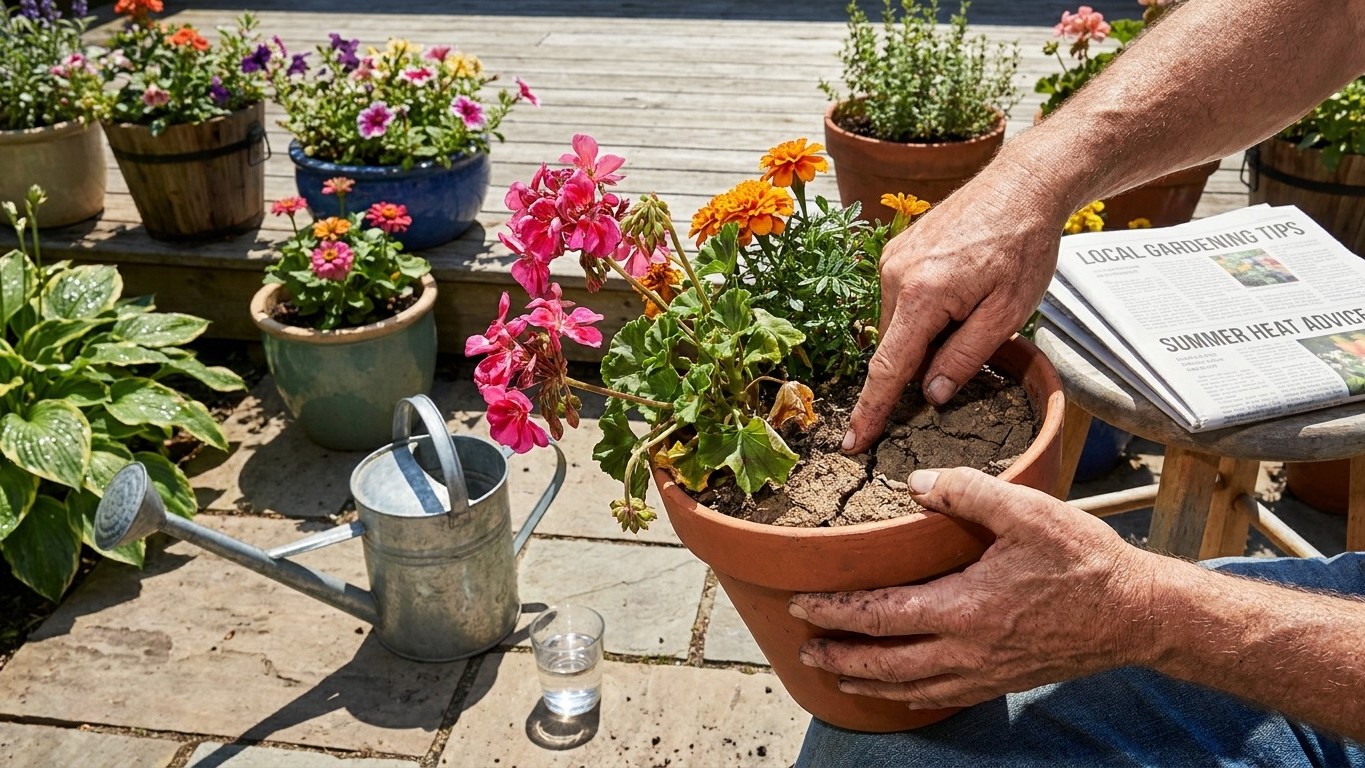

New Jersey’s summer climate sets a clear rhythm for watering pots and containers: heat pushes moisture out of potting mix fast, while the state’s own rainfall pattern rarely covers the gap on its own. Containers dry out well before garden beds do, so the real answer is to water deeply, check the soil by hand rather than by eye, and expect to water more often than a similar-sized patch of ground.
What changes here

Two numbers set the terms for anyone growing in pots in New Jersey. The state averages 20.8 days a year at or above 90F, and its driest summer month, August, brings in just 4.15 inches of rain. Put together, that means nearly three weeks of serious heat land right when the sky is giving back the least water of the whole summer. That’s the moment container plants are most likely to fail, not from disease or pests, but from simple thirst.
Do the arithmetic on that August figure and it comes out to roughly 0.94 inch of rain per week, spread across the month, which sounds close to the classic “an inch a week” rule gardeners use for beds. But that rule was written for soil in the ground, not for a pot. A container holds a fraction of the soil volume a garden bed does, so it can’t bank water the way open ground can, and it loses moisture from all sides, not just the top. On a 90F day, a small pot can lose visible amounts of water within hours, regardless of what fell from the sky the day before.
The June and July numbers (4.34 and 4.66 inches) are a touch higher than August’s, but none of the summer months deliver rain evenly. New Jersey summer rain tends to arrive as thunderstorms, heavy and short, rather than as the slow, soaking rain that actually reaches root depth. A storm that drops half an inch in twenty minutes mostly runs off a container’s surface and out the drainage holes before the mix has a chance to absorb it. That’s the gap the gardener has to carry by hand, and on the hottest days it’s a bigger gap than the monthly averages suggest.
How to water when it matters
The method for containers is simple, but the reasoning behind each step is worth knowing, because it’s what tells a gardener when to break the routine. Watering deeply and infrequently trains roots to grow down and outward through the full container rather than staying near the surface, where the mix heats up and dries out first. Watering at the base, not overhead, keeps water going where roots can use it instead of evaporating off leaves. Morning watering gives the plant a full supply before the heat of the day starts pulling moisture back out, and it lets any splashed foliage dry before evening, when damp leaves overnight invite fungal problems.
Checking the mix by hand beats guessing every time. A finger pushed two inches into the soil (or a chopstick pulled out and inspected) tells the real story; the top half-inch of a container can look bone dry while the root zone below is still moist, or the reverse, especially in mixes with a lot of peat or coir.
- Push a finger about two inches into the potting mix; if it comes out dry, it’s time to water, regardless of how the surface looks.
- Water slowly until it runs freely from the drainage holes, which confirms the whole root ball got wet, not just the top layer.
- Start with watering every two to three days during New Jersey’s 90F stretches, and treat that as a baseline to adjust, not a fixed schedule.
- Check smaller pots (under 12 inches) daily on hot days, since they hold less reserve and dry out faster than larger containers.
- Water at the base of the plant in the early morning, before the day’s heat sets in.
- Empty saucers under pots an hour after watering, so roots aren’t sitting in standing water after a heavy summer thunderstorm.
Containers with a sandy, fast-draining mix will need this cycle more often, since water passes through quickly; a dense, moisture-retentive mix holds water longer but risks staying too wet after one of the region’s typical downpours, so the two-inch finger check matters more than any fixed calendar.
What goes wrong
Watering a little bit every day
A light daily splash feels responsible, but it only wets the top inch of the mix. Roots follow the water, so they stay shallow and close to the surface, right where heat and evaporation hit hardest. When a hot spell arrives, those shallow roots have no reserve to draw on and the plant wilts fast, even though it was “watered” the day before.
Watering the leaves in the evening
Wetting foliage at night, when temperatures drop and humidity is already high in a New Jersey summer, leaves water sitting on leaves for hours with no sun or breeze to dry it. That damp window overnight is exactly what fungal diseases like powdery mildew and blight need to take hold.
Trusting a rain shower to do the job
A summer thunderstorm can look like a soaking rain and still leave the container mix dry underneath. Short, heavy storms typical of New Jersey summers often run off the surface of a pot before they penetrate it. The only way to know is the same finger check used any other day, not the sound of rain on the roof.
Skipping mulch on the container surface
A bare layer of soil at the top of a pot loses moisture straight to the sun and air. A thin layer of mulch, even shredded bark or straw, cuts that surface evaporation and stretches the time between waterings, which matters most across those 20.8 days a year when the mercury hits 90F.
Overwatering after a wet stretch
New Jersey’s summer rainfall, averaging around 13.2 inches across June, July and August, is substantial enough that a run of humid, showery days can leave containers waterlogged if a gardener keeps watering out of habit. Roots sitting in saturated mix for days lose access to oxygen and start to rot, a failure that looks like drought stress from the outside but comes from too much water, not too little.
Local help
Rutgers Cooperative Extension is New Jersey’s land-grant extension service and a direct resource for local growing questions, from soil testing to plant selection for containers. Watering restrictions during dry stretches vary by municipality and water utility, so check with a local water provider for current rules before setting an outdoor watering schedule.
Common questions
How often should I water container plants in New Jersey during summer?
Check the mix two inches down every day during stretches of 90F weather; many pots need water every two to three days as a starting point, smaller pots more often.
Does New Jersey get enough rain to skip watering containers?
Rarely on its own. Even in a wetter month like July, with 4.66 inches of rain, storms tend to run off a container’s surface rather than soak the root zone, so hand-watering is usually still needed.
What size pot dries out fastest in New Jersey heat?
Smaller containers, generally under 12 inches across, hold the least soil volume and lose moisture fastest, especially during the state’s 90F days, and often need daily checking in summer.
Should I water containers in the evening during a heat wave?
Morning is better. Evening watering leaves foliage damp overnight, and New Jersey’s humid summer air keeps that moisture around longer, raising the risk of fungal disease.