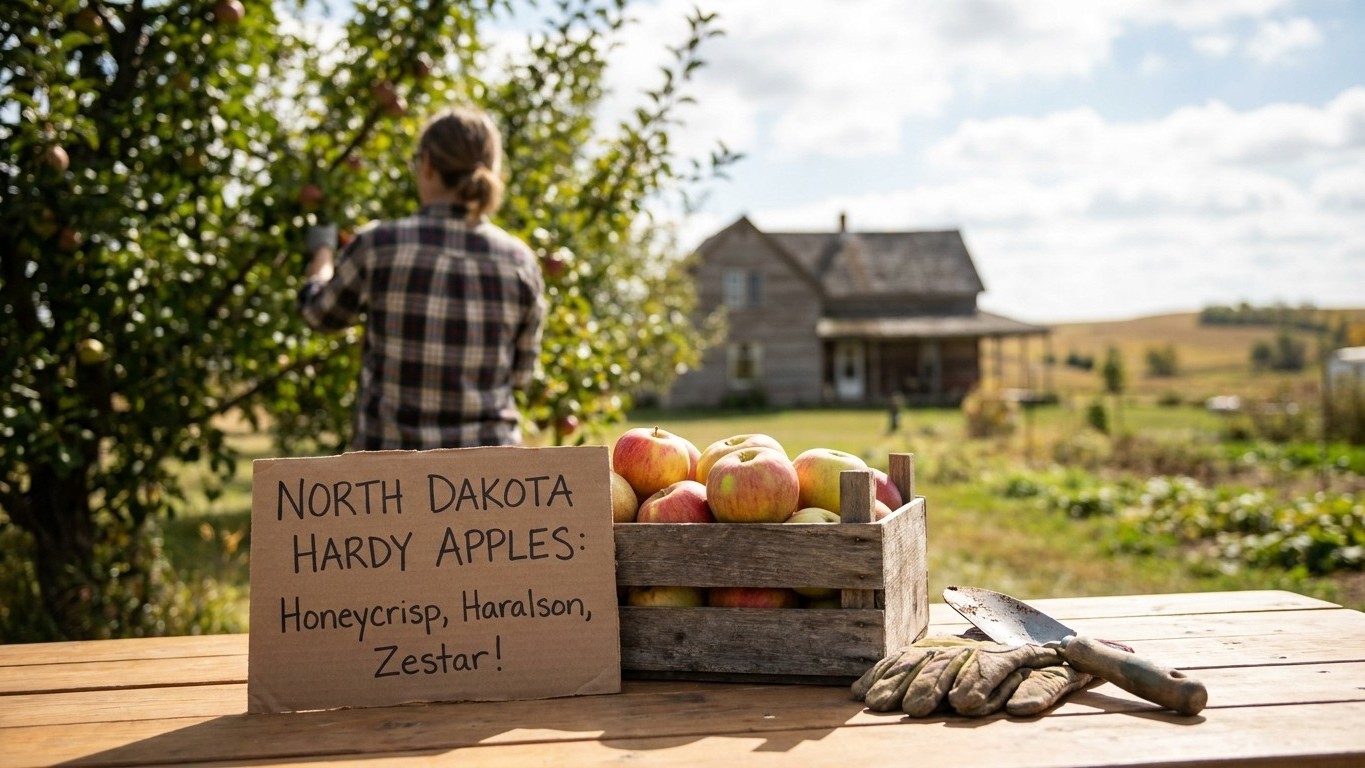

Zero point one degrees Fahrenheit — that’s the average low of Fargo’s coldest month, and it’s the number that decides which apple trees belong in a North Dakota yard. Anything bred for the Mid-Atlantic or the Pacific Northwest simply doesn’t survive it. The varieties that do are the ones developed and proven for extreme northern cold, tested in Minnesota and the Dakotas rather than adapted downward from somewhere milder. Cold hardiness, not winter chill, is what separates a living tree from a dead one here.
The short answer for North Dakota
The variety that survives a North Dakota winter is decided by the state’s own cold, not by a catalog description written for a milder region. NOAA’s NCEI 1991-2020 climate normals record the coldest month at the Fargo reference station running to a mean daily low of 0.1°F, a level that rules out most of the apple varieties commonly grown in the Mid-Atlantic or the Pacific Northwest. Anything worth planting here has to be bred and marketed specifically for extreme northern cold, the kind tested in Minnesota, the Dakotas, and similar climates rather than adapted downward from somewhere warmer.
That answer rests on two separate filters, and it’s common to check only one of them. Cold hardiness determines whether the tree’s wood and buds survive winter at all. A tree that is only marginally hardy can flower fine one spring and still show dead branches, or a dead trunk, the spring after a genuinely cold winter. Winter chill is a different question entirely: whether the tree gets enough cold, dormant hours to break bud and flower normally once spring arrives. North Dakota’s winters supply chill in abundance, so chill is rarely the limiting factor here. Cold hardiness is, and so is the length of the season between spring frost and fall frost.
Because no sourced list of currently recommended named cultivars for this state is available to check against here, the safest move is to buy from a nursery that sells rootstock and scion combinations tested for the northern Plains specifically, and to confirm any hardiness claim with North Dakota State University Extension before ordering a bare-root tree online. If the planting site or soil prep itself still needs sorting out, Growing Apples in North Dakota covers that ground first.
Working through it

Tree form decides the hardiness-versus-speed trade-off
Ranking realistic choices for this climate starts with rootstock and tree form, not the fruit itself. A standard, seedling-grown apple tree on its own roots is usually the hardiest option, because it carries no dwarfing rootstock graft union to freeze and split in a hard winter. The cost is time and size: a standard tree can take six to ten years to bear a real crop and eventually grows tall enough to need a ladder for pruning and picking. Semi-dwarf trees grafted onto cold-hardy interstem or dwarfing rootstock developed for northern climates bear sooner, often in three to five years, and stay manageable from the ground, but the graft union itself becomes a weak point that a standard tree doesn’t have. In a winter that drops well below the 0.1°F average daily low NOAA’s 1991-2020 normals record for Fargo’s coldest month, a marginal graft union can die even when the rest of the tree would have pulled through.
| Tree form | Cold hardiness | Years to first real crop | Mature size |
|---|---|---|---|
| Standard, own-root | Highest | 6 to 10 years | 20 to 30 feet, needs a ladder |
| Semi-dwarf, cold-hardy rootstock | Moderate; graft union is the weak point | 3 to 5 years | 12 to 16 feet |
| Dwarf, cold-hardy rootstock | Lowest of the three, needs a sheltered site | 2 to 4 years | 8 to 10 feet |
Season length limits what can ripen
The second filter is the length of the frost-free window itself. At the Fargo reference station, NOAA’s 1991-2020 normals put the last spring freeze between May 4 and May 15 and the first fall freeze between September 25 and October 5, which works out to a frost-free season running roughly 133 to 154 days depending on where a given year falls in that range. A late-ripening dessert apple that needs a long, warm fall to finish sizing and sweetening can still be hanging unripe when the first hard freeze arrives, especially in a shorter year or in a garden further from Fargo’s own moderated airport reading. An early to mid-season ripening cultivar, picked in late summer rather than October, carries far less risk of being caught green on the tree. Once a tree is in the ground, tracking bloom and bud stage against this frost window, rather than against the calendar month, is covered stage by stage in The North Dakota Apple Calendar, Stage by Stage.
Because no single named cultivar list for this state is available to check against a supplier’s catalog here, the working rule is to ask a nursery two direct questions before buying: what minimum winter temperature the rootstock and scion are each rated to survive, and how many days from bloom to harvest the fruit needs. A cultivar the nursery can’t answer both questions for isn’t one to plant on the strength of its name alone.
What changes across North Dakota
The Fargo figures above come from one weather station, sitting in the flat, low-lying Red River Valley on the state’s eastern edge, and they describe that specific site, not the whole state. NOAA’s own caution on its 1991-2020 climate normals is that suburban and rural properties typically see their last spring frost later and their first fall frost earlier than an open airport reading, often by a week or two and more with elevation, which tightens the safe window on both ends of the season.
Land west of the Red River Valley climbs onto the Missouri Plateau, a higher, more exposed landscape than the valley floor, and open, higher ground generally holds onto cold air longer in spring and loses its warmth sooner in fall than a sheltered low spot does. A valley or natural depression anywhere in the state, whether it’s a river bottom or a shallow basin, can also collect and trap cold air overnight, producing a frost pocket that freezes before the surrounding higher ground does, on a night the general forecast calls frost-free.
None of this changes which cultivars will survive a given winter’s absolute cold, because cold hardiness is a property of the tree, not the site. What it changes is the margin of safety around bloom and around harvest: a marginally hardy graft union, or a late-ripening fruit, has less room for error on the Missouri Plateau or in a frost pocket than it does on a sheltered lot near Fargo. Anyone gardening outside the immediate Fargo area should treat the reference dates above as a starting estimate, and confirm the local pattern with a season or two of their own observation, or with the nearest weather station to their own county.
The mistakes this climate punishes
The most expensive mistake is buying on a nursery’s general zone claim without checking whether that claim was ever tested against a North Dakota winter, rather than a milder one. A tag written for the Mid-Atlantic or the Pacific Northwest can call a tree “cold hardy” and mean it survives occasional single-digit nights, not a winter where Fargo’s own coldest-month average low sits at 0.1°F. That tree can leaf out fine its first spring and still die at the trunk or graft union two or three winters later, once a genuinely severe one arrives. The damage shows up in late winter or very early spring: a tree that never breaks bud, or breaks bud only on wood below the graft line.
Late-summer nitrogen is the second trap. Fertilizing or doing heavy pruning into July or August pushes soft, actively growing wood right when the tree should be hardening off, and that soft growth is the first tissue killed once the first fall freeze arrives inside NOAA’s September 25 to October 5 normal window at Fargo, potentially sooner away from that reference station. The fix is straightforward: stop feeding by midsummer, and save structural pruning for full dormancy rather than late summer.
Planting in a low spot is the third mistake. A frost pocket that collects cold air overnight can freeze open blossoms on a night the surrounding higher ground stays clear, and a tree that loses its bloom to a spring frost produces no fruit that year even though the tree itself is perfectly healthy. Siting the tree on a gentle slope or higher ground, away from the bottom of a swale or the lowest corner of the yard, avoids this without changing anything about the cultivar itself.
Skipping trunk and graft-union protection heading into winter is the fourth, and it’s the mistake most specific to a dwarf or semi-dwarf tree on cold-hardy rootstock. Sun striking a bare trunk on a cold, bright winter day can heat the bark enough to cause sunscald and vertical cracking once the temperature drops again after dark.
Checking this against your county
Every figure above comes from one reference station near Fargo, and North Dakota’s growing conditions vary enough between the Red River Valley and the rest of the state that a grower elsewhere shouldn’t treat these dates as their own. North Dakota State University Extension keeps county-level guidance, and can confirm the current hardiness rating for a specific cultivar a local nursery is selling before money changes hands. Check North Dakota State University Extension before ordering a tree, especially if the property sits outside the Fargo area or higher than the valley floor.
Common questions
Can apples even survive a North Dakota winter?
Yes, but only cultivars and rootstocks specifically bred and tested for extreme northern cold hold up against a winter where Fargo’s own average low for the coldest month sits at 0.1°F, according to NOAA’s 1991-2020 climate normals. A tree simply labeled “cold hardy” for a general national market, without that specific testing, is a gamble.
If a variety is sold as hardy for Minnesota, will it work in North Dakota too?
It depends on the actual minimum temperature the cultivar and rootstock are rated to survive, not the state name on the tag. Parts of Minnesota share a similar climate to parts of North Dakota, but Minnesota-marketed stock can still be rated for a milder low than Fargo’s own coldest-month average, so ask for the specific temperature rating rather than trusting the marketing.
Do I need two apple trees for pollination, or will one produce fruit on its own?
Most apple cultivars need a second, different apple variety blooming nearby to set fruit, since very few are reliably self-fruitful. A flowering crabapple within range can often serve as that second tree if there isn’t room for a full second apple.
Will a winter with little snow cover hurt my tree even if the air temperature isn’t unusually cold?
It can. Snow acts as insulation over the root zone and around the base of the trunk, and a low-snow winter exposes roots and a graft union to colder soil temperatures than a snow-covered one, even when the air temperature itself never sets a record. Mulching over the root zone before the ground freezes helps make up for a thin or late snow cover.