
Rhode Island’s summers hand a garden more help than most people assume, but the driest month still leaves a gap the sky won’t close. July brings 2.91 inches of rain on average, and the region logs 9.4 days a year at or above 90 degrees F. Together, that means deep, infrequent watering, timed to the soil, beats a daily splash almost every time.
What changes here

July is Rhode Island’s driest summer month, delivering 2.91 inches of rain at the reference station near Providence. The same station logs 9.4 days a year at or above 90 degrees F. Together those two figures mean the sky covers most, not all, of what a garden needs in July, and the gap widens fast on the handful of scorching days scattered through the season.
A vegetable bed or a perennial border generally wants about an inch of water a week to keep growing without stress. July’s 2.91 inches, spread across roughly 4.4 weeks, works out to about 0.66 inch a week arriving free from the sky. That leaves the gardener to carry the remaining 0.34 inch, close to a third of the weekly target, through a hose, a can, or a soaker line.
The FACTS for this territory don’t hand over a soil texture reading, but the principle holds everywhere in the state: that same 0.66 inch of July rain behaves differently depending on what it lands on. A sandy plot near the coast drains that rain within hours, so roots see little benefit by the next afternoon. A denser clay loam inland holds the same rain for days, stretching that free 0.66 inch into real coverage across most of the week. Knowing which soil sits under a given bed changes how the leftover 0.34 inch gets delivered, whether that’s a light top-up twice a week or one deeper soak.
None of that arithmetic accounts for the 9.4 days a year the mercury clears 90 degrees F. Those days pull moisture out of soil and leaves faster than any weekly average captures, so a bed that looked fine on Monday can be showing stress by Wednesday afternoon if one of those days lands mid-week.
How to water when it matters
Rhode Island’s mix of moderate summer rain and occasional heat spikes calls for a rhythm built around depth, not frequency. Watering deeply and less often pushes roots down into soil that stays cooler and holds moisture longer, instead of keeping them near a surface that bakes dry within a day. Aiming water at the base rather than the leaves keeps foliage dry, which matters in a state where humid air off Narragansett Bay already gives fungal disease plenty of help. Watering in the morning gives the plant hours to draw up that moisture before the heat of the day pulls it back out, and lets any leaf that did get wet dry out well before evening.
- Check the soil two inches down with a finger or a trowel before watering. If it’s dry at that depth, water. If it’s still moist, wait another day.
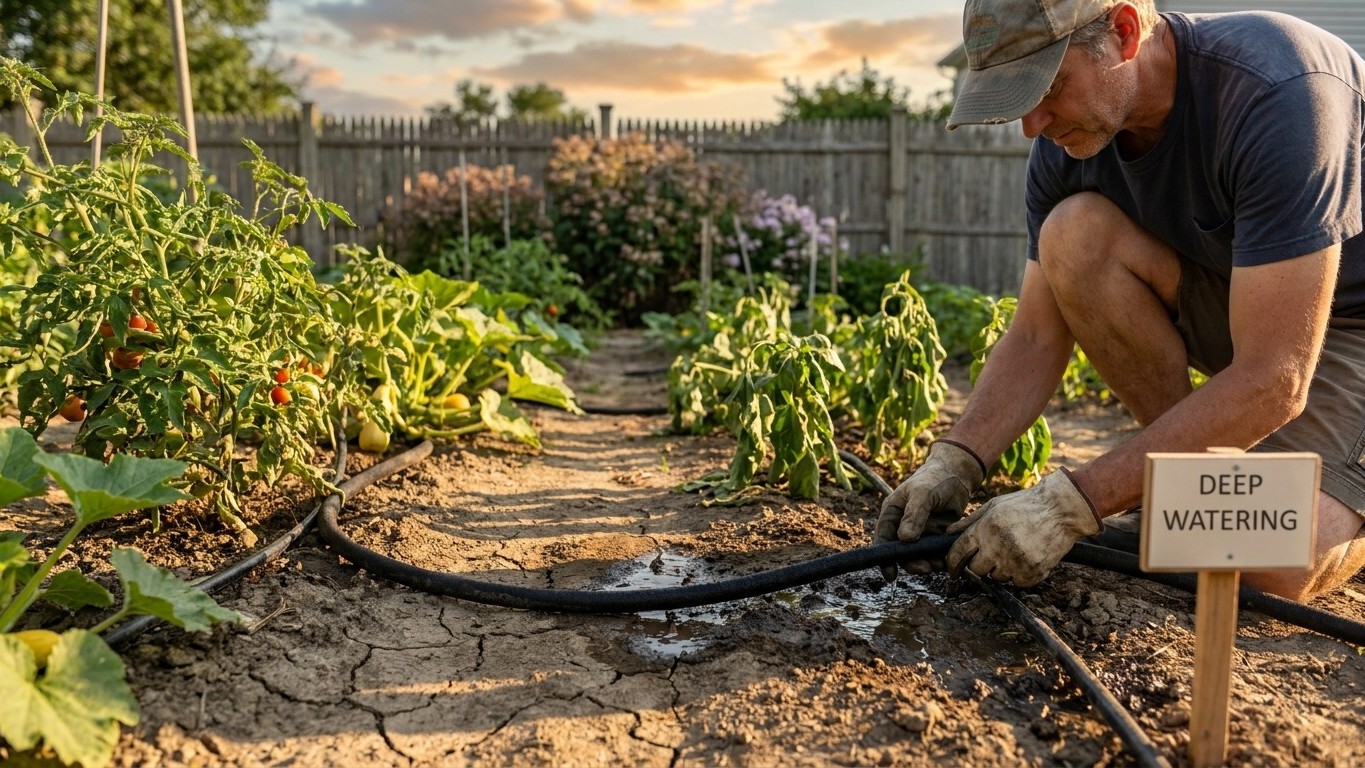
- Water at the base of the plant, at the soil line, using a soaker hose, drip line, or a watering can aimed at the roots rather than the foliage.
- Water early, ideally before 9 a.m., so the plant has time to absorb it before the day’s heat sets in and any wet leaf dries before nightfall.
- Start with about one-third of an inch per session, twice a week, as a baseline for July. Water less often but longer on sandy ground, and shift to a single deeper soak on heavier clay.
- On any day the forecast clears 90 degrees F, check the soil again within 24 hours instead of waiting for the next scheduled watering.
That one-third-inch figure is a starting point, not a rule. A sandy bed near the shore may need that same amount split into three shorter sessions a week, while a clay-heavy yard inland might absorb it in one soak and stay damp for days. The only way to know which applies to a given plot is to check the soil itself rather than trust the average.
What goes wrong
A light sprinkle every day
Watering a little bit every day feels responsible, but it trains roots to stay near the surface, where the day’s heat and evaporation dry them out fastest, especially on the 9.4 days a year that clear 90 degrees F. Bare soil left without mulch makes this worse, since the sun takes back a large share of whatever water just went down before the roots ever reach it.
Watering the leaves in the evening
Wetting foliage as the sun goes down leaves it damp all night, with no sunlight or breeze to dry it. That standing moisture is exactly what fungal and bacterial disease need, and the humid air common near the Rhode Island coastline only extends the window.
Trusting a summer shower
A quick thunderstorm can soak the driveway and still leave only the top half inch of soil damp underneath a plant. The fix is the same finger check described above: push two inches down before deciding the rain did the job.
Watering ground that hasn’t dried
Rhode Island’s summer rainfall runs closer to generous than scarce, at 10.3 inches across June, July and August, and that’s where the more expensive local mistake shows up. On clay-heavy ground, a week’s rain can still be sitting in the soil three or four days later. Adding a scheduled watering on top of it starves roots of oxygen, and the result, yellowing leaves and stunted growth, looks like drought stress even though the cause is the opposite.
Local help
The University of Rhode Island’s Cooperative Extension answers soil, plant, and watering questions specific to Rhode Island conditions. Watering restrictions vary by town and water provider and change through the season, so check with the local water district directly before setting an outdoor watering schedule.
Common questions
How much should I water my Rhode Island garden each week in summer?
Aim for roughly an inch a week total. In July, about 0.66 inch of that arrives from rain on average, leaving around 0.34 inch to add by hand, adjusted for soil type.
Does Rhode Island get enough rain to skip watering some weeks?
Sometimes, especially on clay soil that holds moisture for days. Check two inches down with a finger before deciding to skip a watering rather than assuming the last rain was enough.
What’s the best time of day to water in Rhode Island heat?
Early morning, before 9 a.m. if possible. It gives roots time to absorb water before the day’s heat peaks and lets any wet foliage dry before evening.
Do local water restrictions apply to garden watering in Rhode Island?
Often, particularly during dry stretches, and rules differ by town and water provider. Confirm current restrictions with the local water district before setting a schedule.