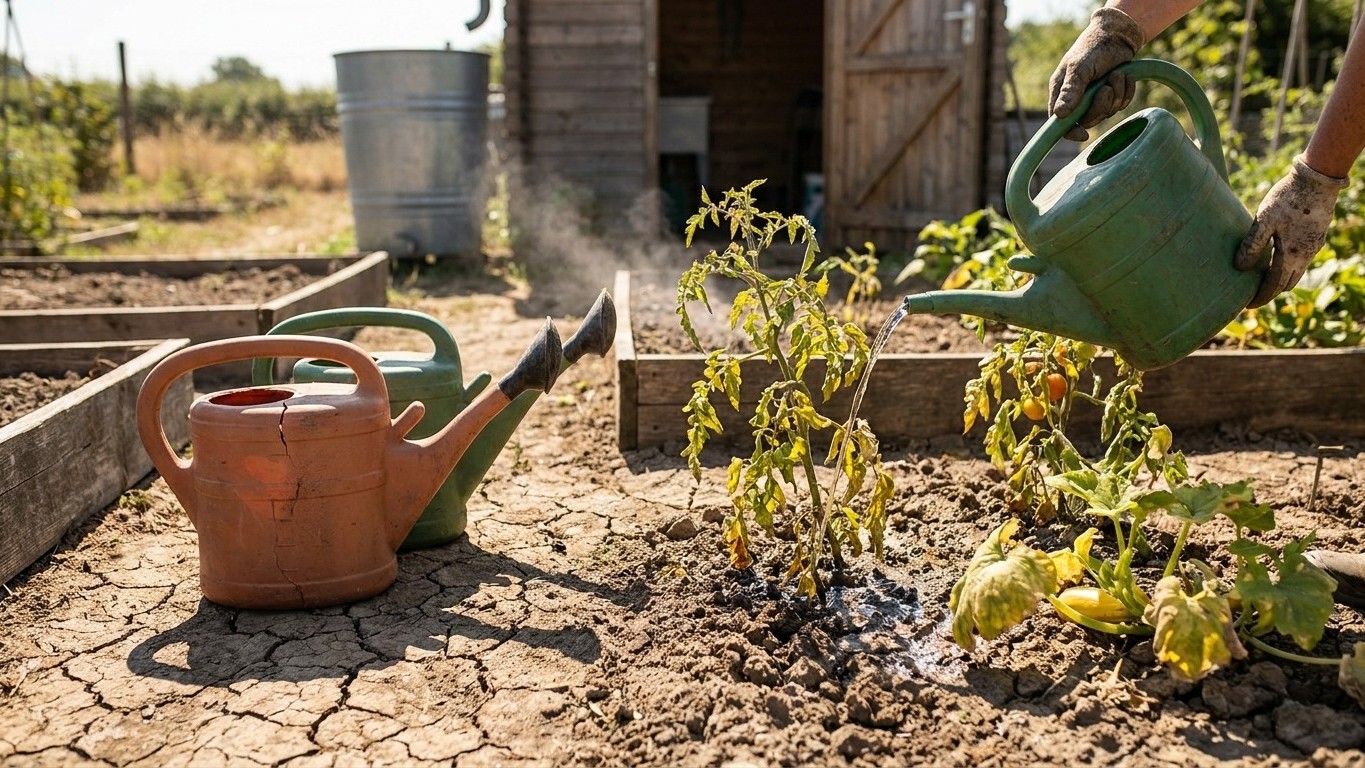

South Dakota’s driest summer month leaves a gap between what the sky delivers and what a growing bed actually needs, and that gap is what decides how big a watering can or drum belongs by the back door. Roughly 14 days a year push past 90F, pulling moisture out of soil fast enough that a weekly rain isn’t always enough on its own.
What changes here

July, South Dakota’s driest summer month, brings 3.25 inches of rain. The same reference station logs 13.8 days a year at or above 90F. Put those together and the message is simple: the month gardeners water the most is also the month the sky offers the least, while the heat that drives plants to drink is already stacked into that same stretch.
Break the rainfall down to a week and the gap gets concrete. July’s 3.25 inches, spread across its 31 days, averages to about 0.73 inches a week. A vegetable bed or a young perennial generally wants close to 1 inch of water a week to keep growing without stress. That means the sky is covering roughly three-quarters of the job in an average July week, and the gardener with a watering can or a hose end needs to make up the remaining quarter-inch or so, by hand, at the base of the plant.
June, at 4.23 inches, and August, at 3.34 inches, both run a little wetter than July, so the shortfall narrows on either side of it. July is still the month to plan a watering container around, because it’s the one month where the arithmetic doesn’t close on its own.
That inch behaves differently depending on what’s underneath it. Much of South Dakota’s ground runs from lighter, sandy-influenced soils in parts of the state to heavier clay-holding ground elsewhere, and the same 0.73 inches that soaks straight through a sandy bed within a day can sit in a clay-rich one for most of a week. A watering routine built for one texture will drown or starve the other, so both the container size and the schedule need to match the ground under your own feet, not just the calendar on the wall.
How to water when it matters
Deep and infrequent beats a light daily sprinkle almost everywhere, and South Dakota’s dry, hot July is exactly where that rule earns its keep. A deep soaking pushes water down to where roots actually grow, six inches or more, training the plant to send roots downward chasing moisture instead of clustering near a surface that bakes dry within hours under a 90F afternoon. Watering at the base, rather than overhead, puts the moisture where roots can use it instead of losing a share to evaporation before it ever reaches the soil. Morning watering gives the plant several hours to take up moisture and dry its foliage before the cooler overnight hours settle in.
Checking the soil beats trusting the calendar. Push a finger two inches into the ground near the root zone, or open a small slit with a trowel and feel below the surface. If it’s dry at that depth, it’s time to water; if it’s still damp, wait another day. Surface soil dries out long before the root zone does, especially under a July sun, so a surface check alone will send you outside with the hose more often than the plant actually needs.
Soil texture sets the rhythm from there. Sandy ground holds onto little of what it’s given, so it calls for shorter soakings delivered more often, maybe every three to four days during the driest stretch, rather than one big weekly dose that mostly drains past the roots before they can use it. Heavy clay ground holds a week’s worth of water, but watering it again before it has actually dried invites soggy, oxygen-starved roots, so the finger test matters there even more than the schedule does.
- Start from about 1 inch of water a week, delivered as one or two deep soakings rather than daily sips, then adjust once you’ve checked your own soil.
- Water at the base of the plant, with a watering can, soaker hose or drip line, so the leaves stay dry.
- Water in the morning, ahead of the day’s heat, so foliage has time to dry and roots have time to draw up the moisture.
- Check two inches down with a finger or trowel before every watering, and skip a day if it still feels damp.
- Shorten the interval on sandy soil and lengthen it on clay-heavy soil, letting the two-inch check, not the clock, make the call.
That 1-inch-a-week figure is a starting point, not a fixed rule. A container plant on a deck dries out faster than the same species rooted in open clay ground, so let your own soil check settle the final schedule.
What goes wrong
Watering a little, every day
A daily five-minute sprinkle feels responsible, but it wets only the top inch or two of soil. Roots follow the moisture, staying shallow and close to a surface that heats up fast on a 90F day. When a hot afternoon arrives, those roots have nowhere deeper to draw from, and the plant wilts even though it was “watered” that same morning.
Watering the leaves in the evening
An evening pass with the hose leaves foliage wet through the night. Fungal disease thrives on that combination of standing moisture and dropping temperature, and a garden that looked fine at dusk can show mildew or leaf spot within days.
Trusting a passing thunderstorm
This is the costliest mistake in a state where the driest summer month brings just 3.25 inches and heat pushes evaporation hard. A loud downpour can feel like it solved the week’s watering, but a fast summer storm often wets only the top half-inch of soil before running off a dry, compacted surface. The finger test settles it. If two inches down is still dry after the storm passed, the bed still needs water.
Skipping the mulch
Bare soil around a plant gives the sun a direct path to whatever moisture was just delivered, whether from a can or the sky. A two- to three-inch layer of mulch slows that loss, keeping the soil cooler and stretching the time between waterings, which matters most during the stretch of the summer averaging close to 14 days at or above 90F.
Local help
South Dakota State University Extension is the state’s land-grant resource for garden and lawn watering guidance, tailored to local soils and conditions. Find county-level contacts and current publications at extension.sdstate.edu. Watering restrictions vary by city and water district and change with drought conditions, so check with your own water provider for the rules in effect where you live.
Common questions
How often should I water a South Dakota garden in July?
Start with about 1 inch a week split into one or two deep soakings, then adjust based on a two-inch soil check, since July’s average rainfall of 3.25 inches covers only part of that need.
Is morning or evening better for watering?
Morning. It gives foliage hours to dry before nightfall and lets roots take up moisture before the day’s heat, which averages 13.8 days a year at or above 90F, pulls it back out through evaporation.
Does a summer rainstorm mean I can skip watering?
Not automatically. A fast, heavy storm can run off a dry surface and wet only the top half-inch of soil. Check two inches down with a finger before deciding to skip a scheduled watering.
Do sandy and clay soils need different watering schedules?
Yes. Sandy soil drains fast and needs shorter, more frequent soakings, while clay-heavy soil holds water for close to a week and can drown roots if watered again before it has dried.