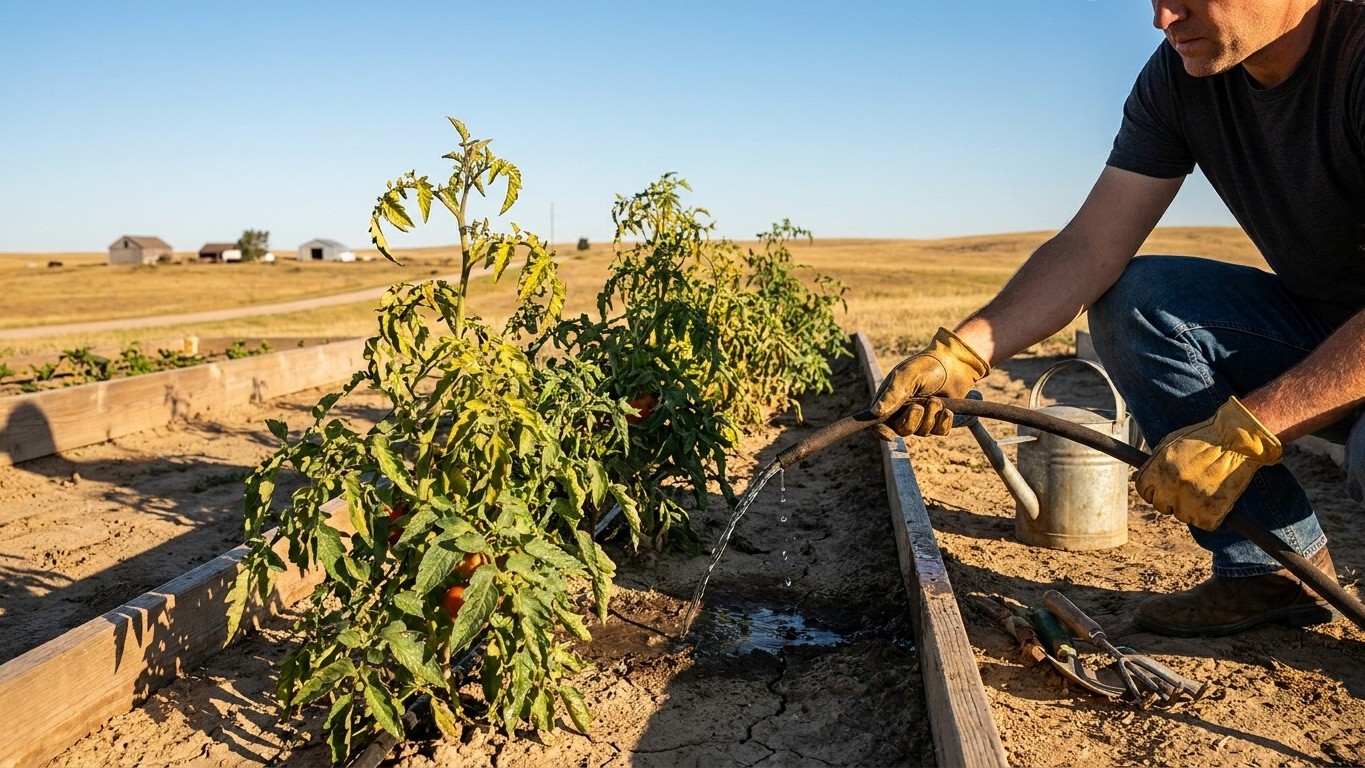

South Dakota gardens need help through summer because the sky doesn’t deliver enough on its own. July, the state’s driest summer month, brings just 3.25 inches of rain, while 13.8 days a year climb to 90F or hotter, pulling moisture out of soil and leaves fast. The fix is deep, infrequent watering at the base of the plant, done in the morning, timed to when the soil two inches down has actually dried out.
What changes here

Two numbers set the terms for every South Dakota garden this time of year: 3.25 inches of rain in July, the driest summer month, and 13.8 days a year that reach 90F or above. Read together, they say one thing plainly: the sky isn’t going to carry a garden through July on its own, and the heat arriving alongside it will pull water out of soil and leaves faster than most gardeners expect.
The arithmetic makes the gap concrete. A vegetable bed or a young perennial border generally wants about an inch of water a week to keep growing without stress. July’s 3.25 inches, spread across roughly 4.3 weeks, works out to about three-quarters of an inch a week falling from the sky, short of that target by a quarter inch, week after week, for the whole month. That shortfall doesn’t announce itself right away. It shows up two or three weeks later as wilted lower leaves, stalled fruit set, or a lawn that goes from green to straw-colored almost overnight.
June runs slightly wetter at 4.23 inches, and August comes close behind at 3.34, so July is the month that actually tests a watering plan. The other two summer months cover more of the gap on their own, which is part of why a stretch of dry July days can catch a gardener off guard after a wetter June.
Where a bed sits matters as much as what falls on it. Sandy soil lets that three-quarters of an inch of rain drain through within a day, taking dissolved nutrients with it and leaving roots dry again by midweek. Heavy clay holds the same rainfall for days, but adding more water before it drains leaves roots sitting in saturated ground where they can start to rot. NOAA’s figures are a regional average measured at the reference station; what a specific yard needs depends on where its soil falls between those two extremes, and a rain gauge staked in the actual bed is the only way to know for certain.
The 13.8 days above 90F don’t spread evenly across the season. They cluster in July and the first weeks of August, the exact stretch when rainfall is thinnest, which is why this window deserves the closest attention of the whole gardening year.
How to water when it matters
Deep and infrequent watering, delivered at the base of the plant, in the morning, outperforms every other approach during South Dakota’s dry stretch. Each piece of that method solves a distinct problem the heat and light July rainfall create.
Watering deeply and less often trains roots to grow downward, chasing moisture that sinks below the surface rather than staying shallow where midday heat bakes it away. Watering at the base instead of overhead keeps foliage dry, which matters because wet leaves sitting in warm, still air overnight are an open invitation to fungal disease. Watering in the morning gives that moisture hours to soak into the root zone before the day’s heat evaporates it off the surface, and it means leaves are dry well before evening.
Checking the soil before turning on a hose matters more than following a fixed schedule. A finger pushed two inches down, or a trowel lifted out for a quick look, tells the real story: if that layer is dry and crumbly, water; if it’s still cool and slightly damp, wait another day.
Soil texture changes the rhythm of that check. Sandy ground holds very little water and needs shorter, more frequent soakings, sometimes twice a week during July’s driest stretch. Heavy clay holds a week’s worth of moisture and can go longer between waterings, but it punishes impatience: adding water before clay has had a chance to dry invites root rot rather than growth.
A reasonable number to start from is one inch of water per session, delivered once or twice a week depending on how sandy or clay-heavy the ground runs. Treat that as a starting point to check against the finger test, not a fixed rule.
- Check soil moisture at root depth first: push a finger or a trowel about two inches down. If it’s dry, water; if it’s still cool and damp, wait another day or two.
- Water at the base of the plant rather than overhead, using a soaker hose or the tip of a watering can aimed at the soil line so the leaves stay dry.
- Water early in the morning, ideally before 9 a.m., so moisture soaks into the root zone before the day’s heat evaporates it and foliage has time to dry before evening.
- Apply about one inch of water per session; sandy ground may need this roughly twice a week during July, while heavy clay can often stretch closer to a full week between soakings.
- Spread two to three inches of mulch around the base after watering to slow evaporation and keep that soaked layer from drying out again within a day.
What goes wrong
Most watering failures in South Dakota trace back to a handful of habits that feel reasonable but work against how plants and this climate actually behave.
A little water every day
A quick daily sprinkle feels responsible, but it wets only the top inch or so of soil. Roots stay shallow, chasing that thin layer of moisture, and end up sitting right where the 13.8 annual days above 90F do the most damage to bare or thinly covered ground. Deep, less frequent watering avoids this by giving roots a reason to grow down instead of out.
Watering the leaves in the evening
Soaking foliage after dinner leaves it wet through the cool overnight hours, which is exactly the condition fungal diseases need to take hold. Watering the base in the morning removes both problems at once: the soil gets the moisture, and the leaves have all day to dry.
Trusting a passing thunderstorm
A loud summer downpour can look like it solved the problem, but a short, intense storm often just wets the top half inch of soil and runs off before it soaks deeper, particularly on clay. Skipping a scheduled watering because it rained is a guess; checking with a finger two inches down is the answer.
Leaving the soil bare
Without mulch, a soaked bed loses much of its moisture back to the air within hours on a 90-degree day. A two to three-inch layer of mulch is what keeps that morning watering session working through the afternoon heat instead of evaporating by noon.
Local help
South Dakota State University Extension offers guidance on garden watering, soil, and drought-stressed lawns tailored to conditions across the state. Watering restrictions vary by city and water district and change from year to year depending on local supply, so check current rules with your own water provider before setting a summer schedule.
Common questions
How often should I water my garden in South Dakota during July?
Start with once or twice a week for sandy soil and closer to once a week for heavy clay, delivering about an inch of water per session, then adjust based on a finger check two inches down.
Is a rain gauge really necessary if I know the monthly averages?
Yes. The 3.25 inches for July is a regional average from the reference station; a rain shadow, a slope, or even a city block can push actual rainfall on a specific property above or below that figure.
Does 13.8 days above 90F mean I should water every one of those days?
No. Those hot days drive faster evaporation and higher plant stress overall, but the watering decision still comes from checking soil moisture at root depth, not from the thermometer alone.
Why does clay soil sometimes need less frequent watering than sand, even in the same heat?
Clay particles hold water tightly and release it slowly, so a single soaking can supply roots for close to a week. Sand drains almost immediately, so the same amount of water disappears from the root zone much faster.