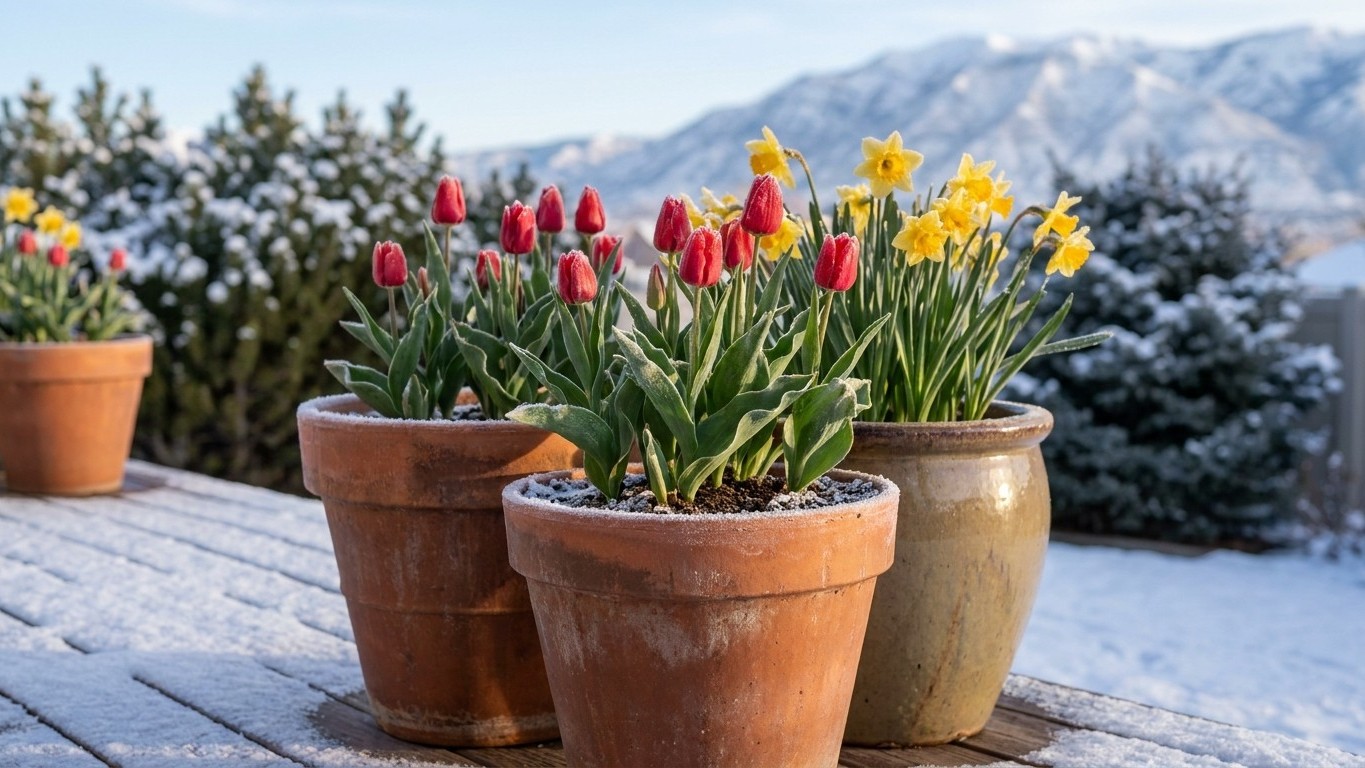

Bulbs like tulips and daffodils grow fine in containers in Utah, but the pot itself is the risk, not a shortage of winter cold. Salt Lake City’s coldest month averages a 24.2°F low, more than enough chill for a bulb sitting in garden soil. A container is a different story: it freezes clear through, roots included, so protecting the pot matters more than manufacturing extra cold.
Why this matters in Utah

The number that settles this is 24.2°F, the average daily minimum for the coldest month at the Salt Lake City reference station, per NOAA NCEI Climate Normals (1991-2020). That figure matters because it’s the one that decides whether a bulb gets the winter chill it needs to bloom, not the record low and not a seasonal average. A spring bulb wants roughly twelve to fourteen weeks below 45°F to complete the flower inside its papery shell. A winter that bottoms out around 24°F for weeks at a stretch delivers that requirement without any help from the gardener.
That puts Utah in the second of the two situations gardeners run into with spring bulbs. Some regions don’t get cold enough, long enough, and the gardener has to fake winter in a refrigerator or a dark closet, a technique called forcing. Utah isn’t short on cold. The problem here is the opposite one: a container doesn’t behave like the ground.
Garden soil is a poor conductor of heat. Even when the air above it drops well below freezing, the soil a few inches down stays warmer, insulated by the earth around and beneath it. A pot has no such buffer. Air surrounds it on every side, so a container left outside tracks the air temperature far more closely than a planting bed does. A bulb rated for a given USDA hardiness zone in the ground can die in a pot in that same zone, because the roots that would have stayed protected underground are instead a few inches from the sub-freezing air.
The USDA Plant Hardiness Zone Map (2023 edition, built on 1991-2020 normals) puts Utah across a startling range, from 4a in the coldest high-elevation valleys to 9a in the warmest southwest corner near St. George. That spread is too wide for one blanket answer, so any specific recommendation here has to be anchored to a named location rather than the zone range itself. Salt Lake City sits solidly in the zone 6 territory, cold enough that a container left unprotected outside all winter is gambling with a bulb the ground would have kept alive without effort.
How to do it here
The steps below cover two different goals: forcing bulbs to bloom indoors ahead of their natural season, and keeping bulbs alive in a container that stays outside through winter. Both rely on the same cold-exposure logic, just applied differently.
- Buy pre-cooled bulbs or plan to chill them yourself starting in early fall, since the cold period has to run its full course before bloom.
- Pot the bulbs in a container with drainage holes, using a well-draining potting mix, pointed end up, set close together for a fuller display.
- Water once after potting, then let the soil stay just barely moist through the cold period, never soggy.
- Move the pot somewhere dark and cold for twelve to fourteen weeks below 45°F: an unheated garage that still holds above freezing works, and so does a spare refrigerator drawer, kept away from ripening fruit since the ethylene gas fruit gives off can kill the flower bud forming inside the bulb.
- Check the pot every couple of weeks for mold or drying soil, but resist opening the cold cycle early.
- If the plan is to leave the container outside all winter rather than force it indoors, the pot needs to be rated at least two USDA zones hardier than the bulb itself, or it needs to be moved into an unheated garage or shed and mulched heavily, because the container will freeze through in a way the garden bed never does.
- Once the chilling period ends, bring the pot into a cool, dim room for a few days before moving it to bright light, letting the stems adjust gradually rather than shocking them into bloom.
Every one of those steps is checkable with a thermometer or a calendar. None of them depends on guesswork about how cold the garage actually gets.
Which bulbs are worth it
Not every bulb rewards the effort of a container. Some finish their cold requirement fast and stand up well in a pot. Others need a longer chill, grow a stem too tall for a container to support upright, or simply don’t force with any consistency.
- Crocus: short cold requirement, compact growth, rarely topples.
- Grape hyacinth (muscari): fast to finish chilling, short stems that stay upright in a small pot.
- Hyacinth: sturdy stem for its height, reliable bloom after a standard chill period.
- Paperwhite narcissus: needs no cold period at all, making it the easiest bulb to force in a container.
- Shorter tulip varieties: bred low enough to stay upright without staking indoors.
- Tall Darwin hybrid tulips: long, top-heavy stems that lean or fall in a lightweight pot.
- Large-flowered trumpet daffodils: the stem often can’t hold the flower’s weight once it opens indoors.
- Fritillaria: a long, finicky chill requirement with inconsistent bloom even when it’s met.
- Allium: stalks grow tall and thin, unstable once the flower head fills out.
Worth remembering: a bulb forced indoors, especially paperwhites and most forced tulips, is rarely worth replanting afterward. It’s spent its one bloom cycle and won’t perform well again outside. That makes forcing a low-risk experiment rather than a long-term commitment, since the bulb was never going to come back next spring anyway.
What goes wrong, and when you can still fix it
Leaves but no flower
This means the cold period ran short. The bulb had enough chill to trigger leaf growth but not enough to finish forming the flower bud inside its layers. There’s no way to add the missing weeks after the fact once the bulb has warmed and started growing. The bulb itself usually isn’t dead; if it’s a variety that can go back into a garden bed, plant it there in fall and let a full natural winter finish the job next year. A one-season bulb like a paperwhite doesn’t have that option, and there’s nothing to salvage.
Flower on a stem too short to see
This is what happens when a pot moves from cold storage into bright, warm light too fast. The flower bud opens before the stem has had time to stretch, so the bloom sits low and stunted in the foliage. Once the stem has set at that height, it won’t stretch further this season. Next time, move the pot into a cool, dim room for several days before it reaches bright light, giving the stem a gradual transition instead of a shock.
Rot in the pot
Soft, discolored bulbs almost always trace back to drainage. A container without holes, or one that sat in a saucer of standing water during the cold period, keeps the bulb wet enough to rot before it ever gets the chance to bloom. This isn’t fixable this season; a rotted bulb is done. The fix is for the next attempt: a pot with real drainage holes, and soil kept just barely moist rather than wet through the entire chilling period.