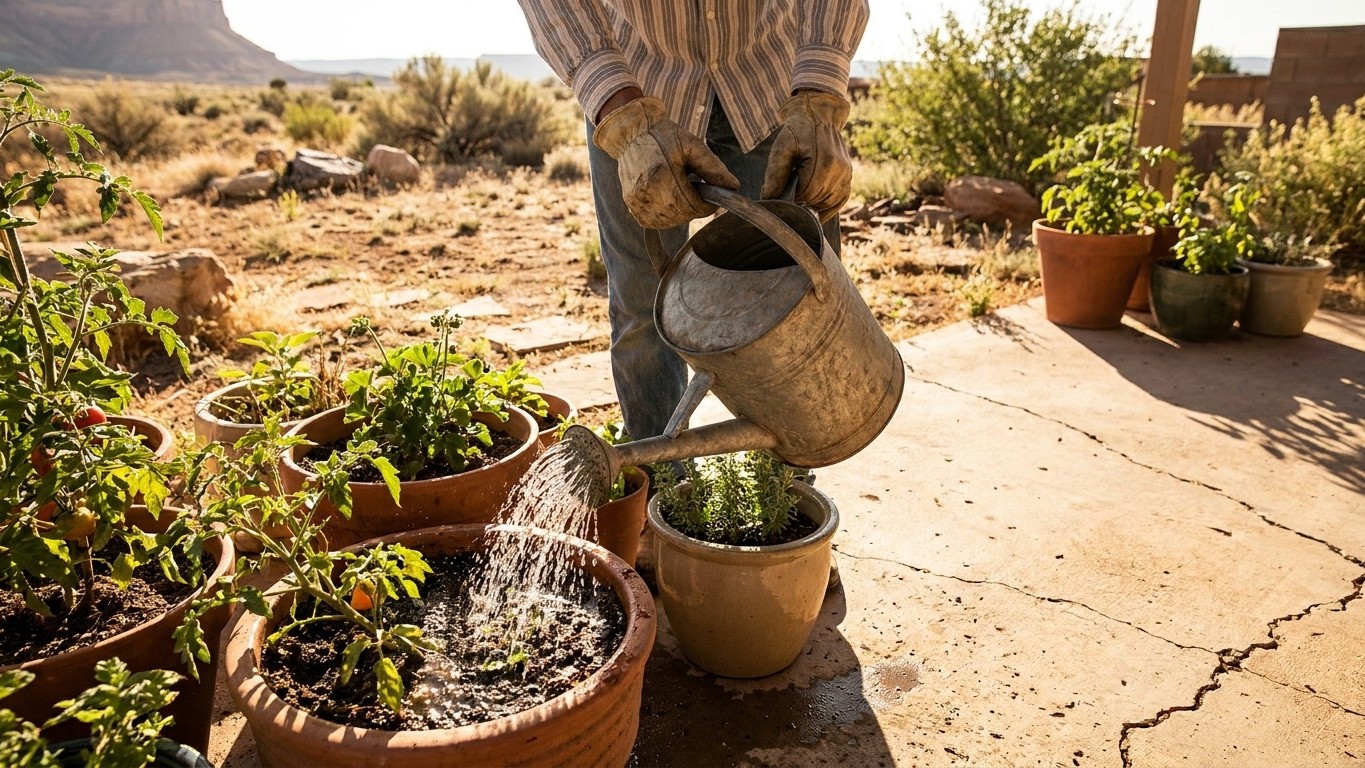

In an average July here, the sky delivers less than half an inch of rain for the entire month, while the thermometer clears 90F on more than fifty days a year. Between those two numbers sits the real answer: a garden bed in this state gets almost nothing from the weather during the driest stretch of summer, and it loses water fast to heat the rest of the time. The gardener carries the difference, bucket by bucket or hose by hose.
What changes here

Start with the two figures that matter most: 0.49 inches of rain in July, the driest summer month on record for this region, and 52.1 days a year that reach 90F or higher. Together they describe a summer where the sky contributes almost nothing and the air pulls moisture back out of the soil at a steady clip. That combination is what forces a watering schedule rather than a wait-and-see approach.
The arithmetic makes it concrete. A vegetable bed or a young shrub wants roughly an inch of water a week to keep growing without stress. July has a little over four weeks in it, and 0.49 inches spread across that month works out to something like a tenth of an inch of rain in an average week, if it falls evenly at all, which it rarely does in a state where summer rain often arrives as a single afternoon thunderstorm rather than a steady drizzle. That leaves close to nine-tenths of an inch a week for the gardener to supply by hand or by irrigation line. June and August aren’t much better, at 0.95 and 0.58 inches for the whole month.
Soil changes how far that carried water goes. On sandy ground, an inch of water moves through the root zone and drains past it within a day, which means the same weekly total has to be split into smaller, more frequent doses. On heavy clay, that same inch can sit in the top several inches of soil for the better part of a week, which sounds convenient until the roots sitting in it start to suffocate from lack of oxygen. Neither soil type gets a free pass with only 0.49 inches of rain falling in July: the sandy bed dries out faster, the clay bed just fails in a different way if it’s watered again before it has had the chance to dry.
The 52.1 days above 90F is the other half of the story. Heat like that speeds up evaporation from the soil surface and pushes plants to pull more water through their leaves just to stay cool. A rain gauge that reads 0.49 inches for the month doesn’t account for how much of that moisture never makes it to the root zone before the afternoon sun burns it off the surface.
How to water when it matters
Deep, infrequent watering at the base of the plant, done in the morning, is the method that fits this climate. Deep watering pushes moisture down to where roots actually live, several inches below the surface, instead of leaving it in the top inch where it evaporates within hours on a 90-degree afternoon. Infrequent watering forces roots to grow downward chasing that moisture, which builds a plant that can handle the dry stretches between waterings rather than one that’s dependent on a daily drink. Watering at the base instead of overhead keeps water off the leaves, where it does nothing for the roots and everything for fungal disease. Morning watering gives the plant hours to take up moisture before the heat of the day starts pulling it back out through evaporation and transpiration.
Checking the soil before turning on the hose matters more than checking the calendar. A finger pushed two inches into the soil, or a trowel pulled up to look at, tells the real story: if it’s dry at that depth, water; if it’s still damp, wait. The surface can look bone-dry an hour after watering while the root zone underneath stays moist for days, and the surface can also look fine after a light rain that only wet the top half-inch while the roots underneath are parched.
Soil texture sets the rhythm. Sandy soil holds little water and drains fast, so it asks for shorter, more frequent soakings rather than one big weekly flood. Heavy clay holds a week’s worth of water in reserve but drowns roots if it gets watered again before that reserve has had time to dry out and let air back into the soil. Neither figure is a rule; both are a starting point to check against the reader’s own ground with a finger or a trowel.
- Check the soil two inches down before watering at all; if it’s still damp, skip that day.
- Water at the base of the plant, not over the leaves, in the early morning hours.
- Apply roughly an inch of water per week total, adjusted up on sandy soil (split into two or three smaller sessions) and down on clay (one deeper session, spaced further apart).
- Add two inches of mulch around the base to slow evaporation between waterings, especially through July and August.
- Recheck soil moisture with a finger two days after watering and adjust the next session’s timing based on what’s actually dry.
What goes wrong
A daily sprinkle that keeps roots at the surface
A light daily watering feels responsible, but it trains roots to stay shallow, right where the topsoil bakes hardest on a 90-degree day. Those roots never develop the depth to survive a missed watering, and with 52.1 days a year that hot, a missed day is a real threat rather than a minor inconvenience.
Watering the leaves in the evening
Wetting foliage after the sun goes down leaves water sitting on the leaves overnight, which is exactly the damp, dark window that fungal disease needs to take hold. Morning watering at the base avoids both problems at once.
Trusting a rain shower that barely wet the surface
A summer thunderstorm can look like a soaking rain and still only dampen the top half-inch of soil before it runs off a sun-baked crust. Given that July averages only 0.49 inches for the entire month, one storm doesn’t erase a week of dry soil underneath. A finger check settles it faster than watching the sky.
Skipping the mulch
Bare soil left exposed through a stretch of 90-degree days gives back a good share of whatever water was just applied, straight into the air by evaporation. A mulch layer is what keeps that water where the roots can still reach it.
Watering clay before it has dried
On heavy clay, adding more water before the previous soaking has drained leaves roots sitting in a soil that has no oxygen left in it, which suffocates them just as surely as drought does. Checking with a trowel before watering again is the fix.
Local help
For soil testing, plant recommendations and current watering guidance suited to specific counties, Utah State University Extension is the state’s land-grant resource. Watering restrictions and allowed days vary by local water district and change year to year, so check with the specific municipal or county water provider for current rules before setting an irrigation schedule.
Common questions
How often should I water in a Utah summer?
Check the soil two inches down rather than following a fixed schedule. On average, expect to water two to three times a week on sandy soil and once a week on clay, adjusting for the roughly 0.49 inches of rain July typically brings.
Does mulch really make a difference with 52 days over 90F a year?
Yes. A two-inch layer slows surface evaporation significantly during the hottest stretches, which matters most in a state where summer rain rarely makes up the difference on its own.
Is morning or evening watering better here?
Morning. It gives plants hours to absorb water before peak heat pulls it back out, and it avoids leaving foliage wet overnight, which invites fungal problems.
Can I rely on summer rain instead of watering by hand?
Not through July. At 0.49 inches for the month, rainfall alone falls well short of the roughly one inch a week most beds need, so hand or irrigation watering has to fill the gap.