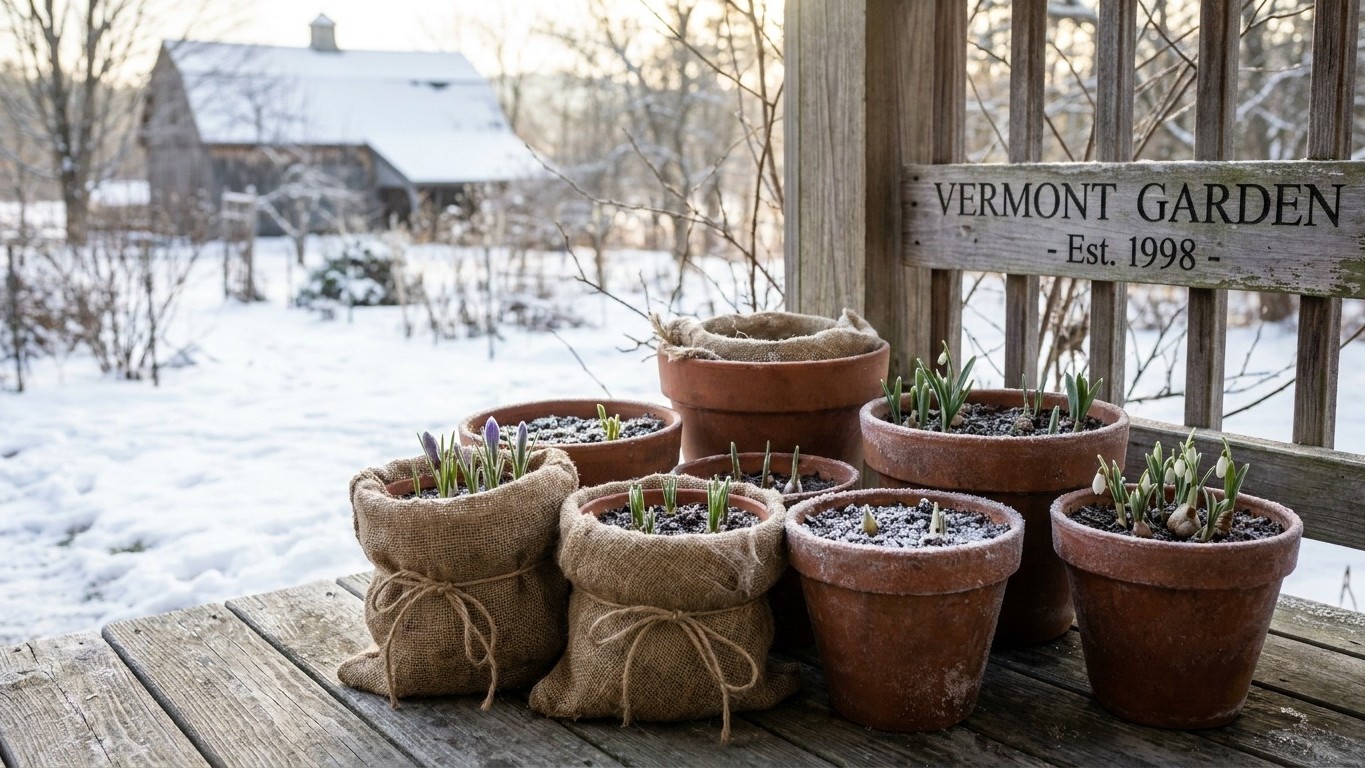

Yes, but the trick in Vermont isn’t waking bulbs up early. It’s keeping the pot itself from freezing solid. A container spring-bulb project here needs one of two treatments: deliberate cold storage for an indoor winter bloom, or enough insulation to survive outdoors, where a pot freezes clear through in a way a garden bed never does. Which treatment applies depends on where the pot spends January.
Why this matters in Vermont

The mean daily minimum for Burlington’s coldest month sits at 12.9°F, according to NOAA NCEI Climate Normals for 1991-2020. That number matters more than the record low, because it describes the temperature a bulb sits in on an average night, week after week, not just the worst night of the decade. A spring bulb needs roughly twelve to fourteen weeks below 45°F to break dormancy properly. At 12.9°F average, Vermont delivers that chilling requirement several times over without any help from the gardener.
That’s the opposite problem from what forcing solves. Forcing exists for climates that don’t get cold enough, long enough, for bulbs to bloom on schedule outdoors, so the gardener substitutes a refrigerator or an unheated space for the missing winter. Vermont doesn’t lack cold. If anything, it has more of it than most bulbs are built to survive when they’re sitting in a pot instead of the ground.
That distinction is the whole point of growing bulbs in containers here. A bulb planted in a garden bed is surrounded by several feet of soil mass in every direction, and that mass buffers temperature swings even when the surface freezes hard. A bulb in a container has no such buffer. The pot’s sides and bottom are exposed to air on every face, so the root zone tracks the ambient temperature almost exactly. A tulip rated hardy to USDA zone 4 in open ground can die in a container in the same yard, because the container effectively drops the bulb’s growing environment by one to two hardiness zones compared to being planted in the ground.
The USDA Plant Hardiness Zone Map, built from the 2023 edition using 1991-2020 normals, places Vermont across a 3b-5b range statewide. That’s a wide spread for one state, and it means a recommendation calibrated to Burlington (on the milder end, closer to lakeside zone 5a conditions) doesn’t automatically hold for a garden in the Northeast Kingdom, where winters run colder and longer. Anyone using a zone number to plan container protection should check their own town against the map rather than borrowing Burlington’s figure wholesale.
So the practical answer for this territory: skip worrying about whether winter is cold enough. It is. Spend the planning effort instead on whether the container can survive that cold without insulation, and on whether any bulb is going indoors for forced bloom, which is a separate decision made for convenience or timing, not necessity.
How to do it here
The sequence below covers both paths: a pot that overwinters outdoors, and a pot chilled deliberately for an indoor bloom. Pick the branch that matches your plan before you start, since the two diverge almost immediately.
- Decide before planting whether the container spends winter outside on a porch or patio, or gets moved into cold storage for a forced indoor bloom. This choice determines everything that follows.
- For an outdoor pot: check the bulb’s rated hardiness zone against your actual location within Vermont’s 3b-5b range, not against Burlington’s figure unless you garden near Burlington. As a rule of thumb, the container needs to sit at least two zones hardier than the bulb’s rating, since the pot loses the insulating mass a garden bed provides.
- If the pot doesn’t meet that two-zone margin, move it into an unheated garage or shed that stays reliably above freezing, or bury the whole pot in the ground and mound mulch over the soil line. Either method restores some of the buffering the pot lacks on its own.
- For a forced indoor bloom: pot the bulbs, water once, then chill them for twelve to fourteen weeks below 45°F. An unheated garage that stays above freezing works, as does a refrigerator’s vegetable drawer, kept well away from any ripening fruit, since the ethylene gas fruit gives off can kill the flower bud forming inside the bulb before it ever opens.
- Check the pot periodically through the chilling period. The soil should stay barely moist, never soggy and never bone dry, since either extreme during dormancy can damage the root system before growth even starts.
- Once the chilling period is complete and shoots have started (typically an inch or two of pale growth), move the pot to a bright but still cool room, around 50-60°F, for a week before giving it full light and warmth. A gradual transition prevents the stem from growing so fast it can’t support the flower.
- Outdoor pots that made it through winter under mulch or in the garage come back out once nighttime lows stay reliably above freezing, following the same gradual re-acclimation.
Which bulbs are worth it
Not every bulb rewards the effort of a container. The ones that force fastest and hold up best in a pot share a short cold requirement and a compact growth habit, so the stem doesn’t outgrow the pot’s stability before the flower opens. The ones that sulk tend to need a longer chill, grow taller, or both, and a top-heavy stem in a lightweight pot is a recipe for a bulb that blooms sideways on the floor.
Where a bulb was never going to survive a Vermont winter outdoors anyway, forcing it for one container season costs nothing in the long run. Paperwhite narcissus fall into that category: they aren’t hardy in this climate at all, so treating them as a single-use indoor bloom isn’t a compromise, it’s simply how they’re grown here.
- Crocus, short cold requirement, compact stem, forces reliably in a small pot
- Hyacinth, moderate chill period, sturdy stem that rarely topples
- Paperwhite narcissus, needs no chilling at all, a genuine one-season container bulb here
- Species and dwarf tulips (such as Tulipa tarda or Tulipa clusiana), short stems that suit a container’s limited stability
- Large trumpet daffodils, long chill requirement and a stem tall enough to topple in a lightweight pot
- Darwin hybrid tulips, tall growth habit that outgrows most container stability
- Alliums, long chill period and a mature size poorly matched to a small pot’s root volume
What goes wrong, and when you can still fix it
Leaves, but no flower
This means the cold period was too short. The bulb had enough energy to produce foliage but the flower bud inside never finished breaking dormancy. There’s no fix for the current season; the bulb needs a full chilling period next winter, twelve to fourteen weeks below 45°F, before it will flower.
A flower on a stem too short to see
This happens when the pot was warmed too fast after chilling, before the stem had time to elongate normally. The flower itself is usually fine, just buried in the foliage. It can’t be lengthened once it’s formed this season, but letting the plant finish its cycle normally, rather than discarding it, keeps the bulb healthy for a longer transition next year.
Rot in the pot
Rot almost always traces back to drainage, or the lack of it. A container without drainage holes holds water against the bulb through the entire dormancy period, and the tissue breaks down before spring. If the bulb is still firm when you catch it, repotting into a container with real drainage and a coarser mix can save it. Once the bulb has gone soft and discolored, it’s lost, not just for this season but for good.