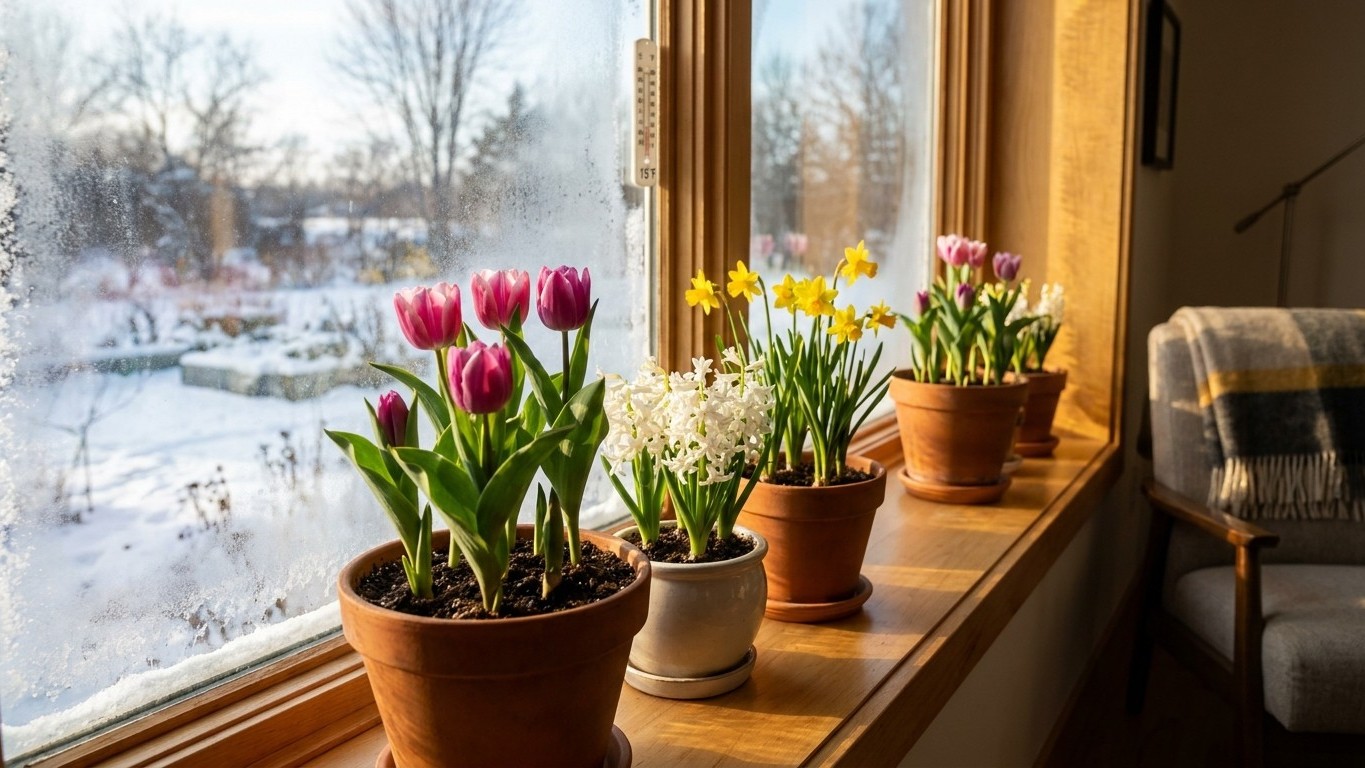

Forcing spring bulbs indoors in Wisconsin isn’t about tricking a shortage of cold into a bulb that needs it. This state hands out cold in abundance. Forcing here is a scheduling trick: you supply the chill on your own timeline, in a refrigerator or an unheated garage, so tulips or hyacinths bloom on your windowsill in February while the ground outside is locked solid until spring.
Why this matters in Wisconsin

The average low during the coldest month here, using Milwaukee as the reference station, sits at 17.2°F. That number matters because a spring bulb needs roughly twelve to fourteen weeks with temperatures below 45°F before it will flower properly. At 17.2°F for a full month, Wisconsin ground delivers that requirement several times over between December and March. So the classic reason for forcing, a winter too mild to chill a bulb naturally, doesn’t apply on this ground. Nobody in this state needs a refrigerator to make a tulip think it survived winter. The ground already convinces it.
Forcing indoors here exists for a different, entirely practical reason: the ground is frozen and inaccessible for months, and gardeners who want to see a hyacinth bloom in January have no other option but to fake the cold indoors on a schedule they control, starting the chill in September or October so the bulb is ready to bring into warmth well before the outdoor thaw.
Containers raise a separate problem, and it has nothing to do with chilling weeks. A pot sitting outside on a porch or patio freezes solid, roots and all, in a way that garden soil never does, because soil several inches down stays insulated by the ground around it while a pot is exposed on every side. The USDA Plant Hardiness Zone Map places this territory across a striking range, from 3b up to 6a, using Milwaukee as the reference point for that scale. A bulb rated hardy for the harsher end of that range can still die in a pot left outdoors, because the pot’s exposed walls push its effective hardiness rating two zones colder than the same bulb would experience in a garden bed at the same address.
That’s the situation this state actually sits in: plenty of natural cold for garden-planted bulbs, but real risk for anything left in a container outdoors, and a genuine reason to force bulbs indoors if the goal is winter bloom rather than survival.
How to do it here
The process is the same sequence of steps wherever you live, but two of them depend on what a Wisconsin winter actually offers a gardener: a garage that stays cold without freezing, and a refrigerator that most households already own.
- Pick bulbs suited to forcing (see the next section), and pot them in a shallow container with drainage holes, in ordinary potting soil, with the bulb noses sitting just above the surface.
- Water once, thoroughly, right after potting, then let the surface dry slightly before moving the pot into cold storage.
- Set the pot somewhere that holds a steady temperature below 45°F but rarely drops below freezing: an attached, unheated garage works for many Wisconsin homes through most of the winter, since it’s insulated by the house on at least one side. A refrigerator crisper drawer works too, but keep it away from apples, pears, or other ripening fruit. Ripening fruit releases ethylene gas, and ethylene kills the flower bud forming inside the bulb before it ever gets the chance to open.
- Leave the pot undisturbed in the dark and cold for twelve to fourteen weeks. Check once a month rather than daily; frequent handling does nothing but risk breaking a shoot.
- Once shoots reach roughly one to two inches and you can see roots at the drainage holes, move the pot to indirect light for about a week before giving it full bright light.
- Expect bloom two to four weeks after the move into light, depending on the bulb.
For bulbs planted in containers left outdoors instead of forced indoors, the rule changes: choose a bulb rated at least two hardiness zones colder than your actual zone, or move the pot into an unheated garage or shed and mulch it heavily for winter. Given how wide this territory’s 3b to 6a range runs, a gardener who doesn’t know their specific zone should assume the colder end and act accordingly, since guessing wrong in the milder direction is what kills the bulb.
Which bulbs are worth it
Some bulbs reward the twelve weeks of fridge space they take up. Others sulk no matter how carefully you follow every step, usually because of how long a cold period they demand or how tall and top-heavy they grow once they do bloom. A short, stocky bulb forces faster and holds itself up in a pot better than a tall one ever will.
- Crocus, short-stemmed and quick to respond to a chilling period
- Hyacinth, reliable bloomer and one of the most common choices for indoor forcing
- Muscari (grape hyacinth), compact and rarely topples
- Dwarf and species tulips, short enough to stand upright in a pot without staking
- Paperwhite narcissus and amaryllis, which need no cold period at all and can go straight into a bright window
- Standard Darwin and single late tulips, tall stems that flop once the flower opens indoors
- Fritillaria, a long and temperamental cold requirement that often ends in no bloom at all
- Alliums, tall and slow, with a weak response to forcing compared to garden planting
- Most tall daffodil varieties, prone to leaning or snapping under their own bloom weight indoors
One thing worth remembering: tulips and daffodils forced indoors rarely thrive if replanted outside afterward, and most gardeners treat them as a one-season purchase regardless of whether they force them. Forced or not, the bulb was likely never coming back next spring. That fact removes the risk from the equation entirely, since there’s nothing long-term to lose by trying.
What goes wrong, and when you can still fix it
Leaves but no flower
This means the cold period ran too short. The flower bud sits fully formed inside the bulb only after it receives its full chilling requirement; cut that short and the bulb pushes out leaves using stored energy but never differentiates a flower. There’s no recovery this season. The bulb can go into the ground outdoors in spring and, if it’s a type that naturally survives Wisconsin winters, it may rebuild enough reserves to try again the following year on its own schedule.
Flower on a stem too short to see
This happens when the bulb gets moved into warmth and light too fast after its cold period ends. The flower bud, having finished its chilling requirement, is ready to open, but the stem hasn’t had time to elongate before blooming starts. It’s a timing problem, not a health problem, and it can’t be corrected once it’s underway. Next time, stretch the transition into light and warmth over a longer stretch, giving the stem a week or two of indirect light before it hits full brightness.
Rot in the pot
Soft, mushy bulbs during or after the cold period point to standing water, either from a pot without real drainage holes or from soil kept too wet during the twelve weeks of storage. Once rot sets in, the bulb is finished for this cycle; there’s no rescuing tissue that’s already broken down. The fix applies only to the next attempt: drainage holes, a lighter watering hand, and checking that the pot never sits in a saucer of standing water during storage.