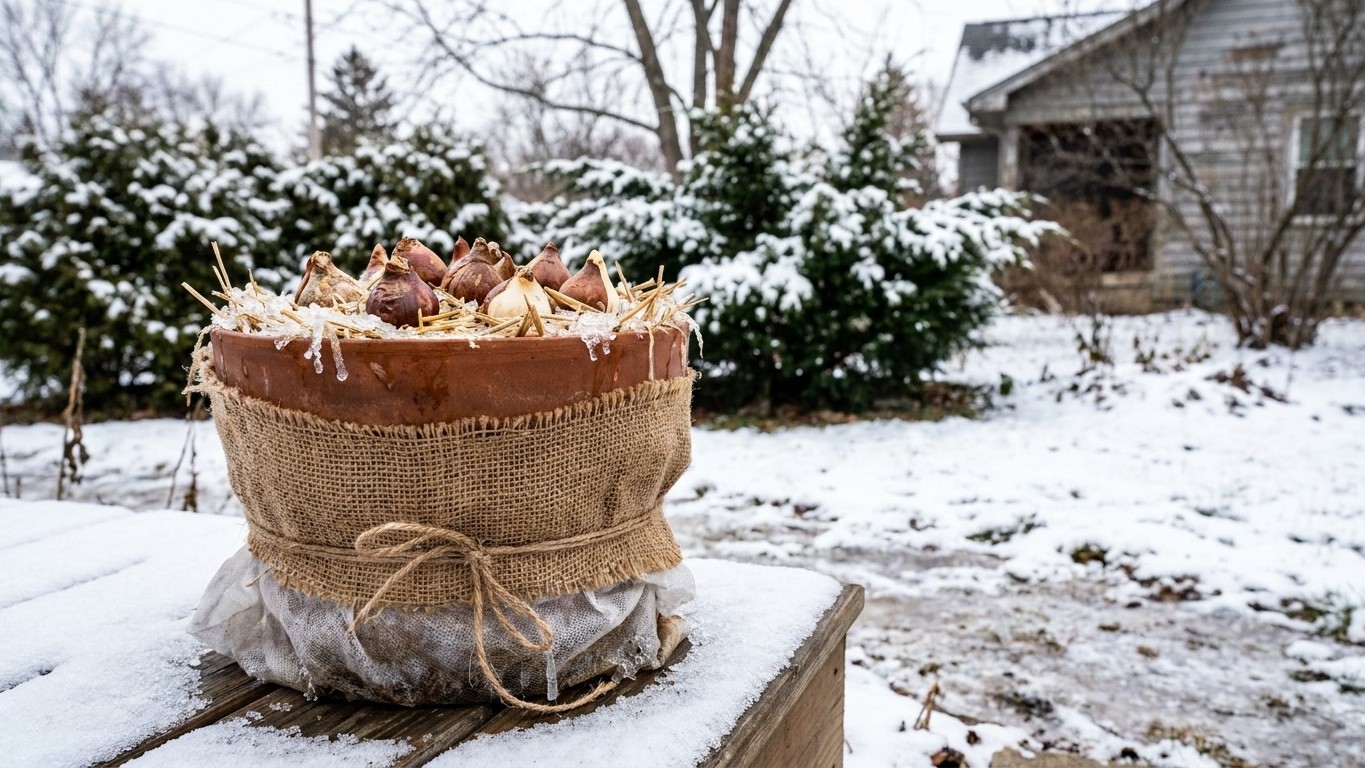

A container of spring bulbs survives a Wisconsin winter only if the pot itself gets extra protection, not because the state lacks cold. The coldest month here averages a daily low of 17.2°F (Milwaukee, NOAA NCEI Climate Normals 1991-2020), far below anything a bulb requires for its dormant chill. The real threat is different: a pot freezes solid, roots included, while garden soil only freezes at the surface. That gap is what decides whether a container makes it to bloom.
Why this matters in Wisconsin

Start with the number that changes everything: 17.2°F. That’s the average daily minimum for the coldest month at the Milwaukee reference station, and it sits nowhere near the 45°F threshold that triggers a spring bulb’s chilling clock. A tulip or daffodil planted in the ground here gets its twelve to fourteen weeks below 45°F within the first month of a typical winter, then keeps getting cold weather for months afterward. There is no shortage to fill. Forcing, in the sense of manufacturing missing cold, is not something this territory needs for bulbs planted directly in the yard.
The USDA Plant Hardiness Zone Map (2023 edition, built on 1991-2020 normals) places Wisconsin across a wide band, zone 3b in the north to 6a around Milwaukee. That range matters for one specific reason: it is calculated from the average annual extreme minimum temperature in the ground, insulated by the surrounding soil mass. A daffodil rated hardy to zone 5 survives a Milwaukee winter in a garden bed because the earth around its roots never drops as far as the air temperature does.
A container erases that insulation. A pot sitting above grade, exposed to wind and air on every side, cools and freezes far faster and far deeper than the same volume of ground. Nursery and extension guidance on overwintering potted perennials generally treats a container as roughly two hardiness zones colder than the ground it sits on, which is the practical reason a zone 5-rated bulb can die in a pot in a spot where it would have sailed through in a bed.
That’s the situation this territory is actually in. Wisconsin gardeners are not short on cold, they’re short on insulation once a bulb goes into a pot instead of the ground. The fix isn’t a refrigerator drawer for outdoor container bulbs, it’s protecting the pot from freezing straight through. Indoor forcing still has a place here, but for a different reason: color in January, not survival.
How to do it here
The steps below split into two tracks, because forcing bulbs indoors and overwintering a container outdoors solve different problems. Follow the one that matches your goal, and check each step against something you can verify yourself, a thermometer, a calendar, a bulb tag.
- Place your county within the 3b-6a range before choosing a bulb or a plan. Milwaukee sits at the warm edge, zone 6a; counties farther north run colder, closer to 4a or 3b, and need more protection for the same pot.
- Decide whether you want outdoor container bloom next spring or indoor flowers ahead of the outdoor season. The two paths use the same bulbs but different handling.
- For indoor forcing, give the potted bulb twelve to fourteen weeks below 45°F. A refrigerator drawer works, but keep it away from ripening fruit, the ethylene gas fruit releases kills the flower bud forming inside the bulb.
- An unheated garage is the other common option, but check it with a plain thermometer over a few days. Many Wisconsin garages track close to outdoor air during a hard cold snap, dropping well below freezing, which can injure bulbs stored loose rather than insulated by soil.
- For a container left outdoors all winter, match the pot’s effective hardiness to two zones colder than your actual zone, or plan to move it. A bulb rated for zone 5 needs a pot treated as though it sat in zone 3 territory.
- Move the pot into an unheated garage or shed for winter, or sink it to its rim in an empty garden bed and mound leaves or straw over the top, so the surrounding ground insulates the container the way it would insulate a planted bulb.
- Water sparingly through dormancy. Roots need a little moisture to stay alive, but a soaked, frozen pot is the fastest way to crack the container and rot the bulb inside it.
- Once the cold period ends, bring forced pots into light gradually and keep the room on the cool side at first; a bulb pushed straight into warmth grows a weak, floppy stem.
Which bulbs are worth it
Some bulbs pay back the effort of a pot and a cold period, others don’t. The dividing line usually comes down to two things: how short the chilling requirement is, and how tall the stem grows once it’s blooming. A short cold requirement means faster results and less risk of the bulb rotting in storage before it’s ready. A tall stem is a liability in a pot, since there’s no surrounding bed of neighboring plants to hold it up.
- Crocus, one of the shortest cold requirements of any spring bulb, and a stem too short to topple
- Hyacinth, reliable in a container and often sold specifically for forcing
- Iris reticulata (dwarf iris), small and stable in a pot
- Muscari (grape hyacinth), forces fast and stays low
- Small daffodils like the ‘Tete-a-Tete’ type, short-stemmed compared to standard trumpet varieties
- Tall tulips, prone to toppling once the flower opens and heavy with water
- Large trumpet daffodils, tall stems that lean hard in a lightweight pot
- Alliums, a long cold requirement paired with height that a container rarely supports well
- Camassia, same problem: tall, and slow to satisfy its chilling needs
Where a bulb is a one-season purchase anyway, like most forced hyacinths and paperwhites sold for winter color, forcing costs nothing in the long run. It was never going to come back reliably outdoors in this climate, so there’s no loss in using it up for a few weeks of bloom indoors.
What goes wrong, and when you can still fix it
Leaves, no flower
This is a blind bulb, and it means the cold period ran short, whether that’s an indoor forcing stint cut off too early or a container that never sat below 45°F long enough. There’s no rescue this season; the plant has already decided not to bloom. The fix is giving that same bulb its full twelve to fourteen weeks next time, tracked against a real thermometer rather than a calendar guess.
Flower on a stem too short to see
A squat, buried-looking bloom usually means the bulb was warmed and brought into light too soon after its cold period, before the stem had time to elongate. This one is also a next-season fix. Once the stem has already formed short, no amount of light or warmth will stretch it out.
Rot in a pot
A soft, mushy bulb that never pushed a leaf points to a pot that never drained. Standing water around a dormant bulb in cold conditions is one of the more common failures in container growing. The bulb is lost for this season. Next time, drainage holes and a gritty, fast-draining mix are the difference between a bulb that survives dormancy and one that doesn’t.