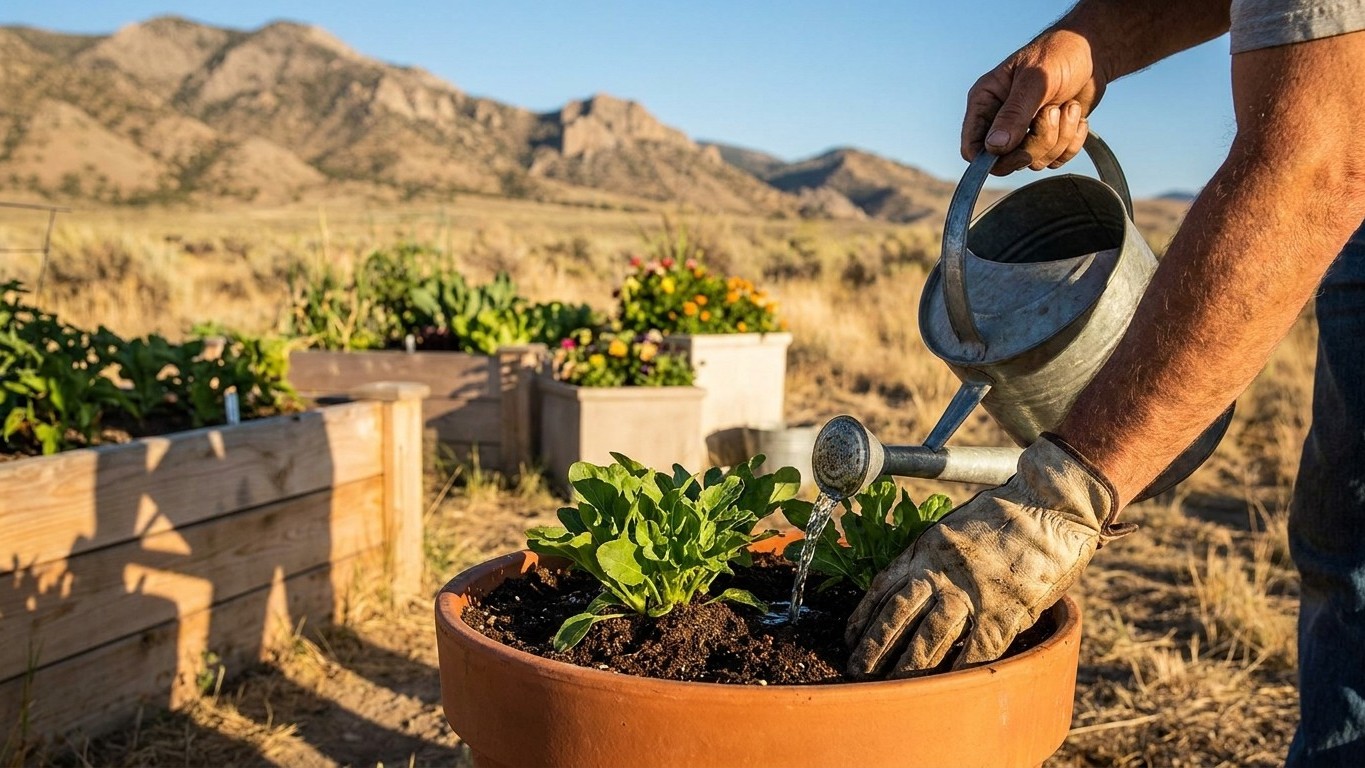

Wyoming’s summers deliver little rain and plenty of heat, which means most beds and containers here rely on the gardener more than the sky. Water deeply, at the base, and check soil moisture two inches down rather than trusting appearances, that combination covers most of what changes when you move from a general watering guide to Wyoming’s own numbers.
What changes here

Two figures set the terms for every watering decision in this state: August, the driest summer month, brings just 1.52 inches of rain, and the reference station averages 10.4 days a year at 90F or above. Together they describe a stretch of the growing season where little water falls from the sky at exactly the moment evaporation is working hardest against it.
Run the arithmetic and the gap becomes concrete. A vegetable bed or a well-planted container generally wants about an inch of water a week to keep growing without stress. August has roughly 4.4 weeks in it, so that 1.52 inches of monthly rain works out to about 0.34 inch of water arriving naturally in an average week. That leaves close to 0.66 inch, roughly two-thirds of what the plant needs, for the gardener to supply by hose, drip line, or watering can. On a week when a thunderstorm skips the property entirely, which happens often in a state this size and this dry, the full inch falls on the gardener alone.
Soil texture changes how that inch behaves once it lands, though the exact sand and clay content varies by county and even by yard in Wyoming’s mixed terrain. A sandy plot lets water pass through quickly, so the same 0.66 inch needs to be split into more frequent, lighter sessions to keep it in reach of roots. A heavier, clay-leaning soil holds water longer, so one deeper session can carry a bed further into the week, but it also means a gardener who waters on a fixed schedule risks adding water before the last round has drained. Neither soil type changes the total the plant needs. Both change how you should deliver it, which is the point of the method in the next section.
How to water when it matters
Deep, infrequent watering at the base of the plant, done in the morning, is the method that fits Wyoming’s dry-month arithmetic better than a quick daily splash. Water applied deeply pushes moisture down where roots can follow it, training the root system to grow deeper and become more resilient to the next dry stretch. Morning watering gives the day’s heat, and those 10.4 days a year above 90F, time to dry any leaf surfaces before evening, cutting the window fungal disease needs to take hold overnight.
Checking the soil rather than the calendar is what keeps this method honest. A finger pushed two inches into the ground, or a trowel turned to check below the surface, tells you whether the root zone is actually dry. Surface soil can look pale and cracked in Wyoming’s dry air while two inches down still holds moisture from the last watering, and watering on top of that just wastes water and encourages shallow roots.
A starting sequence for an established bed or a large container looks like this, to be adjusted once you’ve checked your own soil against it:
- Water early morning, before 9 a.m. if possible, so leaves dry before the day’s heat sets in.
- Apply water slowly at the base until it has soaked at least six inches deep, roughly 0.6 to 1 inch total depending on how much of that week’s inch the sky already delivered.
- Check soil moisture two inches down with a finger or trowel before the next scheduled watering, rather than watering on a fixed calendar day.
- On sandy ground, shorten the interval between waterings and reduce the amount per session, since water moves through faster.
- On heavier, clay-leaning ground, lengthen the interval and confirm the topsoil has dried before watering again, since it holds moisture longer and can drown roots if watered too soon.
Treat that sequence as a baseline to test, not a fixed rule. Wyoming’s soils shift enough from one property to the next that the only way to know your rhythm is to dig in and look.
What goes wrong
Watering a little every day
A light daily sprinkle wets only the top inch or so of soil, which is exactly where it evaporates fastest under Wyoming’s dry air and its ten-plus days of 90-degree heat. Roots follow the water, so they stay shallow and close to the surface, leaving the plant more vulnerable, not less, the next time a heat spell hits. This is the costliest mistake in a state this dry: it feels responsible because it happens often, but it trains a garden to need constant attention instead of building resilience.
Watering leaves in the evening
Wetting foliage after the sun goes down leaves moisture sitting on leaves overnight, and that damp window is when fungal problems like powdery mildew and various leaf spots get their start. Watering at the base instead of overhead, and doing it in the morning, removes both the wet-leaf window and the timing that lets disease settle in.
Trusting a rain shower
A passing summer storm can look like real relief while only wetting the top half-inch of soil, especially when it moves through quickly, which is common with Wyoming’s summer weather. The only way to know whether it actually helped is a finger or trowel check two inches down. If that soil is still dry, the shower didn’t count.
Skipping mulch
Bare soil left exposed to a state that reaches 90F on more than ten days a year gives back moisture almost as fast as it’s applied. A two- to three-inch layer of mulch around beds and containers slows that loss and stretches the time between waterings, which matters most in exactly the driest month, August.
Local help
The University of Wyoming Extension is the state’s land-grant resource for questions specific to local soils, plant varieties, and watering practices. Watering restrictions and drought rules vary by water district and change from year to year, so check with your local water provider for the current rules before setting a summer watering schedule.
Common questions
How often should I water container plants in Wyoming’s summer?
Containers dry out faster than ground soil because they hold less volume and are exposed to air on all sides. During the driest weeks, check the soil an inch or two down daily and expect to water most containers every day or two once temperatures climb into the 90s.
Does the type of pot change how often I need to water?
Unglazed clay and terracotta pots lose moisture through their walls in addition to the soil surface, so they dry out faster than plastic, glazed ceramic, or metal containers. In a dry climate like Wyoming’s, that difference can mean watering a clay pot noticeably more often than a plastic one of the same size.
Is a watering can enough, or do I need drip irrigation?
A watering can works fine for a handful of containers or a small bed, but given how much of that summer inch of water has to come from the gardener rather than the sky, drip irrigation or a soaker hose saves time and delivers water more evenly to larger plantings.
Can I rely on collected rainwater for my containers?
Rain barrels can supplement watering, but with August averaging only 1.52 inches of rain, a barrel alone won’t cover a full container garden through the driest stretch of summer. It’s worth using as a supplement rather than the sole source.