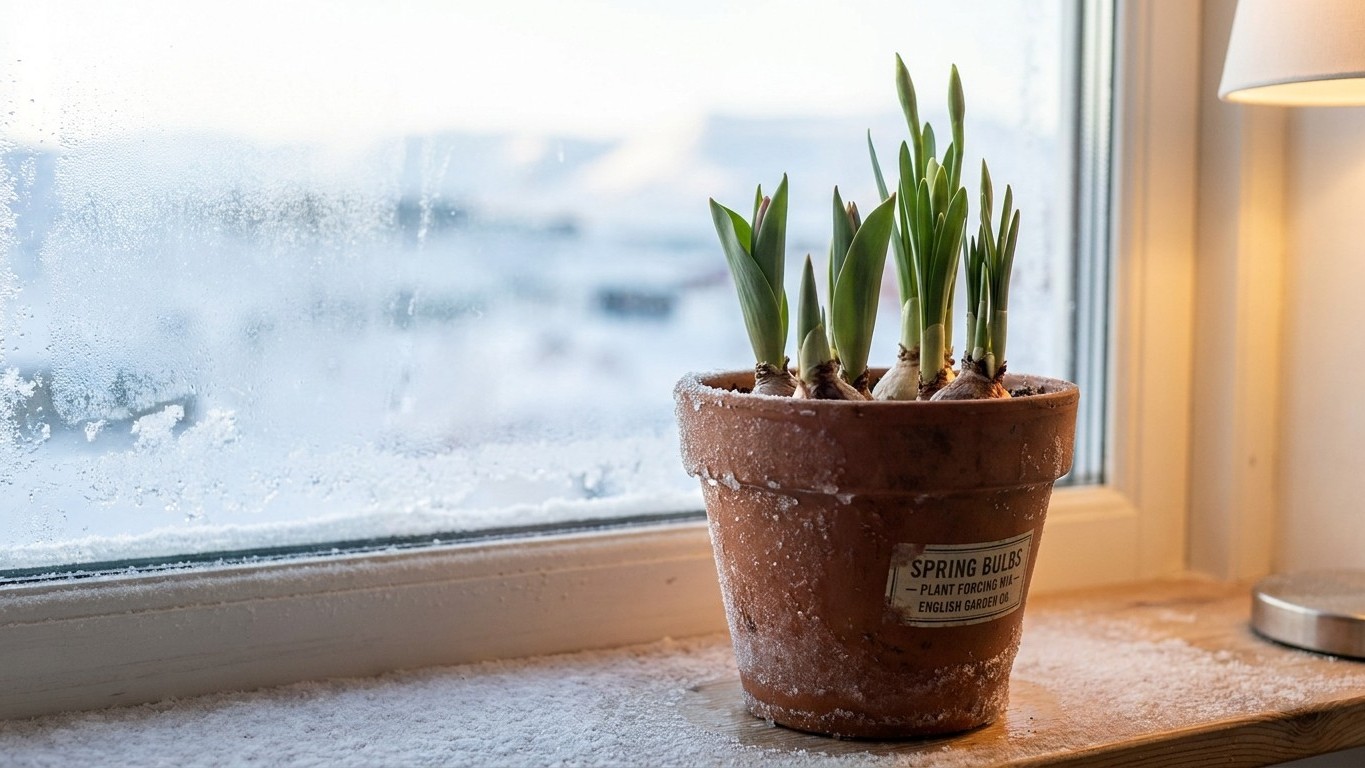

Forcing spring bulbs indoors works fine in Yukon, but the puzzle here isn’t finding enough cold. It’s controlling it. With a coldest-month minimum that averages -2.6°F, the territory has more chill than any bulb will ever need, and the real risk is a forcing pot freezing solid before it gets the chance to bloom on a windowsill.
Why this matters in Yukon

Start with the number: -2.6°F. That’s the mean daily minimum for the coldest month at the Whitehorse reference station, according to Environment and Climate Change Canada’s 1981-2010 Climate Normals. A spring bulb needs roughly twelve to fourteen weeks below 45°F to break its dormancy and set a flower bud. In much of the country, gardeners force bulbs indoors precisely because winter never gets that cold, or doesn’t stay cold long enough, so they build the chill themselves in a refrigerator drawer or a cool closet.
Yukon is the opposite problem entirely. There’s no shortage of cold here. An unheated garage, a porch, even a shed with no insulation will sail past the twelve-week chill requirement in a matter of weeks, not months. The gardener’s job isn’t to manufacture cold. It’s to keep that cold from going too far.
This is where the container issue takes over from the cold-supply issue. A bulb planted in garden soil is buffered by the ground around it. Even in a hard freeze, the earth a few inches down stays warmer than the air above it, which is why a bulb rated for a given hardiness zone can often survive planted in a bed where it would die in a pot. A pot has no such buffer. Soil in a container freezes through, roots and everything, at close to the same temperature as the surrounding air. In a territory where the reference city sits at Canadian zone 1b (Natural Resources Canada, Plant Hardiness Zone by Municipality, 1991-2020 normals), a forcing pot left in a truly unheated, uninsulated space during the coldest weeks can drop well past the point where the bulb tissue itself freezes and dies, not just goes dormant.
That’s the situation Yukon gardeners are actually in: cold that’s abundant to the point of being dangerous to a potted bulb, rather than scarce. The fix isn’t finding a colder spot. It’s finding a spot cold enough to satisfy the chill requirement but never so cold that the pot itself turns into a block of ice around the bulb.
How to do it here
The sequence below assumes you’re starting with dry, dormant bulbs bought or ordered in early fall, before the ground freezes.
- Choose bulbs suited to forcing. Small to mid-sized tulips, daffodils, crocus, and hyacinths are the standard choices. Paperwhites and amaryllis skip the cold step entirely and can be potted straight into growth, which is worth knowing before you set aside garage space you don’t need.
- Pot in a container with drainage holes. Use a standard bulb-planting depth for the species, and leave the pot somewhere at room temperature only long enough to water it in.
- Find your cold spot and check its actual range. A refrigerator drawer works reliably as long as it stays clear of ripening fruit, since the ethylene gas fruit gives off will damage the flower bud inside the bulb before it ever emerges. An unheated garage works too, but only if you know, not guess, that it stays above freezing through the coldest weeks. If it regularly drops well below 32°F, the pot needs insulation (a thick layer of mulch or bagged leaves packed around the container) or it needs to move to the refrigerator instead.
- Hold that temperature for twelve to fourteen weeks. Mark a start date and don’t shortcut it. This is the step most forcing failures trace back to.
- Watch for roots at the drainage holes and pale shoots at the soil surface. That’s the signal the chill requirement has been met.
- Move the pot to a bright, cool room, not a warm one, for the first week. Then shift it to normal indoor warmth and light. Bloom typically follows within two to four weeks of that final move.
Which bulbs are worth it
Not every bulb rewards the effort of a twelve-week chill and a windowsill wait. The ones that force well tend to share a short chill requirement and a compact stem; the ones that sulk tend to need longer cold, grow tall, or simply weren’t bred with a pot in mind. Since almost none of these bulbs are going back into Yukon garden soil afterward anyway (the chilling and forcing process uses up the bulb’s stored energy), there’s no long-term cost to picking a variety purely because it forces reliably. Treat it as a one-season purchase from the start.
Reliable forcers
- Crocus (short chill, short stem, blooms fast once warmed)
- Hyacinths (dependable bloom, strong scent indoors)
- Small early tulips like species and dwarf types (short stem holds up in a pot)
- Daffodils, particularly the smaller narcissus types
- Paperwhite narcissus and amaryllis (no chill period required at all)
Bulbs that sulk
- Tall, large-flowered tulip varieties (the stem often topples once the flower opens)
- Large-flowered daffodil types bred for garden beds, which want a longer chill than most gardeners give them
- Fritillaria (long, finicky chill requirement, uneven results indoors)
- Large alliums (too tall and top-heavy for a forcing pot)
What goes wrong, and when you can still fix it
Leaves but no flower
The bulb put out green growth but never produced a bud. This almost always means the cold period ran short, either cut off too soon or held at a temperature that dipped above 45°F for stretches without you knowing. There’s no fixing it for that bulb this season; the bud simply never formed. Note the actual dates and temperatures next time, and let the chill period run the full twelve to fourteen weeks before checking again.
A flower on a stem too short to see
This is a timing problem, not a cold problem. The pot was moved into warmth before the stem had a chance to elongate, so the flower opened low and half-hidden in the leaves. This season’s bloom is what it is. Next time, hold the pot in that intermediate bright, cool room a few extra days before moving it to full indoor warmth.
Rot in the pot
Soft, mushy bulb tissue and a sour smell mean water sat around the roots with nowhere to go, almost always a container without real drainage holes or a saucer that was never emptied. That bulb is done, and there’s no reviving it this season. For the next batch, use a pot with functioning drainage and check the saucer after every watering rather than assuming it drained on its own.