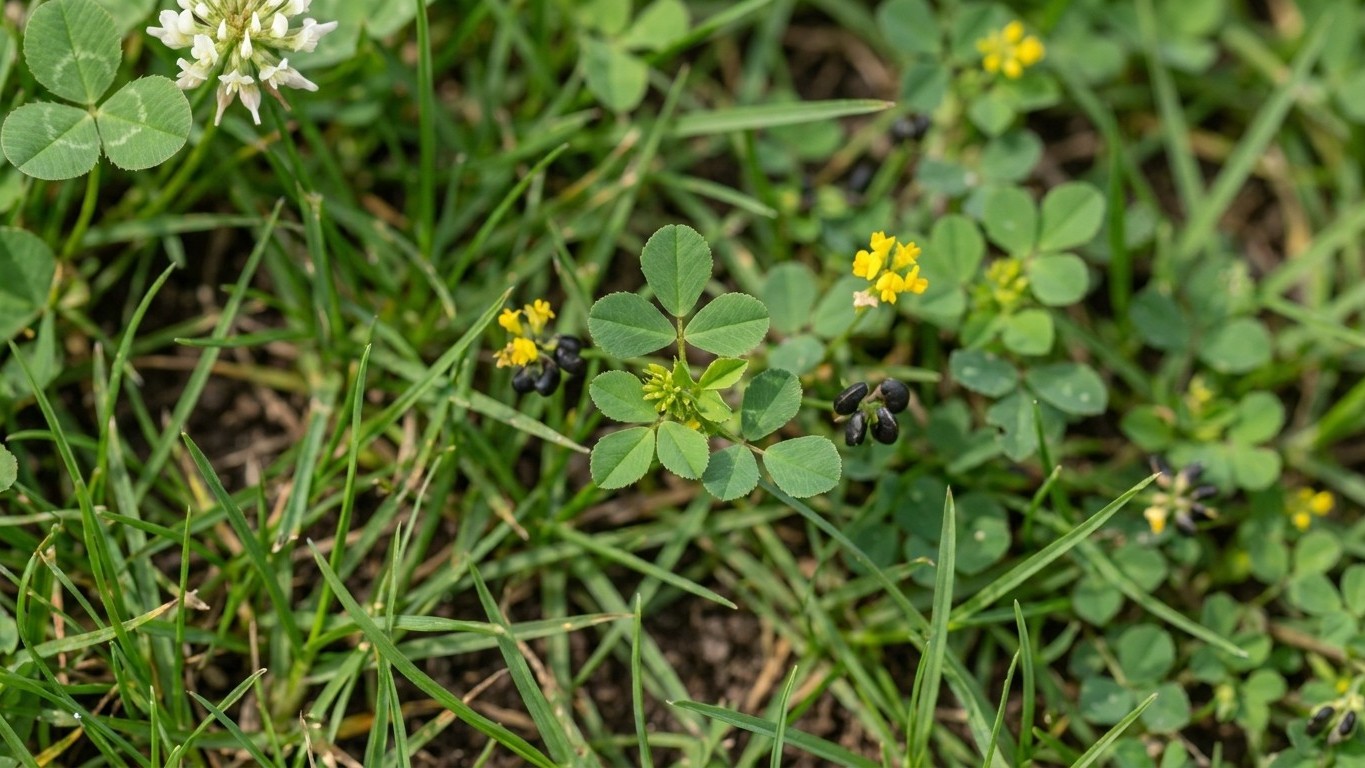

If you’re finding small yellow flower clusters and black, kidney-shaped seed pods scattered through a thin patch of lawn, you likely have black medic, not clover. The giveaway is in the middle leaflet: on black medic it sits on its own short stalk, set apart from the other two. On clover, all three leaflets meet at a single point. That one detail settles most identification questions before you even look at the flowers.
How to be sure that is what you have

Black medic (Medicago lupulina) is a low, sprawling annual (sometimes a short-lived perennial) in the pea family. Its stems trail along the ground rather than standing upright, often forming mats a foot or more across in bare or thin turf. Each leaf has three small oval leaflets, and that’s exactly why it gets mistaken for clover at a glance.
The two plants people confuse it with most are white clover and hop clover. White clover (Trifolium repens) has white to pale pink flower heads shaped like small pom-poms, and its leaflets usually carry a faint white chevron mark. Hop clover (Trifolium species) also produces yellow flowers, which is where the real mix-up happens. But on both clovers, all three leaflets attach to the stem at the same central point.
Black medic breaks that pattern. Look closely at the middle leaflet: it sits on a small stalk of its own, noticeably separated from the two side leaflets. That’s a trait it shares with its close relative, alfalfa, and it’s the single most reliable field mark when the flowers aren’t out yet.
What it looks like through the seasons
In spring and summer, black medic sends up tight clusters of tiny yellow flowers, each cluster no bigger than a pencil eraser. By mid to late summer those flowers give way to small black, coiled seed pods, tightly clustered and easy to miss until you’re on your knees looking. In fall, established plants often die back with the first hard frost if they germinated that spring, though patches that rooted the previous year can persist and green up early. It’s not a plant that hides well once you know the leaflet trick.
Why it is in your lawn
Black medic doesn’t show up by accident. It’s a legume, and legumes are built to thrive where nitrogen is scarce because they fix their own nitrogen from the air through bacteria living in nodules on their roots. A lawn thick with black medic is very often a lawn running low on nitrogen, whether from skipped feedings, sandy soil that leaches nutrients fast, or years of clippings bagged and hauled away instead of left to break down.
Low fertility is only part of the story. Black medic also favors compacted soil and thin, stressed turf, the same conditions that invite crabgrass, spurge, and plantain. Walkways worn bare by foot traffic, spots along driveways where soil gets driven over, and lawns mowed too short all open up bare ground that grass can’t fill fast enough. Black medic, with its ground-hugging habit, moves in and covers that space before turf grass gets the chance.
Drought-stressed lawns are another common entry point. Because black medic tolerates poor, dry soil far better than most turf grasses, it often persists in exactly the spots where cool-season grass like Kentucky bluegrass or tall fescue thins out during a hot, dry stretch. Treat the weed without addressing the compaction, the low nitrogen, or the mowing height, and it comes right back the following year in the same bare patches.
The window that decides everything
Timing separates a herbicide that works from one that’s wasted money. For a pre-emergent application, the target is the soil temperature at which black medic seeds germinate, not a date on the calendar. Clemson University’s Home & Garden Information Center (HGIC 1219) times crabgrass pre-emergent applications to forsythia bloom and dogwood bloom, because those flowering events line up with the soil warming that triggers seed germination in many lawn weeds. The same logic applies broadly to spring-germinating broadleaf weeds, black medic included: watch the plants, not the month.
That bloom trigger doesn’t arrive on the same week nationwide. Forsythia and dogwood bloom weeks apart moving from the Gulf Coast toward the upper Midwest and New England, so a pre-emergent window that’s already closed in Georgia may still be weeks away in Minnesota. Rather than guessing from a generic date, check your state extension office’s lawn calendar for the local bloom timing tied to your area.
Post-emergent control works on the opposite logic: it targets black medic that has already germinated and is actively growing, ideally while plants are young and before seed pods form. Once those black seed pods mature, the plant has already reseeded itself for next year, and any herbicide applied at that point is closing the barn door late. For established plants, spraying during active growth in spring or early summer, before flowering peaks, gives the best results with the least product.
Cool-season lawns (bluegrass, fescue, ryegrass) and warm-season lawns (bermudagrass, zoysia, St. Augustine) don’t share a calendar here either. Cool-season turf sees its main black medic flush in spring as soil warms; warm-season lawns, dormant longer into the year, often see it appear as they green up later. Match the treatment window to your grass type, not a fixed month.
Getting rid of it
Pulling by hand is the first move worth trying, especially for scattered plants rather than a solid mat. Black medic has a taproot, and young plants come up cleanly with the root intact if the soil is moist. Older, more established plants can leave root fragments behind, and unlike some perennial weeds, those fragments generally don’t resprout into new plants the way dandelion root pieces do. Pull, don’t just clip, and get as much root as the soil will give up.
For patches too widespread to manage by hand, post-emergent broadleaf herbicides are the chemical option, and here the active ingredient matters more than the brand name on the label. Products combining 2,4-D, dicamba, and mecoprop (MCPP), sold as three-way broadleaf herbicides, are the standard home-lawn choice for legume weeds like black medic. These actives target broadleaf plants and are labeled safe for most established cool-season and warm-season turf grasses when used at labeled rates, though newly seeded lawns and certain warm-season grasses like St. Augustine can be sensitive to dicamba specifically. Read the label for your grass species before spraying.
None of these products will touch grassy weeds like crabgrass, since they’re formulated for broadleaf plants only, so don’t expect a single application to clear a lawn with mixed weed problems. It’s also worth knowing that dicamba and 2,4-D use is restricted in some states, with rules varying around application timing, buffer zones, or licensing depending on where you live. Check your state department of agriculture’s current herbicide regulations before buying, since availability and restrictions change lawn to lawn depending on local ordinances.
Whatever the method, treating the weed alone rarely finishes the job. A bare or thin spot that grew black medic once will grow it again unless something else fills that ground.
Keeping it out
Thick, healthy turf is the only control that holds up year after year, because it simply leaves no bare soil for black medic seed to reach. Everything else, pulling, spraying, is maintenance on a symptom.
Mowing height does more work here than most homeowners expect. Cutting cool-season grass at 3 to 3.5 inches, rather than scalping it short, shades the soil surface and keeps weed seeds from getting the light and warmth they need to germinate. Warm-season lawns have their own optimal ranges, generally shorter, but the same principle holds: don’t cut so low that soil is exposed.
Since black medic thrives specifically where nitrogen runs low, a proper feeding schedule addresses the root cause rather than just the symptom. Cool-season lawns generally benefit from fall feeding when grass is building root reserves; warm-season lawns respond best to feeding during their active summer growth period. Skipping fertility for a season or two is often exactly what opens the door for a nitrogen-fixing weed to move in.
Overseeding thin spots each fall, particularly for cool-season lawns, closes gaps before spring weed seed gets a chance to germinate there. Combined with correcting soil compaction, through core aeration on heavily trafficked lawns, thick turf becomes self-defending. A lawn dense enough that soil is never visible between blades is a lawn black medic mostly can’t establish in to begin with.
Common questions
Is black medic bad for my lawn?
Not in the sense of damaging turf directly. It’s more a sign of underlying soil fertility or compaction issues than a threat on its own, and it competes with grass for space rather than harming it chemically.
Can I just mow black medic and be done with it?
Mowing removes the flowers and slows seed production, but because the plant grows low and spreading, mower blades often miss the crown entirely. It regrows quickly after cutting.
Does black medic actually add nitrogen to my soil?
Yes, as a legume it fixes atmospheric nitrogen through root nodules, but the amount is modest and doesn’t offset the poor fertility conditions that let it establish in the first place.
Will black medic come back if I don’t reseed the bare spot?
Very likely, especially since seed pods dropped by mature plants can persist in soil and germinate again the following season once conditions turn favorable.