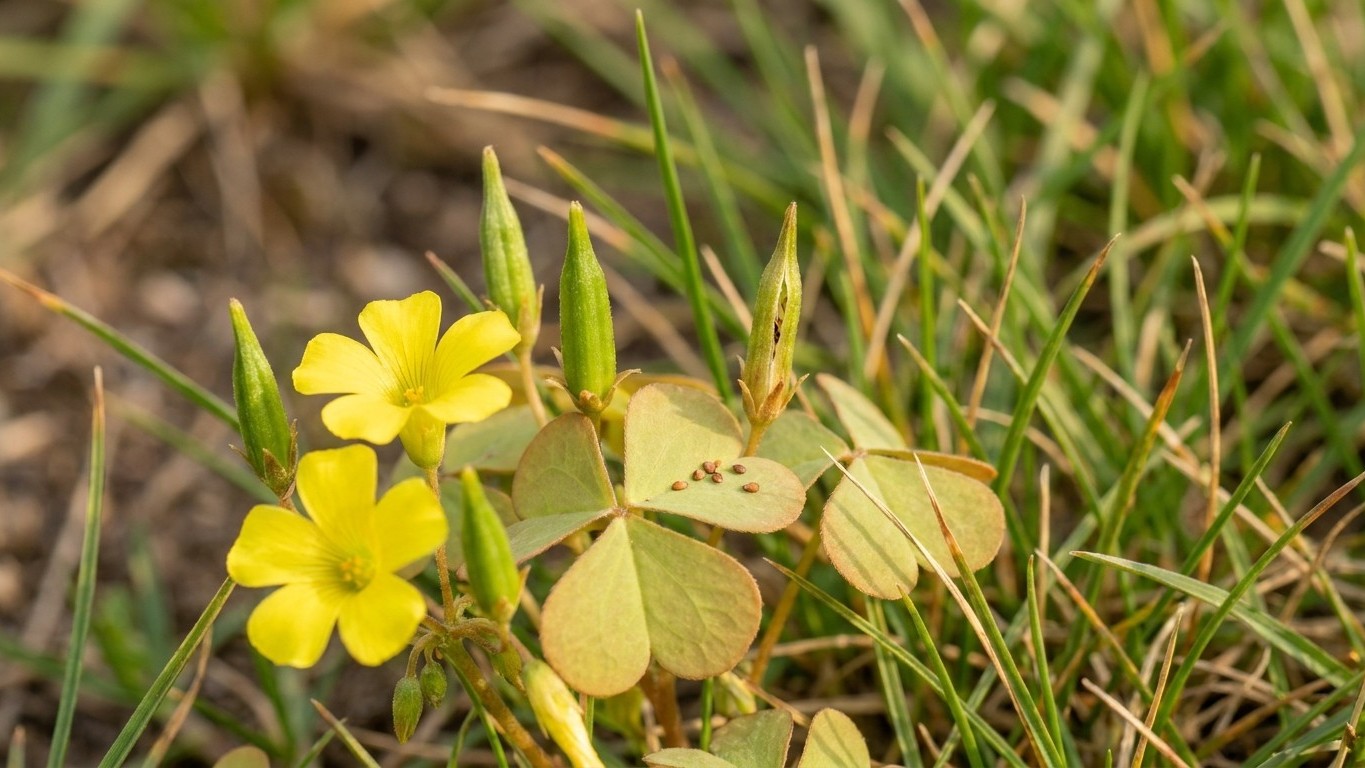

Those clover-look-alike leaves with the yellow flowers and the seed pods that snap open at a touch are almost certainly yellow woodsorrel (Oxalis stricta), a low-growing broadleaf weed that thrives in thin, stressed turf. It spreads by both seed and creeping stems, which is why one patch this spring can look like ten by August.
How to be sure that is what you have

Look at the leaflet tip before anything else. Yellow woodsorrel has three heart-shaped leaflets, each notched at the outer edge, folded together like a shamrock that’s been left in the rain too long. The color runs pale to medium green, sometimes with a purplish or bronze cast, especially in full sun or cooler weather. The leaves fold shut at night and during the hottest part of the day, a trait that trips up a lot of people expecting clover to behave the same way (it doesn’t).
Flowers are small, five-petaled, and bright yellow, blooming almost continuously from late spring through fall. Right behind each flower, a slender, upright seed capsule forms, shaped a bit like a tiny okra pod standing on end. Brush that pod when it’s ripe and it explodes, flinging seeds several feet in every direction. This is a real mechanical trait called ballochory, and it’s the single fastest way to confirm the plant, since almost nothing else in a home lawn does this.
Two lookalikes cause most of the confusion. White clover (Trifolium repens) has rounded, sometimes pale-chevroned leaflets and round white or pinkish flower heads, and its seed pods stay tucked inside the flower rather than launching anything. Black medic (Medicago lupulina) also carries small yellow flowers, which is where people get stuck, but its leaflets are oval with a tiny raised point at the tip and finely toothed edges, and its seed pods are small, coiled, and kidney-shaped rather than upright capsules. Neither one explodes. If you’re staring at heart-shaped leaflets and a pod that pops when nudged, you’re looking at yellow woodsorrel.
Why it is in your lawn
Yellow woodsorrel doesn’t move into healthy, dense turf. It moves into the gaps. Compacted soil is the most common invitation, especially along paths, near driveways, or anywhere foot traffic has packed the ground tight enough to choke out grass roots. Compaction also holds surface moisture unevenly, and this weed tolerates dry, poor soil far better than most lawn grasses do.
Mowing too short is the second big driver. Scalped turf lets sunlight hit bare soil, and that light exposure is often the trigger that wakes up dormant weed seed already sitting in the ground. A lawn mowed at the right height for its grass type shades the soil surface enough to keep a lot of that seed from ever germinating in the first place.
Thin turf from drought stress, disease, or heavy shade creates the same opening. So does poor drainage, where standing water or soggy low spots weaken grass roots while barely slowing this weed down at all. None of this means the lawn is diseased or dying. It usually means one habit, mowing height, watering schedule, or soil compaction, needs adjusting before any herbicide will make a lasting difference. Pull the weed without fixing the underlying condition and the same bare patch will just refill with something else next season.
The window that decides everything
Timing matters more than the product you choose. A pre-emergent herbicide works by stopping germinating seed from establishing, so it has to go down before the weed seed sprouts, not after. Applying it once yellow woodsorrel is already up and flowering is wasted effort and wasted money.
Clemson Cooperative Extension’s Home & Garden Information Center (HGIC 1219) times pre-emergent applications to a visual cue rather than a fixed date: when forsythia and dogwood are blooming, soil temperatures have typically warmed enough that weed seed germination is beginning. That bloom signal is a soil-temperature proxy, and it’s a lot more reliable than a calendar date because spring arrives on its own schedule every year.
Here’s the part that trips a lot of homeowners up: that bloom window doesn’t happen on the same week nationwide. Forsythia flowers weeks earlier in the Gulf Coast states than it does in the Upper Midwest or New England, and warm-season lawns in the South wake up on a completely different clock than cool-season lawns further north. Applying a pre-emergent by a date you saw online, rather than by what’s actually blooming and greening up in your own yard, is one of the most common reasons the product underperforms. Check your specific region’s spring green-up and bloom calendar before you buy anything, since the trigger for your county could land a full month apart from a neighboring state’s.
If the weed is already growing and flowering, you’ve moved past the pre-emergent window entirely, and a post-emergent broadleaf herbicide, or hand-pulling, becomes the realistic option instead.
Getting rid of it
Pulling it by hand
Mechanical removal works, with a catch. Yellow woodsorrel has a taproot, and if you snap the top off without getting the root, it regrows from what’s left underground. Pull after rain or watering, when the soil is soft, and work slowly enough to draw the whole root out intact. Handle any plant that already has seed pods carefully. A jostled pod will fire seed into the surrounding soil the moment you touch it, which can undo the benefit of pulling in the first place. Bagging plants that have gone to seed, rather than tossing them on the mower path or compost pile, keeps the problem from spreading.
Chemical control, and its limits
Yellow woodsorrel has a reputation among turf managers for shrugging off straight 2,4-D, which is one of the most common broadleaf lawn herbicides on the shelf. Products that combine 2,4-D with triclopyr tend to perform better against it, since triclopyr has stronger activity on this particular weed. These are selective broadleaf herbicides, meaning they’re formulated to kill broadleaf plants like oxalis while leaving turfgrass largely unharmed, but “largely” isn’t “entirely.” Newly seeded lawns, certain fine fescues, and some warm-season grasses can be sensitive to these actives, so reading the label for grass-type restrictions before spraying matters more than usual with this weed.
Non-selective herbicides like glyphosate will kill yellow woodsorrel, but they’ll also kill the turf around it, leaving a bare spot that’s an even easier target for weed seed to recolonize. Several broadleaf herbicide actives, including some dicamba and 2,4-D formulations, carry state-specific use restrictions or licensing requirements, particularly near water sources or in states with stricter pesticide rules, so checking your state’s cooperative extension guidance before purchasing is worth the ten minutes it takes.
Keeping it out
Thick, dense turf is the only control that actually lasts, because it’s the only thing that keeps sunlight off bare soil and out of the germination window this weed depends on. Everything else is maintenance against a symptom that will keep coming back.
Mowing height sets the tone. Cool-season lawns (Kentucky bluegrass, tall fescue, perennial ryegrass) generally do best kept around 3 to 3.5 inches, which shades the soil surface far more effectively than a lawn scalped down to 2 inches. Warm-season lawns (Bermuda, zoysia, St. Augustine) run shorter as a group, but each species has its own recommended range, and cutting below it thins the canopy the same way overmowing does up north.
Feeding timing follows the grass, not the calendar on the wall. Cool-season lawns build their thickest turf from a fall feeding program, when root and rhizome growth peaks. Warm-season lawns respond better to feeding through late spring and summer, matching their active growth period. Overseeding thin or bare patches in the fall for cool-season lawns, or plugging and sprigging warm-season varieties during their growing season, closes the gaps before weed seed gets the chance to fill them instead. A lawn that’s dense enough to choke sunlight off the soil surface rarely needs a herbicide conversation at all.
Common questions
Is yellow woodsorrel harmful to pets or people?
It contains oxalic acid, the same compound found in spinach and rhubarb leaves, which can cause mild stomach upset if eaten in large quantities. Small amounts of casual contact or nibbling generally aren’t a serious concern, but it’s not something to encourage pets to graze on regularly.
Will mowing over the seed pods spread the weed?
Yes. Running a mower through mature plants can trigger the pods to burst and scatter seed across the lawn, which is one more reason to pull or treat plants before they set seed rather than after.
Does yellow woodsorrel die over winter or come back from the same roots?
It behaves as both an annual and a short-lived perennial depending on climate and growing conditions, and it also reseeds itself heavily, so a patch can persist year after year even where the individual plants don’t survive a hard winter.
Can I just ignore it if it’s only a small patch?
A small patch rarely stays small. Because each pod can fling seed several feet and the plant also spreads by creeping stems, a handful of plants left untreated in spring often becomes a much larger patch by late summer.
Related guides
- Prostrate Knotweed: The Weed That Maps Your Compacted Soil
- Speedwell: The Low Mat With Heart-Shaped Seed Pods
- Black Medic: Clover’s Look-Alike, and What It Says About Your Nitrogen