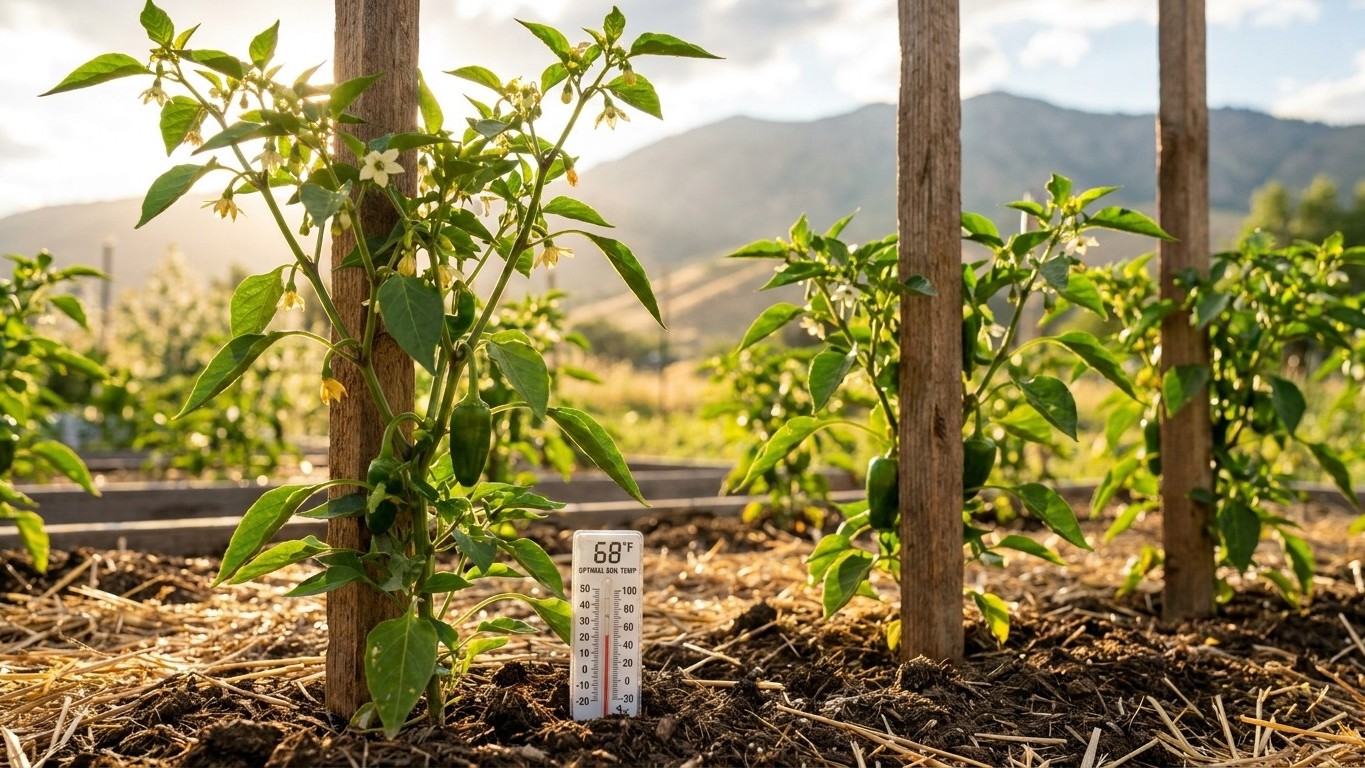

Yukon gardeners get a rare gift on the hot end of the pepper equation: this territory logs essentially zero days a year at 90 F or above, so heat-driven blossom drop almost never happens here. The catch sits on the other side of the thermometer. Peppers stall and drop flowers when nights fall below 55 F. Pair that with a frost season that only lifts in early June, and picking the right start date matters more than picking a fast-ripening variety.
The short answer

The hot end: not a problem here
Whitehorse’s climate normals record 0.0 days a year at or above 90 F, according to Environment and Climate Change Canada’s 1981-2010 averages for the region. For pepper growers, that number is almost startling in how little it demands. Utah State University Extension notes that pepper fruit set fails whenever daytime highs climb past 90 F, because the heat causes flowers to abort before they ever set fruit. A territory that logs zero such days, on average, removes that failure mode almost entirely. You will not lose blossoms to a heat wave here the way growers do in warmer climates further south.
The cold end: the real unknown
That is the easy half of the equation. The same USU Extension guidance flags the opposite failure just as firmly: nights below 55 F stall fruit set the same way extreme heat does, only through cold instead of heat. Pepper flowers need warm nights to hold and develop, and a cool snap, even a brief one, can knock blossoms off the plant before pollination finishes.
This is where the record for Yukon runs out. This site tracks days at or above 90 F for each territory and state, because that figure is measured and published. It does not track summer night minima, and no reliable published figure lets us tell you how many nights in a Yukon summer drop under 55 F. Latitude alone cannot answer that question either: two sites at the same latitude can have very different overnight lows depending on elevation, valley drainage, and distance from open water, so guessing from a map is not a substitute for watching your own thermometer.
Practically, that means the real work of growing peppers in Yukon happens on the cool end, not the hot one. Track overnight lows at your own garden through the growing season, and if a stretch of nights keeps reading under 55 F, take that as your cue to add a cold frame, a row cover, or a south-facing wall that holds heat, rather than assuming the calendar alone will protect the crop. The zero on the heat side buys you a wide margin. The unknown on the cold side is the one that needs attention, night after night, right through the season.
When to start seed here
Backdating a pepper sowing date starts with the transplant date, and the transplant date depends on two separate thresholds clearing at the same time: the last frost, and a soil temperature of 60 F. Utah State University Extension is explicit that transplanting should wait for both, not for the calendar alone.
Working out your own transplant window
- Find your frost baseline. Environment and Climate Change Canada’s Whitehorse A station puts the mean last spring frost at June 5. That word “mean” matters: in one year out of every two, frost arrives after that date, so treat June 5 as the middle of a window rather than a safe line to plant against.
- Adjust for where you actually garden. A single station cannot speak for an entire territory. Northern districts and higher ground routinely run weeks behind Whitehorse’s own readings, so a garden up a valley or further north should push its working frost date later than June 5, not earlier.
- Wait on the soil, not just the air. Soil temperature typically lags behind air temperature, sometimes by a week or more, especially after a slow spring. Even once frost risk has passed, hold off transplanting peppers until a soil probe confirms a reading at or above 60 F.
- Count back 8 to 10 weeks for the indoor start date. Once you have a realistic, locally adjusted transplant target, count back a full 8 weeks for the earliest reasonable seed-starting date indoors, or 10 weeks if you want larger, more established transplants ready to go.
- Rerun the math every season. Because the frost mean is exactly that, a mean, and not a promise, recheck your own conditions each spring rather than reusing last year’s dates automatically.
Worked one way: if a local transplant target lands in mid-June rather than the territory-wide June 5 mean (a reasonable adjustment once soil lag and local frost risk are factored in), an 8-week count back lands the indoor sowing date in mid-April, and a 10-week count back moves it into early April. Redo that subtraction with your own transplant date, since your county’s actual frost and soil timing may differ from the station reading.
What goes wrong here
Blossom drop, two directions
- Blossom drop during a rare hot spell. Even in a territory that averages 0.0 days at or above 90 F, a warm microclimate (a greenhouse, a south-facing wall, a plastic tunnel with poor ventilation) can push local temperatures past that mark on an otherwise mild day. USU Extension links exactly that heat level to fruit set failure. The remedy is ventilation: crack a greenhouse or tunnel, and avoid placing pepper beds directly against reflective, sun-baked surfaces without airflow.
- Blossom drop on a cool night. This is the more likely failure in Yukon, since USU Extension ties fruit set failure to nights below 55 F, and this territory’s short, cool season makes those nights common outside the warmest weeks. Watch your own overnight lows rather than assuming the season has warmed enough, and when a cool stretch is forecast, cover plants with a row cover, cloche, or portable cold frame overnight to hold in ground heat.
Problems once fruit has set
- Sunscald on exposed fruit. Long summer daylight hours here mean peppers can sit in direct light for many more hours a day than gardeners further south are used to, and fruit that loses its leaf cover, from wind, hail, or over-eager pruning, can scald on the exposed side. Keep the plant’s natural canopy intact rather than stripping leaves for “more sun,” and stake or cage plants so wind does not tear foliage away from the fruit.
- Blossom-end rot from uneven watering. Short, intense growing seasons often bring irregular watering, heavy rain one week and dry soil the next, which disrupts calcium uptake and shows up as a dark, sunken patch on the fruit’s blossom end. Even soil moisture, held steady with a layer of mulch, does more to prevent this than any additive applied after the spot appears.
Common questions
Do Yukon summers ever get hot enough to stop pepper fruit set?
Not on average. Whitehorse’s climate normals show 0.0 days a year at or above 90 F, so the heat-driven failure that Utah State University Extension describes almost never occurs at the regional level. A hot microclimate, like an unventilated tunnel, can still create local conditions that reach that threshold.
What’s the biggest single risk to pepper fruit set in Yukon gardens?
Cool nights, not heat. USU Extension ties fruit set failure to nights below 55 F, and this site does not carry summer night minima for the territory, so that risk has to be tracked with your own thermometer rather than assumed from published data.
Can I rely on the June 5 frost date to plan transplanting?
Treat it as a midpoint, not a guarantee. Environment and Climate Change Canada’s Whitehorse A station reports June 5 as the mean last spring frost, which means frost arrives later than that date in about half of all years, and northern or higher-elevation gardens typically run behind the station reading.
How many weeks before transplant should I start pepper seeds indoors?
USU Extension recommends 8 to 10 weeks indoors before transplanting. Count that span back from your own locally adjusted transplant date, once both frost risk has passed and soil has reached 60 F, rather than from the territory-wide average alone.