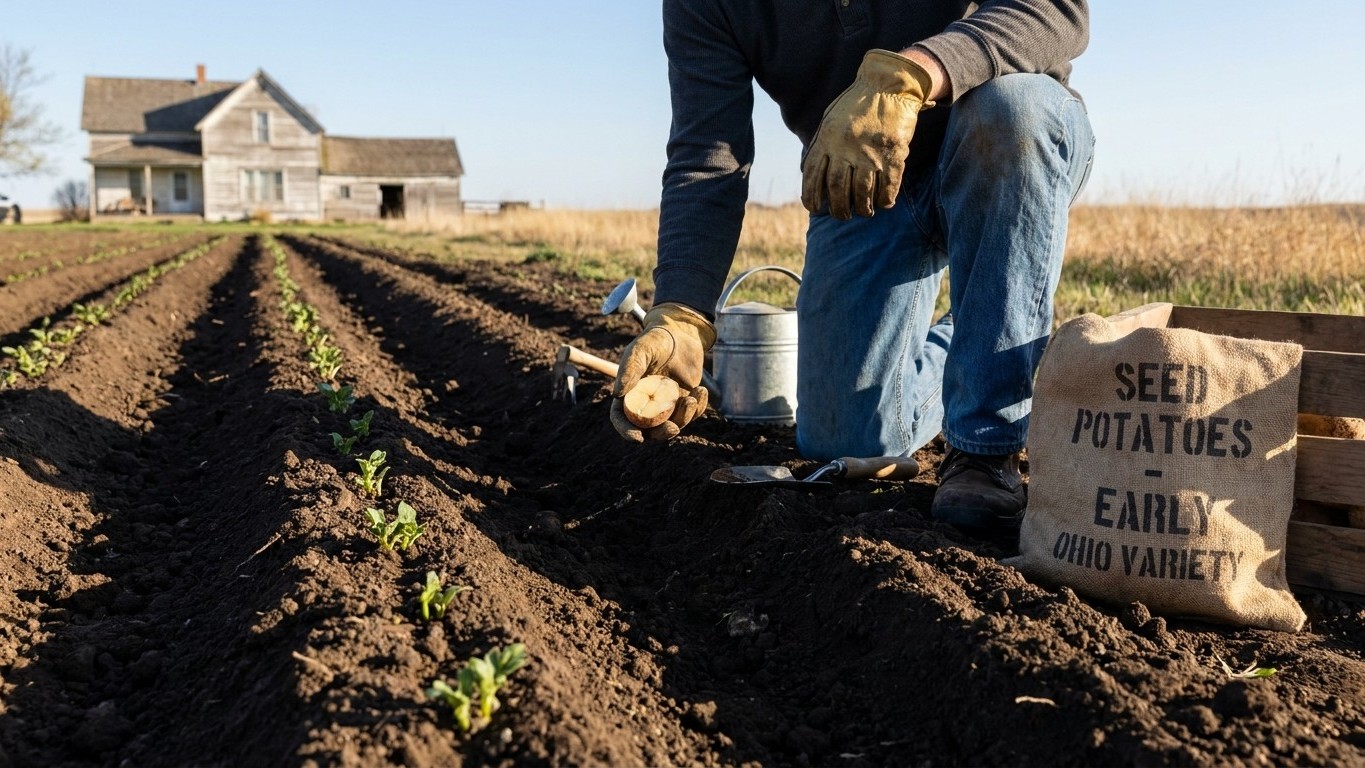

In Nebraska, the calendar matters more than the thermometer. The reference city, Omaha, averages 28.1 days a year at 90 F or hotter, and the last spring frost typically falls between April 12 and April 23. That combination points to one plan: plant early, get tubers sizing before the heat load builds, and treat this as a spring-into-early-summer crop rather than a long summer grow.
The short answer

Start with the number that sets the ceiling: Omaha averages 28.1 days a year reaching 90 F or higher, according to Utah State University Extension’s fact sheet on potatoes in the garden, which uses that threshold to mark where tuber set and fill are inhibited. That’s not an extreme desert count, but it’s enough days, concentrated in July and into August, to matter for a crop that stops sizing once soil temperatures cross that line.
The last spring frost window at the reference station runs April 12 to April 23. That gives Nebraska gardeners a workable early spring, but the tradeoff is a summer that can turn hostile to potatoes before the plants would otherwise be ready to bulk up tubers. The practical read: this is not a state where you can plant in May and coast through August. The heat days arrive right when a late-planted crop would need cool soil to keep filling.
So the season here favors an early planting, an early-to-mid harvest, and getting the crop out of the ground before the hottest stretch of summer sets in. A spring crop, dug ahead of the worst heat, is the more reliable pattern than trying to nurse plants through a full, hot summer. Knowing the right techniques for Harvesting and Storing Potatoes in Nebraska ensures the crop comes in clean before that heat sets in. Choosing among Potato Varieties That Suit Nebraska can help make the most of this shortened window.
Where varieties fit
Neither Utah State University Extension nor the University of Maine Cooperative Extension publishes a days-to-maturity number for individual varieties, and neither uses the words “waxy” or “floury.” What they do publish is season class, early, mid-season, or late, and end use, whether a variety is suited to baking or boiling. In a climate with nearly a month of 90-degree days concentrated in mid-summer, early-season types have the advantage: they’re closer to finished by the time that heat load peaks, which lowers the odds of tuber set stalling out mid-crop.
When to plant here
The planting date isn’t chosen by looking at a calendar page. It’s built backward from two things: the last frost window and the point where soil temperature hits 50 F. For a full breakdown of When to Plant Potatoes in Nebraska, here’s how that arithmetic works for Nebraska’s reference window.
- Start from the last frost window. At the Omaha reference station, that’s April 12 to April 23. That’s the date range you’re counting backward from, not the planting date itself.
- Subtract 14 to 21 days. Potatoes go in the ground once soil reaches 50 F, which typically happens 14 to 21 days before the last frost date, not after it. Counting back from April 12 by 21 days lands near March 22. Counting back from April 23 by 14 days lands near April 9.
- Treat that as your window, not a single date. That puts the likely Nebraska planting stretch somewhere between late March and early April, depending on how the current season’s soil warms.
- Check soil temperature directly before trusting the calendar. A soil thermometer pushed 4 inches down, checked over a few consecutive mornings, tells you more than any date range does. If it reads 50 F or above, that’s the signal, whether or not it lines up with the window above.
- Redo the math for your own ground. If your county’s last frost date runs later than Omaha’s, as it often does outside the city, shift the whole window later by the same amount.
What the heat does to the crop
The mechanism is simple and it’s the whole story: once soil temperatures climb above 90 F, tuber set and fill are inhibited. That’s published by both Utah State University Extension and the University of Maine Cooperative Extension’s Bulletin #2077. The plant doesn’t die outright. It just stops doing the one thing that matters, converting energy into bigger tubers underground.
Nebraska’s 28.1 average days a year at 90 F or above are not spread evenly across the growing season. They cluster in July and August, which is exactly when a late-planted or late-maturing crop would still be trying to size up. A gardener who plants in May, expecting a long summer grow, runs the plants straight into that heat stretch at the worst possible growth stage.
This is where watering more doesn’t rescue the crop. Extra irrigation cools the plant’s immediate environment a little and keeps foliage from wilting, but it does not lower soil temperature below the 90 F threshold once ambient heat has driven it there. The tubers are underground, insulated by soil and mulch, but a run of 90-degree-plus days still pushes root-zone temperatures up over time. Watering addresses drought stress; it does not address the heat-driven shutdown of tuber fill.
Given Nebraska’s heat count, the safer target is a spring crop: plant in that late March to early April window, let the plants establish and bulk tubers during the cooler weeks of late spring and early summer, and dig before the bulk of those 28-plus 90-degree days land. Trying to run a full-season crop that’s still filling tubers in late July asks the plant to do its most heat-sensitive work during the least forgiving stretch of the year.
What goes wrong here
- Starting with uncertified seed. Seed potatoes bought without certification carry a real risk of viral disease that can quietly cut yield all season without an obvious cause. Buying certified seed potatoes is the single easiest way to remove that risk before the season even starts.
- Planting into cold, wet soil. Getting eager in early March and planting before soil hits 50 F invites seed piece rot rather than an earlier harvest. The 14-to-21-day rule exists because soil that’s still cold and waterlogged does more harm than a slightly later planting date ever would.
- Skipping the hilling. Tubers that develop too close to the surface, without soil mounded up around the stems, turn green from sun exposure. Green potato skin signals the buildup of solanine, which makes those tubers unsafe to eat. Hilling twice during the season, as plants grow, keeps tubers covered and prevents this.
- Digging too early out of impatience. Pulling plants the moment they look done, rather than letting the foliage die back naturally, cuts the harvest short before tubers have finished sizing and thickened their skins for storage. In a climate where the safe window closes fast once heat arrives, it’s tempting to rush, but an early dig trades yield and storage life for nothing gained.
Checking this against your own county
Every figure above is anchored to one reference station, Omaha, and a state as wide as Nebraska doesn’t warm up on one schedule. Elevation changes, and the gap between the state’s northern and southern counties, can shift both the last frost date and the arrival of 90-degree days by two weeks or more in either direction. A garden in the Panhandle or at higher elevation will likely see a later last frost and a shorter run of extreme heat days than the Omaha numbers suggest.
Treat the dates and figures here as a starting framework, not a fixed instruction for your specific plot. For soil temperature readings, frost records, and planting guidance calibrated to your own county, Nebraska Extension is the resource built for that, available at extension.unl.edu.
Common questions
Can I still plant potatoes in Nebraska if I missed the late-March window?
Yes, but the margin for reaching a full harvest before the heaviest heat shrinks. A later planting still works, especially for early-season varieties, but the crop is more exposed to the summer’s 90-degree stretch during tuber fill.
Does mulching lower soil temperature enough to avoid the heat problem?
Heavy mulch can moderate soil temperature swings and help retain moisture, but it does not reliably keep root-zone temperature under 90 F during a sustained heat run. It’s a helpful supporting practice, not a substitute for timing the crop around the heat.
Is a fall potato crop realistic in Nebraska?
The facts used for this guide don’t cover a fall planting timeline for this state, so no days-to-maturity or fall planting window is given here. A gardener considering one should check directly with Nebraska Extension for local guidance.
Why does certified seed matter if my plants look healthy?
Viral infection in seed potatoes often shows no obvious symptoms early on while still reducing yield and vigor over the season. Certification is the only reliable way to know the seed stock has been checked and cleared, which is why it’s treated as a non-negotiable starting point rather than an optional upgrade.