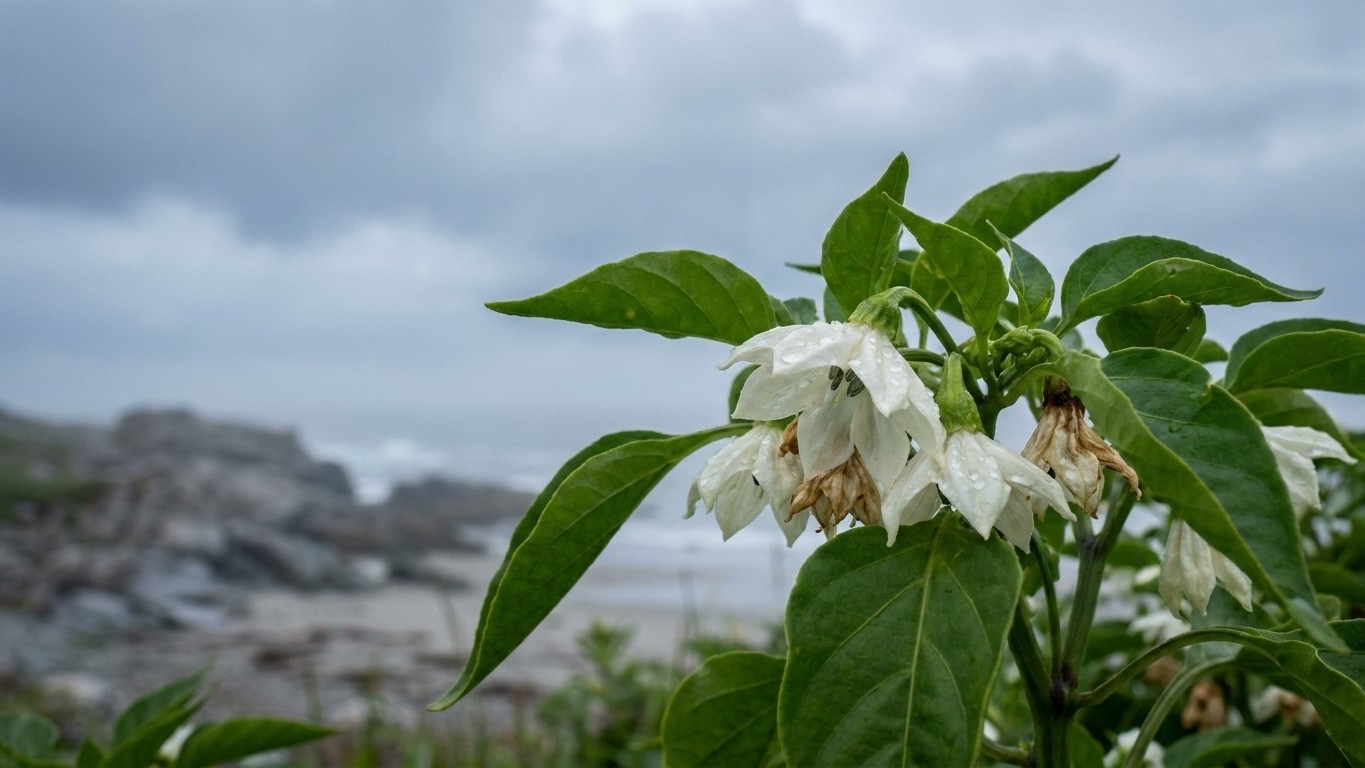

Halifax averages zero days a year at or above 90°F, so heat-driven blossom drop is rare here. The bigger risk sits at the other end of the scale: pepper flowers also abort when nights drop below 55°F, and this site does not track summer night lows for Nova Scotia. That means the coolest-end risk is one you have to watch in your own yard, not one you can read off a chart.
The short answer

Zero days above 90°F, measured at the Halifax reference station over the 1981-2010 normals period, tells you almost everything about the hot-end risk for peppers in Nova Scotia: there basically isn’t one. Pepper flowers abort when daytime highs push past 90°F for any stretch, because the plant stops setting fruit to protect itself from heat stress. With an average of zero such days a year, that failure mode is not what typically limits pepper crops along the Nova Scotia coast or in the Annapolis Valley.
The other threshold is just as real and works in the opposite direction. According to Utah State University Extension, pepper fruit set also fails when nighttime temperatures drop below 55°F. In a maritime province with cool, damp air rolling in off the Atlantic on a regular basis, that is the threshold worth losing sleep over, not the 90°F mark. A pepper plant can sit through a chilly June night with its leaves looking fine and still drop every flower it was carrying, because the failure happens at the blossom, not in the foliage.
Here is the catch: this site carries the days-above-90°F count for Nova Scotia, but it does not carry summer night minima for the province. That is not an oversight to work around by guessing. Latitude does not tell you what a low-lying valley does at 2 a.m. in July, and the coldest month of the year tells you nothing reliable about a single summer night. Coastal fog belts, inland valleys, and hillside gardens a few miles apart can post very different overnight lows on the same date, and none of that shows up in a provincial average.
The practical move is to track your own nights through the growing season, using a simple min-max thermometer set at plant height in the bed where the peppers actually grow. If you see a run of nights dipping under 55°F while plants are flowering, expect thin fruit set for that stretch and don’t read it as a disease or a nutrient problem, a distinction covered in more depth in Why Peppers Fail to Set Fruit in Nova Scotia. Once nights climb back above that line, flowering typically resumes on its own. That single piece of data, gathered from your own garden over one season, will tell you more about your pepper prospects than any provincial normal ever could, and it pairs well with getting your timing right by checking When to Start Pepper Seed in Nova Scotia, along with choosing Pepper Varieties That Ripen in a Nova Scotia Season from the start.
When to start seed here
Working out a sowing date for peppers in Nova Scotia means counting backward from a transplant date that itself depends on two separate conditions being met, not one. Utah State University Extension recommends starting pepper seed indoors 8 to 10 weeks before transplanting, and moving transplants outside only after the last frost has passed and the soil has warmed to 60°F. Here is how that arithmetic plays out using the local numbers available.
- Start with the mean last spring frost date. At Halifax Stanfield Int’l A, the Canadian Climate Normals for 1981-2010 put the mean last spring frost at May 7. That is a mean, not a guarantee: in roughly half of all years, frost arrives after that date, sometimes well after it.
- Build in a margin past that mean date. Because frost falls later than May 7 in about one year out of two, treat that date as the midpoint of a risk window rather than a safe cutoff. Gardeners who transplant right on the mean date are, by definition, gambling on the better half of the odds.
- Check soil temperature separately from air temperature. The 60°F soil threshold is a distinct condition from frost clearing, and in a cool maritime climate, soil often lags behind air temperature by a meaningful stretch. This site does not carry a specific soil-warming date for Nova Scotia, so the only reliable way to know is to push a soil thermometer a few inches into the bed yourself before setting plants out.
- Pick the later of the two dates as your real transplant target. Whichever condition, frost-safety or soil warmth, lands later on your calendar becomes the date that actually governs when peppers go outside. In much of Nova Scotia that tends to land in late May to early June rather than right at the mean frost date.
- Count back 8 to 10 weeks from that transplant target to find your sowing date. If your best estimate for transplanting is the first week of June, counting back 8 weeks lands seed-starting around the second week of April; counting back the full 10 weeks pushes it to around the last week of March.
Run that same sequence with your own county’s frost record and your own soil thermometer reading, and the sowing date will shift earlier or later accordingly. The formula stays fixed; only the local inputs change.
What goes wrong here
- Blossom drop from a cool night. Flowers open, look healthy, then fall off without setting fruit after a night below 55°F. There is no cure for a night that has already happened; the remedy is prevention through row cover or a cold frame on nights when your own thermometer shows a drop coming, plus patience once temperatures recover, since flowering usually restarts on its own.
- Blossom drop from a hot spell. Less common given Nova Scotia’s near-zero count of days above 90°F, but a short heat spike can still trigger the same failure at the flower. The remedy is light afternoon shade cloth during any unusual heat run and keeping soil evenly moist so the plant isn’t fighting drought stress on top of heat.
- Sunscald on exposed fruit. Peppers that lose leaf cover to wind, pruning, or disease can develop pale, papery patches on the side facing direct sun, even in a climate with limited extreme heat. The remedy is leaving foliage in place to shade developing fruit rather than pruning leaves back hard, and using shade cloth on plants that have already thinned out.
- Blossom-end rot. A sunken, leathery patch on the fruit’s blossom end, usually tied to uneven watering that disrupts calcium uptake rather than a soil calcium shortage on its own. The remedy is consistent watering on a schedule, mulch to hold soil moisture steady, and avoiding the swing between bone-dry and soaked that stresses the plant’s ability to move calcium into developing fruit.
Checking this against your own county
Provincial normals and a single reference station tell you the general pattern, not the specifics of your particular garden. A valley bottom, a hillside, or a lot close to the Bay of Fundy can each run a very different frost calendar and a different set of summer nights than the Halifax Stanfield station used for the figures above.
For county-level guidance tailored to Nova Scotia growing conditions, the province’s own agriculture department is the resource to check: Nova Scotia Agriculture. Pair that with your own min-max thermometer readings over a season, and you’ll have a working picture of your site’s real frost window and night-temperature pattern, rather than a provincial average standing in for it.
Common questions
Can peppers set fruit at all if nights stay cool through June?
Flowering typically pauses rather than stops for good. Once nights climb back above 55°F, plants that survived the cool stretch generally resume setting fruit, though the harvest is pushed later in the season as a result.
Does Nova Scotia’s zero days above 90°F mean shade cloth is unnecessary?
Not entirely. A short, unusual heat spike can still occur even where the seasonal average sits at zero such days, and sunscald from direct exposure can happen at more moderate temperatures too. Keeping shade cloth on hand for an odd hot stretch is still worth doing.
Why start seed 8 to 10 weeks early if the mean frost date is only May 7?
Because the mean frost date is a midpoint, not a safe date, transplanting often happens later than May 7 once you add a safety margin and wait for 60°F soil. Counting back 8 to 10 weeks from that later, realistic transplant date is what determines the sowing window, not the mean frost date itself.
How many days does it take a pepper flower to become harvestable fruit?
According to Utah State University Extension, the span from flowering to harvest generally runs 35 to 45 days, counted from the point a flower opens, not from when seed was sown or when transplants went into the ground.