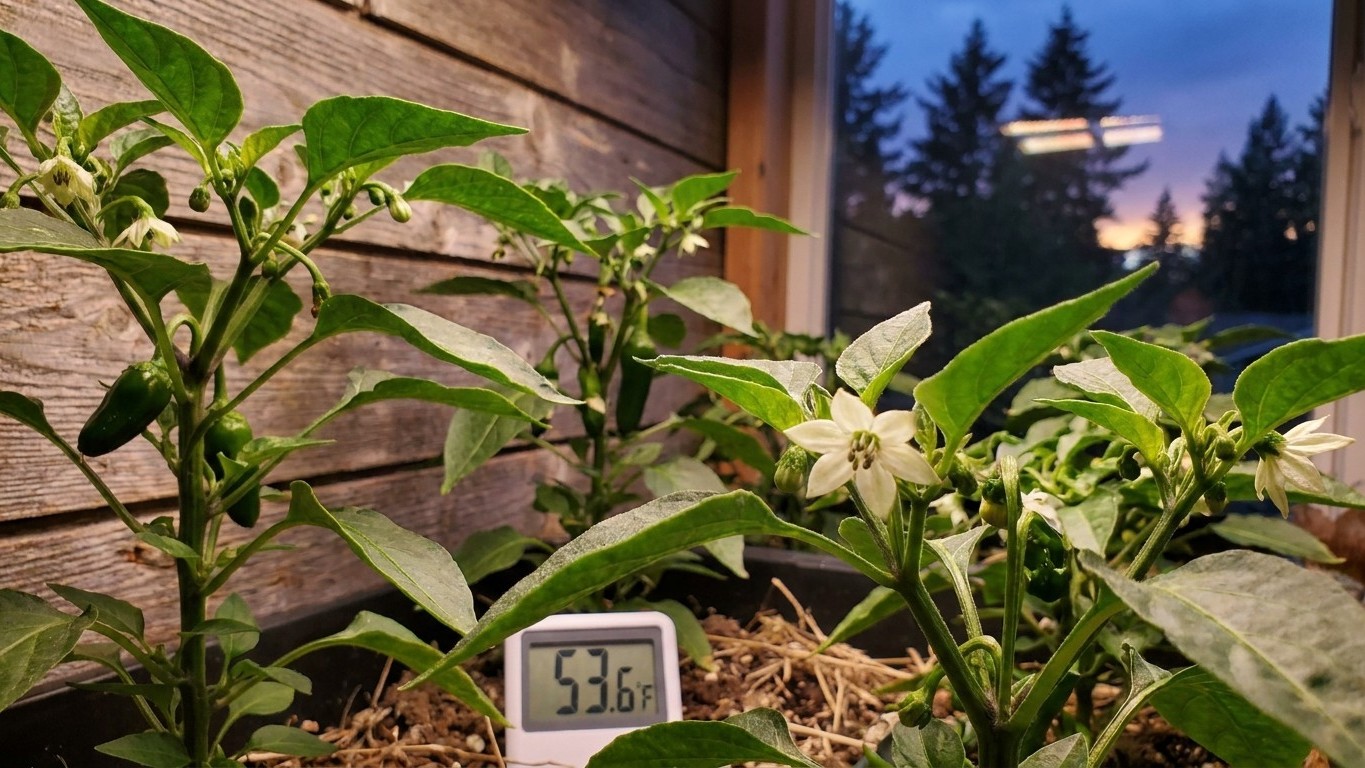

Yukon growers get a rare advantage most of the Lower 48 never sees: this territory averages zero days a year at or above 90 F, so pepper fruit set almost never fails from heat. The real threat here runs the opposite direction. Nights below 55 F stop pepper flowers from setting fruit just as surely as a heat wave does. That means the grower has to watch a thermometer near the plants, not a chart, from bud to first fruit.
The short answer

The reference station at Whitehorse, drawing on the Canadian Climate Normals for 1981-2010, records a mean of 0.0 days a year reaching 90 F or higher. That is not a rounded-down small number. It is a flat zero across three decades of records. For a pepper grower, that figure answers the hot-end half of the fruit set question outright: the days when heat alone shuts down flowering and causes buds to drop simply do not show up in a typical Yukon summer. A grower here can plant a pepper bed against a south wall, in a greenhouse, or in a black plastic mulch tunnel without worrying that an afternoon spike past 90 F will abort the blossoms, because that afternoon almost never comes.
That leaves the other half of the equation, and it is the half that actually matters at this latitude. Pepper flowers abort just as reliably when nights drop below 55 F as when days climb past 90 F. Both thresholds interrupt the same process: pollen becomes sterile or the plant simply drops the flower rather than commit resources to a fruit that will not finish. In a climate with essentially no heat risk, the cool-night risk is the whole story, and Yukon summer nights are not warm by any Lower-48 standard.
This is where the record runs out, and it is worth being direct about that gap. This site carries the days-above-90 count for Yukon because that figure is published and stable. A grower cannot substitute a guess for that missing number, and a guess based on how far north Yukon sits, or on how cold the coldest month runs, would be worse than no number at all. Latitude tells you about day length, not about a specific July night’s low. The coldest month tells you about January, not about the overnight readings during flowering in July.
The workable answer is a cheap one: a min-max thermometer placed at plant height, checked each morning through the flowering window. If overnight lows are sitting near or under 55 F on a given week, that week’s blossoms are the ones likely to drop, whatever the daytime high does. Choosing from among Pepper Varieties That Ripen in a Yukon Season can also reduce this risk by shortening the time the plant needs those warm nights to set fruit. Row cover pulled over the bed at dusk, or moving containers against a heat-retaining wall, buys back a few degrees exactly when it counts.
When to start seed here
Getting a pepper crop to actually set fruit in Yukon is less about variety choice and more about counting backward correctly from two fixed points: the last spring frost and the soil temperature a transplant needs to survive. Utah State University Extension gives the baseline rule for peppers everywhere: start seed 8 to 10 weeks indoors, and hold the transplant until soil has warmed to 60 F and frost risk has passed. In Yukon, both of those markers land later than almost anywhere in the Lower 48, which changes the math the reader needs to run.
- Anchor to the frost date, but treat it as a midpoint, not a guarantee. The Whitehorse A station’s Canadian Climate Normals for 1981-2010 put the mean last spring frost at June 5. That is an average of thirty years, not a promise. In roughly one year out of two, frost arrives after June 5, sometimes well after. A grower who transplants the week of June 5 is playing the midpoint of the window, not the safe edge of it.
- Wait for soil, not just air, to clear 60 F. Air can feel mild while soil three inches down is still holding spring cold, especially in a northern growing season where the ground thaws late. A soil thermometer pushed into the bed each morning is the only reliable check here; a calendar date alone will not tell a grower whether the root zone is ready.
- Count back 8 to 10 weeks from whichever of those two dates lands later. If soil in a given Yukon garden typically reaches 60 F in the days around June 5, seed should go into indoor trays roughly 8 to 10 weeks earlier, which puts sowing in the first half of April. If soil runs cooler and does not clear 60 F until later in June, in a colder pocket or a heavier clay soil, the indoor sowing date slides later to match, since starting too early only leaves leggy, rootbound seedlings waiting on a windowsill for weeks past their prime.
The arithmetic is simple once a grower has their own two numbers: their actual soil-warm date and the date frost risk has genuinely passed on their own property, not the station average. Everything else follows from those two figures, recalculated fresh each season rather than assumed from memory.
What goes wrong here
- Blossom drop from a hot spell or a cool night. Even in a climate that averages zero days above 90 F, a short warm stretch can still push a greenhouse or a plastic-tunneled bed past the threshold, and an open-air night can still dip under 55 F even in midsummer. Either one causes the plant to shed flowers rather than set fruit. The remedy is the same thermometer habit described above: track the microclimate the plants are actually sitting in, not the regional average, and vent a greenhouse on a hot afternoon or cover the bed on a cold night.
- Sunscald where the sun is strong. Long summer daylight hours at this latitude mean intense, extended exposure even when air temperatures stay moderate, and a pepper fruit that loses its leaf cover to pruning or wind damage can develop a pale, papery, sunken patch on the side facing the sun. The fix is leaving the plant’s own foliage in place as natural shade rather than stripping leaves for airflow, and using light shade cloth over exposed fruit during the brightest weeks.
- Blossom-end rot. This shows up as a dark, leathery patch on the blossom end of the fruit and traces back to uneven water delivery interrupting the plant’s calcium uptake, not to a soil calcium shortage in most cases. Consistent watering on a set schedule, rather than a soak-then-forget pattern, keeps the interruption from happening and lets fruit finish cleanly.
Checking this against your own county
Every figure in this article comes from a station-level record or a general extension guideline, and neither one describes a single backyard. Whitehorse’s frost date and heat count are the best public numbers available for the territory, but a garden in a river valley, a north-facing slope, or a sheltered yard against a building can run days or even weeks off that station’s pattern in either direction.
Agriculture and Agri-Food Canada, at agriculture.canada.ca/en, is the federal resource worth checking against local conditions before locking in a planting date. It is the place to confirm whether a more localized frost record or growing guidance exists for a specific district, rather than relying solely on the territorial station average used here.
Common questions
Can peppers ripen at all in a Yukon growing season?
Yes, but the growing window is short enough that starting seed indoors on schedule and transplanting promptly once soil hits 60 F matters more here than variety selection. A late start, more than any weather event, is the most common reason a pepper crop runs out of season before fruit finishes.
Does the zero days-above-90 figure mean heat is never a concern?
It means the open-air average is effectively zero, based on three decades of Whitehorse station data. A greenhouse, cold frame, or plastic tunnel can still trap heat past that threshold on a bright day, so a grower using season-extension structures still needs to monitor and vent them.
How do I know if my nights are too cold for fruit set, since this site doesn’t track that number?
Place a min-max thermometer at plant height and check it each morning through the flowering period. If readings are consistently under 55 F, expect blossom drop that week regardless of the daytime high, and consider row cover at dusk to hold in a few extra degrees.
Is June 5 a safe date to transplant peppers outdoors?
It is the mean last frost date at the Whitehorse A station for 1981-2010, meaning frost falls after that date in roughly half of all years on record. Treat it as the middle of a risk window, not a green light, and confirm local soil temperature has also cleared 60 F before moving transplants outside.