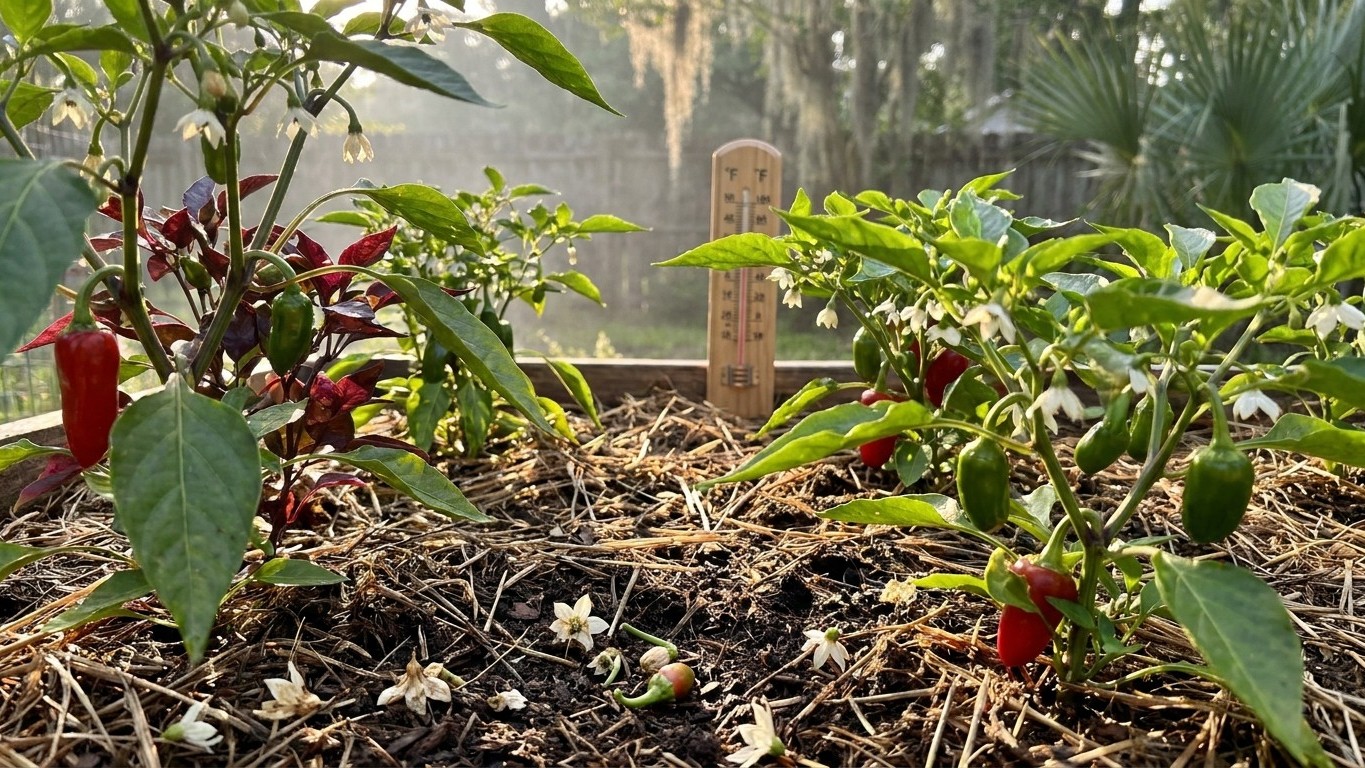

Peppers set fruit in a narrow band: nights need to stay above 55°F and days need to stay below 90°F. South Carolina’s Lowcountry averages 55.1 days a year at or above 90°F, based on the Charleston reference station, so hot-end failure is a real and recurring risk there. The cool end matters too, but this site doesn’t track summer night lows, so you’ll need to watch your own thermometer for that half of the equation.
The short answer

Start with the number: 55.1 days a year hit 90°F or hotter at the Charleston reference station, according to NOAA NCEI Climate Normals for 1991-2020. That’s not a handful of scorching afternoons in late July. It’s closer to eight full weeks, scattered across a growing season that typically runs from spring transplant through early fall harvest. Pepper flowers don’t tolerate that kind of heat well. When daytime highs push past 90°F, especially with humidity stacked on top, pollen becomes sterile or fails to release properly, and the plant drops blossoms rather than setting fruit it can’t support. You’ll see flowers form, look healthy, then fall off within a day or two, with no fruit behind them.
That’s the hot end. The cool end is just as unforgiving, and it works the opposite direction. When nights drop below 55°F, pepper plants stall in the same way: pollen viability drops, fruit set stops, and growth slows even if daytime temperatures look perfectly pleasant. This is the part growers tend to overlook, because a 55°F night doesn’t feel alarming the way a 95°F afternoon does. But the plant doesn’t care how the air feels to you. It cares about the number. For a deeper look at both ends of this problem, see Why Peppers Fail to Set Fruit in South Carolina.
Here’s where this gets specific to your situation rather than the state as a whole: this site carries daytime heat data (the days-above-90°F count) for South Carolina, but it does not carry summer night minimum temperatures. That’s not an oversight to shrug off. Nighttime lows vary by elevation, distance from the coast, tree cover, and even how close you are to pavement or a building that radiates heat after sunset. A spot in the Upstate foothills and a spot in the coastal plain can differ by several degrees on the same night, and neither number is something you should guess based on where South Carolina sits on a map.
The practical move is to track your own overnight lows through the stretch when your peppers are flowering, using a basic outdoor thermometer or a weather station app tied to the nearest observation point to your property. This matters just as much when you’re deciding When to Start Pepper Seed in South Carolina, since starting too early or too late can push flowering right into the coldest or hottest nights of the season. If you’re seeing multiple nights under 55°F while plants are in bloom, that’s your fruit-set problem, not a mystery. Do the same for the 90°F days: know when your local hot stretches tend to land, and expect blossom drop during them, especially if they coincide with drou[ght]. Choosing the right cultivars can also buy you some margin, so it’s worth reviewing Pepper Varieties That Ripen in a South Carolina Season before you settle on what to plant.ght stress.
When to start seed here
Working backward from your transplant date is more reliable than working forward from a generic seed-starting chart, because it forces you to account for your actual frost and soil conditions rather than a national average. Here’s how the math runs, step by step:
- Find your last spring frost window. NOAA NCEI’s 1991-2020 Climate Normals put the 32°F freeze probability window at USW00013880 between February 28 and March 17. That’s a range, not a single date, reflecting the 30-70% probability band rather than a guarantee. Peninsular Charleston tends to run milder than that airport station suggests, while the Upstate runs several weeks tighter on both ends of the season, so treat this window as a starting point to check against your own location, not a fixed calendar entry.
- Confirm soil temperature, not just air temperature. Utah State University Extension is specific on this point: pepper transplants shouldn’t go into the ground until the soil itself reaches 60°F, and only after your frost risk has passed. Air temperature can feel warm on a March afternoon while the soil six inches down is still cold from winter, especially in clay-heavy ground that holds cold longer than sandy soil does. A simple soil thermometer, checked at the depth you’ll actually plant, tells you more than the calendar does.
- Count back 8 to 10 weeks for indoor seed starting. That’s the window Utah State University Extension gives for raising pepper transplants indoors before they’re ready to go into the garden. If your soil hits 60°F and frost risk has cleared by, say, the back half of your local frost window, count backward 8 to 10 weeks from that date to know when to start seed under lights indoors.
- Build in slack for a slow spring. Because the frost window itself spans nearly three weeks in the NOAA data, and because soil warms at its own pace regardless of the calendar, it’s worth starting seed toward the earlier end of that 8-to-10-week range rather than the later end. A transplant that’s ready a week early and has to wait indoors under lights is a far smaller problem than a transplant that’s undersized when the soil finally hits 60°F.
Once transplants are in the ground and flowering starts, remember that fruit typically follows flowering by 35 to 45 days, a figure that runs from the flower opening, not from the day you set the transplant out or the day you sowed seed. That timeline only holds if nights stay above 55°F and days stay below 90°F while the plant is flowering, which is exactly why the heat and cold thresholds matter more than the sowing date itself.
What goes wrong here
- Blossom drop during a hot spell. When daytime highs climb past 90°F, especially several days in a row, flowers form and then fall without setting fruit. Given that South Carolina’s reference station averages 55.1 such days a year, this isn’t rare. The remedy is timing and shade: aim to have plants already fruiting before the heaviest heat arrives, and use 30-40% shade cloth over plants during the worst afternoon stretches to knock a few degrees off the microclimate around the flowers.
- Blossom drop during a cool night. The same failure, opposite cause: nights below 55°F stall pollen viability just as effectively as extreme heat does. Because this site doesn’t track summer night minima, you’ll need to watch your own thermometer through the flowering stretch. If a cool front drops overnight lows into that range for several nights running, expect a lull in fruit set until temperatures recover, and don’t assume something’s wrong with the plant itself.
- Sunscald on exposed fruit. South Carolina’s summer sun is strong enough that fruit exposed directly to afternoon light, especially after pruning or on plants with sparse foliage, can develop pale, papery patches on the skin facing the sun. The remedy is leaf cover: avoid over-pruning foliage that shades developing fruit, and consider shade cloth on the sunniest exposures if scald shows up repeatedly.
- Blossom-end rot. This shows up as a sunken, dark, leathery patch on the bottom of the fruit, and it’s driven by inconsistent water delivery interrupting calcium uptake rather than a soil calcium shortage in most cases. The remedy is even soil moisture: mulch to buffer against wet-dry swings, and water on a steady schedule rather than letting plants dry out between heavy soakings, particularly during the hot stretches when soil moisture evaporates fast.
Checking this against your own county
Everything above describes South Carolina in general terms, anchored to one reference station’s data. Your county might run warmer, cooler, wetter, or drier than that station, and the only way to know for sure is to check locally. Clemson Cooperative Extension is the land-grant extension service for South Carolina, and it’s the resource built specifically to answer county-level questions on planting windows, local pest pressure, and soil conditions that a statewide overview can’t cover.
Reach out through Clemson Extension before you lock in a transplant date, particularly if you’re farther inland than the coastal reference station this article draws from, or at a different elevation than what the state averages suggest. A quick call to your county office can tell you whether local growers are seeing their frost window run earlier or later than the statewide normals, and whether the current season is trending toward more or fewer 90°F days than usual.
Common questions
Why do my pepper flowers fall off without producing fruit?
Fruit set fails at both temperature extremes. Daytime highs above 90°F and nighttime lows below 55°F both interrupt pollen viability, so flowers form and drop without setting fruit. Check which end you’re hitting: track your local overnight lows during flowering, since this site’s data covers daytime heat but not summer night minima.
When should I start pepper seeds indoors in South Carolina?
Count back 8 to 10 weeks from your planned transplant date. Transplant only after your last frost has passed and soil temperature reaches 60°F, per Utah State University Extension guidance. In South Carolina, the last spring frost window (32°F probability) runs February 28 to March 17 at the NOAA reference station, though your county may differ.
How long after flowering do peppers produce ripe fruit?
Roughly 35 to 45 days from the flower opening, not from the sowing or transplant date. That window assumes nights stay above 55°F and days stay below 90°F throughout flowering and early fruit development.
Does South Carolina’s heat make pepper growing harder than in cooler states?
The hot end is a documented risk here, with 55.1 days a year averaging 90°F or above at the Charleston reference station. But the cool end matters just as much, and neither extreme is worse than the other for fruit set. Watching your own local conditions through the flowering window matters more than comparing states.