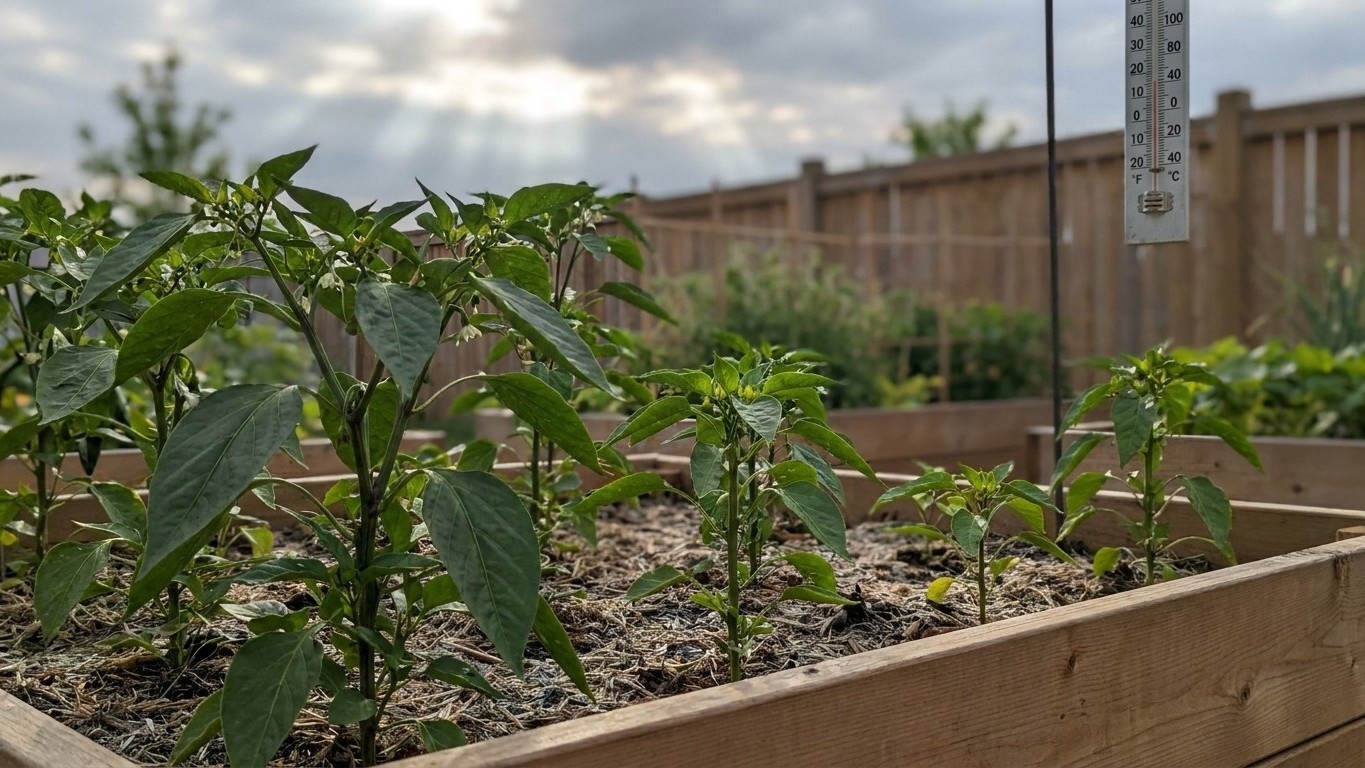

In Manitoba, the heat side of pepper trouble barely exists on paper: the reference station logs zero days a year at or above 90 F. The cold side is the real threat, and it hides in your own yard, not in any published table. Here’s how those two facts actually shape a Manitoba pepper season.
The short answer

Start with the number that surprises most gardeners: 0.0 days a year reach 90 F or higher at the Winnipeg reference station, based on the 1981-2010 Canadian Climate Normals. That’s not a rounding error. It means the failure mode that plagues pepper growers in hot US states, flowers aborting because daytime highs cook the plant, essentially doesn’t happen here on an average year. Pepper fruit set breaks down once days push past that 90 F line, and Manitoba summers, at least at the reference station, rarely if ever get there.
That sounds like good news, and mostly it is. But fruit set fails at both ends, not just the hot one. Peppers also drop flowers, or never form them properly, when nights fall below 55 F, a cool-end failure explained in more detail in Why Peppers Fail to Set Fruit in Manitoba. This is where Manitoba growers need to pay closer attention than the near-zero heat number lets on. A season with no 90-degree days can still be a poor pepper season if nights stay cool into June, or turn cool again in late August before the crop finishes.
Here’s the catch worth sitting with: this site tracks days above 90 F for every territory in this series, because that figure is measured and published at the station level. It does not carry summer night minima. Nobody publishes a clean “average low temperature, July” figure that applies evenly across a province the size of Manitoba, and even if they did, a single number would flatten out real differences between a garden in Winnipeg, one near Brandon, and one tucked into the Interlake region.
So the honest answer is a split one. On the hot end, Manitoba peppers are close to worry-free, at least judged against the 1981-2010 normal. On the cool end, nobody can tell you from a distance whether your particular yard dips under 55 F on a given July night. That depends on elevation, on how close you are to a lake or river, on whether your garden sits in a low spot where cold air pools, and on ordinary year-to-year variation that no normal can predict. Choosing from among the Pepper Varieties That Ripen in a Manitoba Season can help hedge against these cool-night risks, and getting the timing right on When to Start Pepper Seed in Manitoba matters just as much for giving plants a head start before those risky cool nights arrive. The only way to know is to watch a thermometer in your own garden through the growing season, ideally one that logs overnight lows, rather than assume that because you’re at a certain latitude your nights must run a certain way. Latitude alone does not tell you your night temperature. A river valley two miles away can run five degrees cooler after dark than a spot on higher, drier ground.
When to start seed here
Working out a start date for pepper seed is arithmetic, not guesswork, once you have the two anchor points. Manitoba’s anchor is the average last spring frost date, and the general pepper rule is 8 to 10 weeks of indoor growing before the plant goes outside, timed to when the soil itself has warmed to 60 F, not simply after the calendar clears frost. Here’s how that works step by step.
- Find your frost anchor. At Winnipeg Richardson International Airport, the average last spring frost falls on May 23, according to Environment and Climate Change Canada’s 1981-2010 Canadian Climate Normals. That’s a mean date, not a guarantee. In one year out of two, the last frost actually lands later than May 23, so treat it as the midpoint of a risk window, never as a safe transplant date on its own.
- Add the soil-temperature check. Peppers don’t care what the calendar says; they want 60 F soil before they go in the ground, measured a few inches down, not just air temperature. In a cool spring, soil can lag well behind the frost-free date, so the frost date and the soil-warming date don’t always line up. Wait for whichever comes later.
- Count back 8 to 10 weeks. Using May 23 as a working midpoint, and allowing for the real chance that frost risk runs later some years, most Manitoba gardeners land on a mid-to-late March start for seed indoors, giving transplants enough size and root development by the time both frost and soil conditions clear.
- Build in a buffer, not a fixed date. Because May 23 is an average, not a promise, treat late May and even early June as still within the window where a late frost can happen. Gardeners who transplant right at the average date without a frost blanket on hand are gambling on the half of years that run milder than normal.
- Redo the math for your own county. This sequence works the same way anywhere: take your local average last frost date, add the wait for 60 F soil, subtract 8 to 10 weeks, and that’s your indoor seeding window. A grower thirty miles north or in a low-lying valley may need to start a week or two earlier than someone right in Winnipeg, because their own frost normal runs later.
What goes wrong here
- Blossom drop from a cool night. Given Manitoba’s climate, this is the more likely version of blossom drop, more than the heat-driven kind. Flowers open, then fall without setting fruit, often after a stretch of nights that dipped below the range peppers need for pollen to work properly. Watch your own overnight lows through the flowering weeks rather than assuming a “normal” summer night is warm enough, and hold off judging a plant as unproductive until you’ve tracked a run of nights, not just one cold snap.
- Sunscald on exposed fruit. Even without many 90 F days, strong summer sun on peppers that have lost leaf cover, from pruning, wind damage, or disease, can bleach and blister the skin on the side facing the sun. The fix is straightforward: keep the plant’s own foliage intact as much as possible, and avoid heavy pruning that opens fruit to direct light once it’s set.
- Blossom-end rot. This shows up as a dark, sunken patch on the bottom of the fruit, and it’s a calcium-delivery problem tied to inconsistent watering rather than a soil calcium shortage in most cases. Uneven moisture, a dry week followed by a heavy soak, is often the trigger. Keeping watering steady, and mulching to hold moisture evenly, is the practical remedy.
Checking this against your own county
Every number in this article comes from a station-level reading or a general extension guideline, and neither one describes your exact backyard. A frost date measured at a Winnipeg airport, or a heat-day count from the same reference station, is a starting point for the province, not a forecast for a specific garden forty minutes away by car.
For local guidance tuned closer to your own soil and microclimate, Manitoba Agriculture is the extension service to consult directly. Their office can speak to regional variation across the province, from the Red River Valley to the Parkland region, in a way a single provincial normal can’t.
Common questions
Do Manitoba summers ever get hot enough to stop pepper fruit set?
Based on the 1981-2010 normal, the reference station records 0.0 days a year at or above 90 F, so heat-driven fruit set failure is rare in an average year. Individual yards with a lot of paved surface or south-facing exposure can still run warmer than the station reading on a given afternoon.
Is May 23 a safe date to transplant peppers outdoors in Manitoba?
No. May 23 is the average last spring frost date at Winnipeg Richardson International Airport, meaning frost falls later than that in about half of all years. Treat it as a midpoint, not a guarantee, and keep frost protection on hand into early June.
How do I know if my garden’s nights are too cool for pepper fruit set?
There’s no published figure for summer night minima at the local level, so the only reliable method is tracking your own garden with a thermometer through the flowering period and watching for lows under 55 F, rather than assuming based on your general region or latitude.
What’s the single biggest timing mistake Manitoba pepper growers make?
Starting seed too late for the 8 to 10 week indoor window, then rushing transplants outside before soil has actually reached 60 F. Soil temperature, not the frost date alone, is the second checkpoint that decides whether young plants stall or take off.