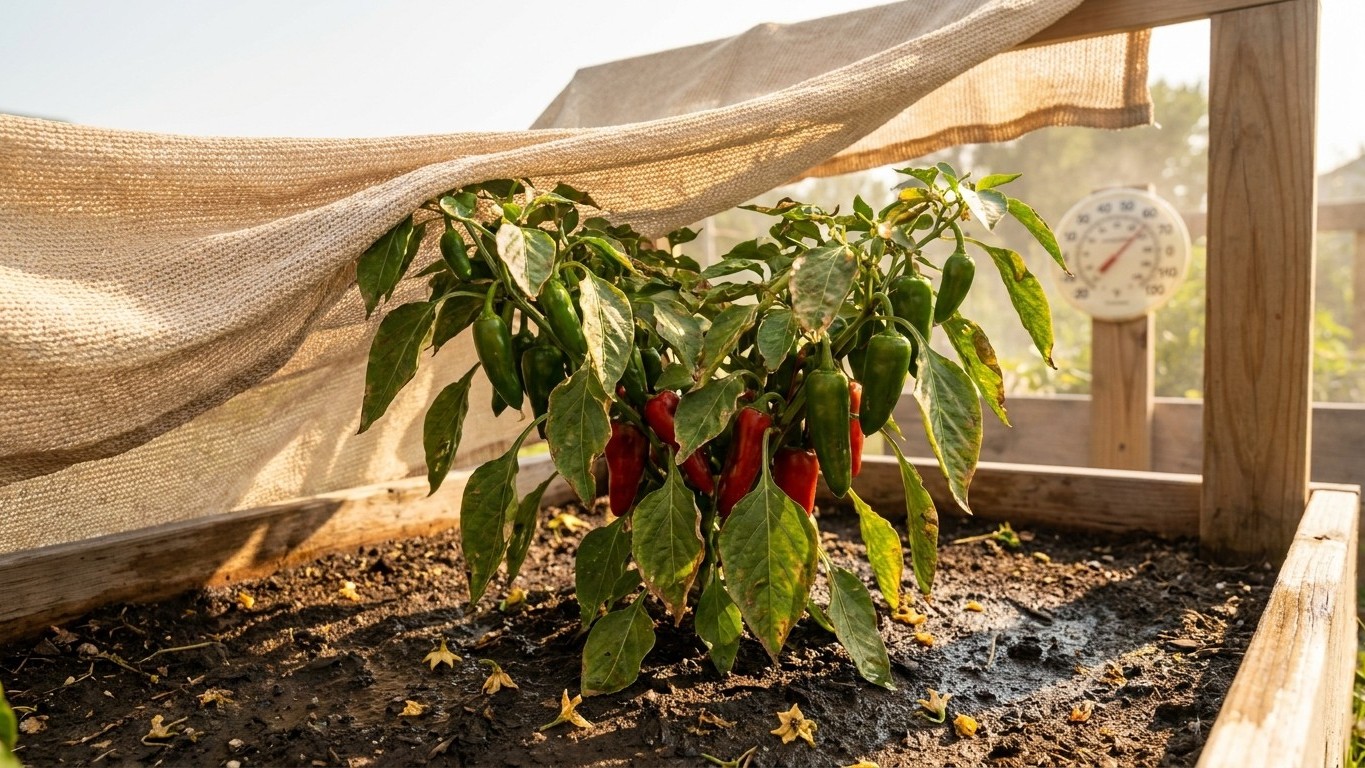

Peppers set fruit reliably across most of an Iowa season, but two temperature edges can shut flowering down without warning: a stretch of days near or above 90 F, and any night that dips under 55 F. Iowa State University Extension figures put transplant dates at four days later than airport data suggests. Start seed 8 to 10 weeks before you set plants out, after frost and once soil hits 60 F, and track your own overnight lows since that number isn’t published here.
The short answer

Des Moines averages 18.4 days a year at or above 90 F, based on NOAA NCEI Climate Normals for 1991-2020. That’s not a heat wave here and there. It’s the equivalent of nearly three full work weeks where afternoon temperatures climb high enough to stress a pepper plant’s ability to hold onto its flowers. Pepper blossoms are fragile machinery: pollen becomes sticky and less viable once daytime highs push past 90 F, and if that heat arrives while a plant is mid-bloom, the flowers can drop before they ever become fruit. An Iowa grower doesn’t need to guess whether this matters. With 18.4 days a year running that hot, most seasons will include at least one stretch long enough to interrupt fruit set for a week or two, usually in mid to late July when the plants are otherwise loaded with buds.
The fix isn’t complicated, but it does require attention. Afternoon shade cloth over the hottest rows, deep watering before a heat spell rather than during it, and choosing a planting spot that gets some relief from a building or a taller crop in the late afternoon all help plants ride out those 18-plus days without losing an entire flush of blossoms. Choosing the right cultivar matters too, so it’s worth reviewing Pepper Varieties That Ripen in a Iowa Season before you decide what to start.
The other edge of the problem gets less attention, and that’s a mistake. Pepper fruit set fails just as surely when nights drop below 55 F, a subject covered in more depth in Why Peppers Fail to Set Fruit in Iowa. Cool nights slow pollen development and can cause the same blossom drop as a heat spell, just from the opposite direction. Early in the season, before the calendar catches up with the soil, an Iowa night in the 40s or low 50s is entirely possible even after the last frost has passed. This site tracks days above 90 F because that figure is measured and published for this territory. It does not carry summer night minima, and there’s no reliable way to back into that number from latitude, from the coldest month of the year, or from any other stand-in. A grower who wants to know how many nights near their own garden fall below 55 F needs to watch a thermometer at their own site through June, because a river valley, a hilltop, and a sheltered yard three miles apart can post very different lows on the same night. Guessing here costs a harvest; checking costs nothing.
When to start seed here
Working backward from transplant to seed-starting is arithmetic, not guesswork, and it’s worth doing on paper rather than trusting a seed packet’s generic date.
- Start with the last spring frost window. NOAA NCEI’s 1991-2020 Climate Normals put the 32 F freeze probability window for this reference station between April 12 and April 24. Iowa State Extension’s county-level figures, drawn from 1950-2021 data, tend to run about four days later than that airport-based window, so treat April 12-24 as the optimistic end and add a few days if your county sits outside a metro station’s immediate footprint.
- Wait for soil, not just air, to warm. Pepper transplants need soil at 60 F, and soil temperature typically lags a week or two behind the last frost date depending on how quickly spring warms up and whether the ground is bare or mulched. A cold, wet spring can push that 60 F mark two or three weeks past the frost date even when the air feels warm enough.
- Set a realistic transplant target. Combining a frost date in the April 12-24 range with a typical soil-warming lag puts most Iowa transplant dates somewhere in early to mid-May, later in northern counties and in springs that stay cool longer than average.
- Count back 8 to 10 weeks for seed starting. If the transplant target lands in early May, seed should go into trays roughly 8 to 10 weeks earlier, which works out to mid-February through early March. A mid-May transplant target pushes seed-starting into late February or the first two weeks of March.
- Recheck the math against your own county’s records rather than relying on a single reference station, since a four-day shift in frost date can shift the whole seed-starting window by nearly a week.
What goes wrong here
- Blossom drop in a hot spell. Flowers open, then fall off without setting fruit once daytime highs run above 90 F for several days in a row, which happens on average 18.4 days a year at the reference station for this territory. The remedy is timing and shade: avoid heavy fertilizing right before a forecast heat spell (excess nitrogen worsens drop), water deeply the morning before the heat arrives, and use shade cloth over the row during the worst afternoon hours so flowering can resume once temperatures ease.
- Blossom drop on a cool night. The same failure, opposite cause: nights under 55 F slow pollen viability just as effectively as extreme heat does. Because this site doesn’t track summer night lows, the only real defense is watching your own thermometer through late spring and early summer and holding off on setting out tender transplants until nights are reliably staying above that mark, especially in low-lying or exposed garden spots that run colder than the rest of a yard.
- Sunscald on exposed fruit. Strong summer sun can scorch pepper skin, especially on fruit that loses its leaf cover to disease, pruning, or wind damage. Pale, papery patches on the sun-facing side of a pepper are sunscald, not disease. Keep foliage full through the season, avoid heavy pruning during the hottest stretch of days, and consider light shade cloth on the row’s sunniest side if scald shows up repeatedly.
- Blossom-end rot on developing fruit. A sunken, leathery brown patch on the bottom of a pepper points to inconsistent watering, which interrupts calcium uptake even when soil calcium levels are fine. Even soil moisture, achieved through mulch and a regular watering schedule rather than occasional deep soaking after dry stretches, is the practical fix.
Checking this against your own county
Every figure here comes from a single reference station or a statewide climate dataset, and Iowa is large enough that conditions in one county can run noticeably different from another. A county along the Mississippi River bottomland warms differently than a county near the Minnesota border, and soil types shift the pace at which ground reaches that 60 F transplant threshold just as much as air temperature does.
Iowa State University Extension, at extension.iastate.edu, keeps county-specific frost data, soil temperature guidance, and local horticulture contacts that can confirm or adjust the windows discussed here for your exact location. That’s the resource to check before committing seed-starting or transplant dates to the calendar.
Common questions
Can peppers still set fruit during an Iowa heat wave?
Often not while the heat lasts. Once daytime highs push past 90 F, a threshold this territory reaches on 18.4 days a year on average, flowers frequently drop before pollination succeeds. Fruit set typically resumes once temperatures ease back below that mark, so a plant that stalls in late July can still produce a strong late-summer harvest.
How do I know if my garden’s nights are too cool for peppers?
There’s no published figure for summer night minimums at the county or state level here, so the only reliable method is placing a min-max thermometer in the garden itself and tracking nightly lows through late spring. Nights under 55 F can stall fruit set the same way extreme heat does, and low spots or open, unsheltered areas often run several degrees colder than the rest of a yard.
Why did my pepper plants flower but never produce fruit?
This usually traces back to one of the two temperature edges: a heat stretch above 90 F or a run of nights below 55 F during bloom. Both interrupt pollination without necessarily harming the plant itself, which is why a pepper plant can look healthy and full of flowers while still not setting fruit.
Is it too late to start pepper seed if I missed the mid-February window?
Not necessarily, though the harvest window shrinks. Since transplants need 8 to 10 weeks indoors before going out after frost and once soil hits 60 F, starting seed later than early March pushes the transplant date later too, leaving less of the growing season for fruit to mature before fall’s cooler nights return.