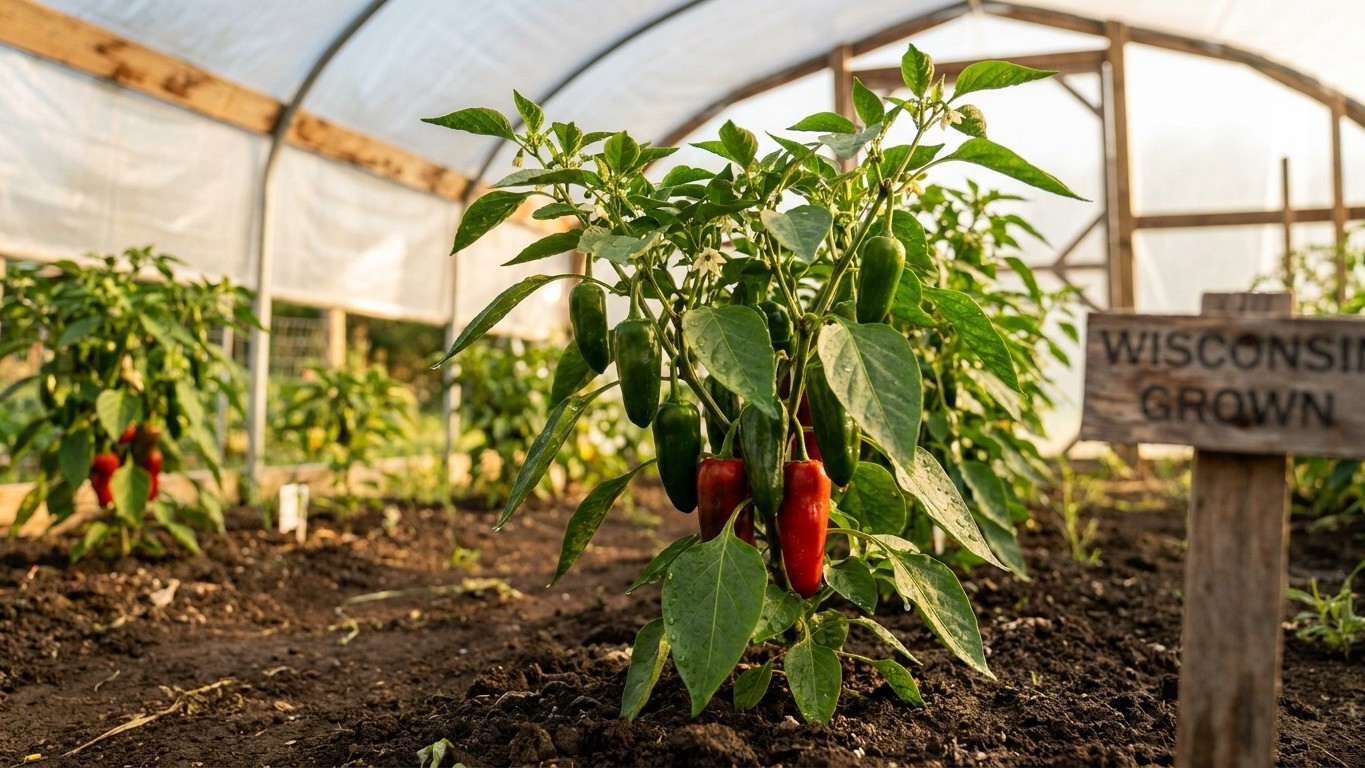

Wisconsin’s climate is on the mild side of pepper country, which is good news for fruit set but bad news for anyone who starts seed too late. The plants need heat to flower and fruit, but not too much heat, and they need warm nights just as badly. Get the timing right and the rest mostly takes care of itself.
The short answer

The reference station at Milwaukee logs a mean of 7.0 days a year at or above 90 F, based on NOAA NCEI Climate Normals for 1991-2020. That’s a low heat load compared to the Sun Belt, and it matters because pepper fruit set breaks down once daytime temperatures push past 90 F for a stretch. Flowers open, but the plant aborts them rather than putting energy into fruit it may not be able to finish. In most Wisconsin summers, that ceiling gets touched only a handful of days, so hot-spell blossom drop is the smaller of the two risks here, not the bigger one.
The bigger one is the other end of the scale. Pepper fruit set also fails when nights drop below 55 F, according to Utah State University Extension. Cool nights confuse pollen viability and flower development the same way extreme heat does, just from the opposite direction. This is where the numbers get harder to hand you on a plate—for a fuller breakdown of both failure points, see Why Peppers Fail to Set Fruit in Wisconsin. This site tracks the daytime heat load for Wisconsin (that 7.0-day count above 90 F), but it does not carry summer night minimum temperatures for the state.
That gap isn’t a small detail to shrug off. A 55 F threshold is specific enough that guessing wrong costs you a chunk of your pepper crop, and there’s no shortcut that gets you there safely. Don’t estimate your local nighttime lows from where Wisconsin sits on the map, and don’t borrow the coldest month’s average as a stand-in either. Latitude tells you almost nothing about a June or July night in a particular yard, since local terrain, elevation, tree cover, and distance from Lake Michigan all shift actual overnight readings well beyond what a state-level look implies. A low spot near a creek can run several degrees cooler overnight than a slope a half mile away, and that difference is exactly the range that separates a night that sets fruit from one that doesn’t.
The practical move is to put an outdoor min-max thermometer where your pepper bed actually sits and read it through the growing season, especially in the shoulder weeks of early June and again in late August when Wisconsin nights start slipping. If you see nights repeatedly under 55 F while plants are trying to flower, that’s your signal, not a number pulled from a regional average.
When to start seed here
Working out a start date for pepper seed is an arithmetic problem more than a calendar one, and it works backward from the transplant date rather than forward from a guess. Choosing the right cultivar matters just as much as timing, so it helps to check which Pepper Varieties That Ripen in a Wisconsin Season before you commit seed to soil.ss.
- Pin down your last spring frost. Across the reference period NOAA NCEI tracked for station USW00014839, the last spring freeze fell somewhere between April 16 and April 29, based on the 32 F freeze probability band. That’s a range, not a single date, and where your county sits inside it depends on local geography.
- Wait for 60 F soil, not just a frost-free calendar. Utah State University Extension is clear that pepper transplants go into the ground when soil temperature reaches 60 F and frost risk has passed, whichever comes later. Air can feel like spring while the soil is still too cold for pepper roots to do anything useful, so a soil thermometer beats a calendar guess.
- Count back 8 to 10 weeks from that transplant date for your indoor sowing date. If your soil and frost line up around the end of April in your part of the state, 8 to 10 weeks earlier lands seed-starting in the back half of February. If your local conditions push the safe transplant date into May, shift the sowing window later by the same amount rather than starting early and holding leggy seedlings indoors.
- Factor in your fall frost date before you finalize the schedule. Lake Michigan delays the first fall freeze right along the lakeshore, while inland southern Wisconsin typically sees its first freeze in early October and the northern part of the state considerably earlier than that. Since fruit needs 35 to 45 days after flowering, not after sowing or transplanting, to mature, a shorter fall window in the north means your indoor start date matters even more than it does near the lake.
Redo this arithmetic for your own county rather than for the state as a whole. A grower near the lakeshore and a grower two hours inland can have meaningfully different safe windows even though both are technically “Wisconsin.”
What goes wrong here
- Blossom drop during a hot spell. Even with only about 7.0 days a year averaging 90 F or above, a run of hot afternoons back to back is enough to trigger flower abortion. Provide afternoon shade during a heat spike, keep soil moisture even so the plant isn’t drought-stressed on top of heat-stressed, and expect a short pause in fruit set rather than a permanent failure once temperatures ease.
- Blossom drop from a cool night. This is the more likely failure point in Wisconsin, since the state’s overall heat load is mild. If your own nighttime readings dip under 55 F during flowering, particularly in the first couple weeks after transplant or again as summer winds down, cover plants with row cover or a cloche in the evening and remove it in the morning. There’s no published fix that raises night temperature outdoors, so timing your transplant to avoid the coldest stretches matters more than any in-season remedy.
- Sunscald on exposed fruit. Peppers that lose their leaf cover to disease, pruning, or wind damage end up with fruit sitting in direct sun for hours, and the skin develops pale, papery patches that can rot. Leave foliage intact where you can, and if a plant is thin on leaves, rig light shade cloth over exposed fruit clusters during the hottest part of the afternoon.
- Blossom-end rot. This shows up as a dark, sunken patch at the bottom of the fruit and traces back to inconsistent watering interrupting calcium uptake, not to a soil calcium shortage in most cases. Even, regular watering, mulch to hold soil moisture steady, and avoiding the swing from bone-dry to soaked address it far more reliably than adding calcium products.
Checking this against your own county
Everything above is a state-level starting point, and Wisconsin is large enough that conditions along Lake Michigan, in the southern farmland belt, and up near the Northwoods don’t behave the same way. Before you lock in a sowing date, run your specific county past the University of Wisconsin-Madison Division of Extension at extension.wisc.edu. Local extension offices track county-level frost data and can flag microclimate quirks, like a low-lying garden bed that runs cooler than the surrounding area, that no state-wide figure can capture. Pair that local input with your own thermometer readings on nighttime lows during flowering season, since that’s the one number this article can’t hand you directly.
Common questions
Do peppers need full sun in Wisconsin?
Yes, most pepper varieties want six or more hours of direct sun daily to flower and fruit well. In a state with only around 7.0 days a year at or above 90 F, sunscald risk from bare, unshaded fruit is a bigger practical concern than a total lack of sun exposure.
Can I direct-seed peppers outdoors in Wisconsin instead of starting indoors?
Direct seeding is possible in principle, but Wisconsin’s frost-free window, running from a last frost sometime between April 16 and April 29 through a fall freeze that arrives earlier in the north than along the lakeshore, is tight for many varieties to mature outdoors from seed. Starting indoors 8 to 10 weeks before transplant gives the plant a head start the outdoor season may not otherwise provide.
Why are my peppers flowering but not setting fruit?
Check both ends of the temperature range before assuming a pest or disease problem. Utah State University Extension notes fruit set fails when nights run below 55 F or days climb above 90 F. Since this site doesn’t track summer night minimums for Wisconsin, put a thermometer in your own garden bed to see which threshold you’re hitting.
How long after flowering should I expect ripe peppers?
Utah State University Extension puts fruit maturation at 35 to 45 days after flowering, not after the seed goes into soil or the transplant goes into the ground. Counting from flowering, rather than from an earlier stage, is the only way to estimate a realistic harvest date against your local fall frost.