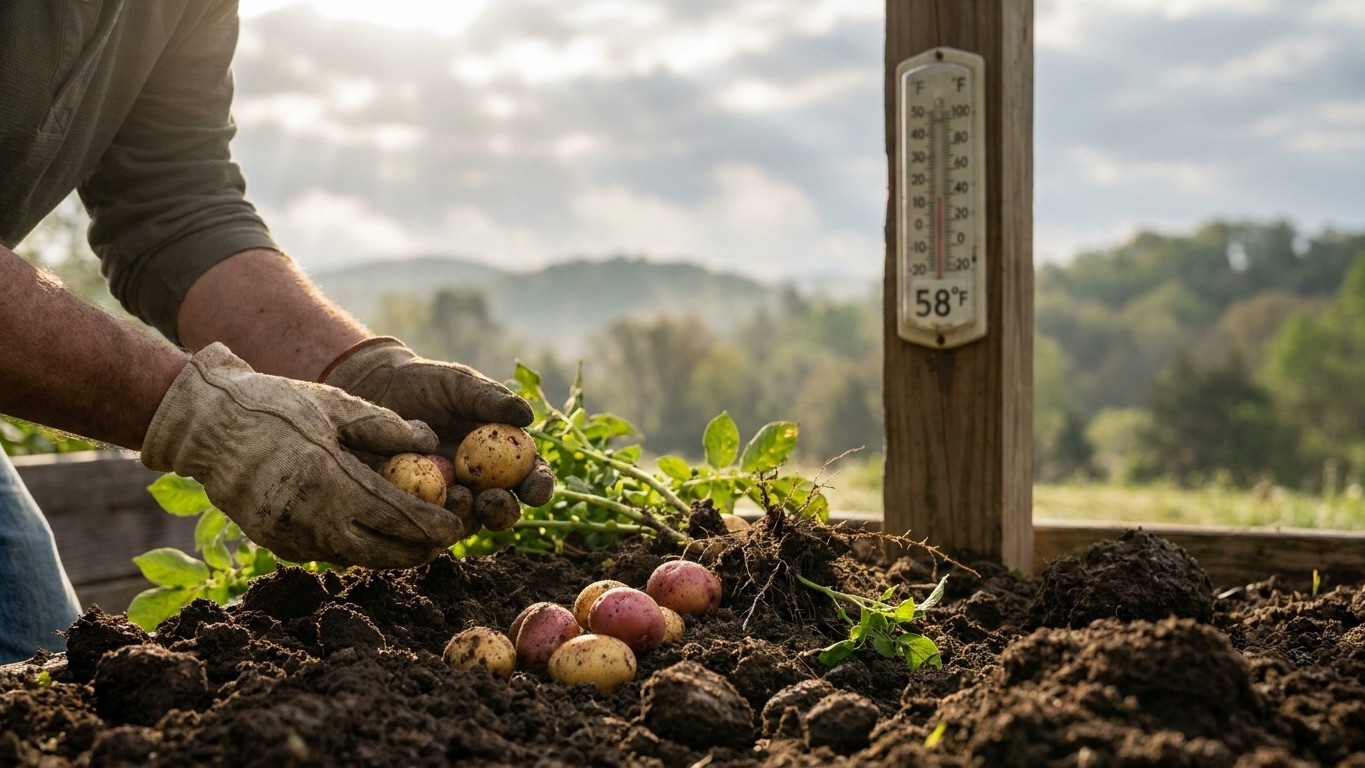

Tennessee gardeners get one real shot at sizing potatoes before summer heat shuts the plant down. The fix is timing, not variety magic: plant as early as the soil allows, count backward from the local frost date, and dig before the soil bakes. Everything else on this page is the arithmetic behind that one move.
The short answer

Two numbers decide this crop in Tennessee. The first is heat load: at the Nashville reference station, NOAA NCEI Climate Normals (1991-2020) put the average at 40.0 days a year reaching 90 F or more. The second is timing: the last spring frost at station USW00013897 falls somewhere in the window of March 31 to April 12, based on NOAA’s 32 F freeze-probability normals for 1991-2020. For the full breakdown of dates by region, see When to Plant Potatoes in Tennessee.
Forty days above 90 F is not a handful of hot afternoons. It is a stretch of the growing season long enough to push soil temperatures well past the point where potato plants can keep working underground. Utah State University Extension is direct about the mechanism: tuber set and fill are inhibited once soils climb above 90 F. That single fact is what settles the question for this state.
Given a heat load that high, Tennessee is not a place to plan a full-season summer crop the way a gardener in Vermont or Minnesota might. The season here works as a spring crop: plant as early as the ground allows, let the plant bulk tubers through the cooler weeks of late spring, and get the crop out of the ground before the run of 90-degree days arrives in force. Nashville’s own summer pattern, with heat building through June and settling in hard by July, leaves a workable window from planting in early spring through harvest before peak heat, but that window is not generous, and it is not the same in every county. For the specifics of digging and curing the crop once that window closes, see Harvesting and Storing Potatoes in Tennessee.
This also shapes which varieties make sense. Neither Utah State nor the University of Maine Cooperative Extension publishes a days-to-maturity figure for named varieties, so nothing here should be planned against one. What both sources do publish is season class: early, mid-season, and late. In a state with 40 days a year above 90 F, an early or mid-season variety gets tubers set and sized before the heat ceiling closes the window, while a late-season variety is racing a clock it may not win. For a closer look at which season classes fit this state, see Potato Varieties That Suit Tennessee. Choice of use matters too: some varieties are described by these extensions as suited to baking, others to boiling, and that published detail is worth checking before choosing seed, even though neither source frames it in terms of texture.
None of this changes with more water. Heat stress on tuber set is a soil-temperature problem, and irrigation cools soil only marginally. The short answer for Tennessee is: plant early, choose an early or mid-season type, and treat the harvest as a race against the calendar rather than the plant’s own internal maturity clock.
When to plant here
Work backward from the frost window instead of picking a date off a generic calendar. Here is the sequence, county by county adjustable, using Nashville’s normals as the starting point.
- Start with the local last-frost window. For the Nashville reference station, that is March 31 to April 12, per NOAA NCEI’s 1991-2020 normals. That is a range, not a single day, because freeze probability drops gradually rather than switching off.
- Subtract 14 to 21 days. Potatoes go in the ground once soil temperature hits 50 F, and University of Maine Cooperative Extension guidance puts that point 14 to 21 days ahead of the last frost date, since seed potatoes tolerate a light frost on emerging foliage in a way many other vegetables do not.
- Land on a planting window, not a date. Counting back three weeks from March 31 lands in early March; counting back two weeks from April 12 lands closer to the end of March. That spread, roughly early to late March for the Nashville area, is the realistic planting window this year’s soil conditions should confirm.
- Confirm with a soil thermometer before committing seed. Calendar math gets you close. A thermometer pushed a few inches into the bed tells you whether the ground has actually reached 50 F, since a cold, wet spring can lag the calendar by a week or more.
- Adjust for your own county’s frost pattern. Warmer valley locations near the Nashville basin may hit that soil temperature sooner; cooler upland spots will run behind it. The math is the same, only the input date shifts.
What the heat does to the crop
The mechanism is simple, and it is the reason this whole page exists. Once soil temperature climbs above 90 F, potato plants stop setting new tubers and stop filling the ones already forming. Utah State University Extension states this plainly as part of its potato growing guidance, and University of Maine Cooperative Extension’s Bulletin #2077 backs the same threshold. The plant does not die. It simply stalls underground while the foliage keeps growing above.
In a state averaging 40.0 days a year above 90 F at the Nashville reference station, that threshold is not a rare event. It is a recurring feature of a Tennessee summer, typically arriving in force by mid to late June and continuing into August. A potato crop planted in early spring and left in the ground through that stretch is not sizing during those weeks. It is treading water at best.
That is why the workable strategy here is a spring crop dug before the heat load builds, rather than a full summer season carried through July and August the way it might be in a cooler climate. Plant in that early-to-late-March window described above, let the plant bulk tubers through April, May, and early June while soil stays under the ceiling, and get the crop out of the ground as foliage begins to die back, generally before the heaviest run of 90-degree days sets in.
Watering more does not solve this. Soil temperature at planting depth, typically several inches down, does not track air temperature directly, and irrigation cools it only at the surface and only briefly. A gardener who keeps a hot bed soaked through July is not rescuing tuber set. Once soil at tuber depth is running above 90 F, the plant’s internal signal to keep sizing tubers is already suppressed, and no amount of moisture reverses that signal. The only lever that works is timing the crop so that window of heat arrives after harvest, not during bulking.
What goes wrong here
- Planting uncertified seed potatoes. Seed saved from a grocery-store potato or an unlabeled bag carries a real risk of viral disease that stunts the plant before heat is even a factor. Buying certified seed potato stock, sold specifically as disease-tested for planting, removes that risk before the season starts.
- Planting into cold, wet soil before it reaches 50 F. Seed pieces sitting in cold, saturated ground are prone to rot rather than sprouting. Waiting for a soil thermometer reading of 50 F, even if that means planting a few days later than the calendar math suggested, avoids losing seed pieces before they ever break the surface.
- Skipping hilling and ending up with green tubers. Tubers that push up near the surface and catch sunlight turn green and develop solanine, a compound that makes them unsafe to eat. Mounding soil over the row as the plant grows, two or three times through the season, keeps developing tubers covered and out of the light.
- Digging too early, before the plant has finished bulking. Pulling potatoes as soon as flowers appear, rather than waiting for foliage to yellow and die back, means harvesting undersized tubers before the plant has put on its final weight. Given the tight window Tennessee’s heat load allows, that early dig gives away size the plant could otherwise still add.
Checking this against your own county
The Nashville normals used throughout this page are a starting point, not a fixed instruction for every county in the state. East Tennessee and the Cumberland Plateau sit at higher elevation and run cooler and later in spring than the Nashville basin, which pushes both the last-frost window and the safe planting date back by a week or more in some years. The same logic applies to microclimates within a single county: a low, sheltered garden bed can lag or lead a nearby ridge by several degrees on a given morning.
For a planting date and frost history specific to your own location, the University of Tennessee Institute of Agriculture Extension is the named authority to check. County-level guidance from that office accounts for local elevation and frost patterns in a way a single statewide figure cannot.
Common questions
Can I grow a fall crop of potatoes in Tennessee instead of a spring one?
Nothing in the sourced facts here addresses a fall planting window for Tennessee, so no date or recommendation can be given for one. What is established is that soils above 90 F stop tuber set and fill, and Nashville averages 40.0 such days a year, which is the constraint any second planting would have to work around.
Does mulching lower soil temperature enough to prevent heat stress?
That is not addressed in the Utah State or University of Maine guidance referenced for this page. What both sources agree on is the 90 F soil threshold itself; whether a given mulching practice keeps soil under that line in a Tennessee summer is not something published here.
How do I know if my soil has actually reached 50 F for planting?
Use a soil thermometer inserted a few inches into the bed rather than relying on air temperature or the calendar alone, since a cold, wet spring can delay soil warming by a week or more compared to a typical year.
Should I choose an early-season or late-season variety in Tennessee?
Given a heat ceiling that closes the tuber-sizing window once soils pass 90 F, and Nashville’s average of 40.0 days a year at or above that mark, an early or mid-season variety class, as published by Utah State University Extension and University of Maine Cooperative Extension, has more time to size tubers before that ceiling arrives than a late-season type.