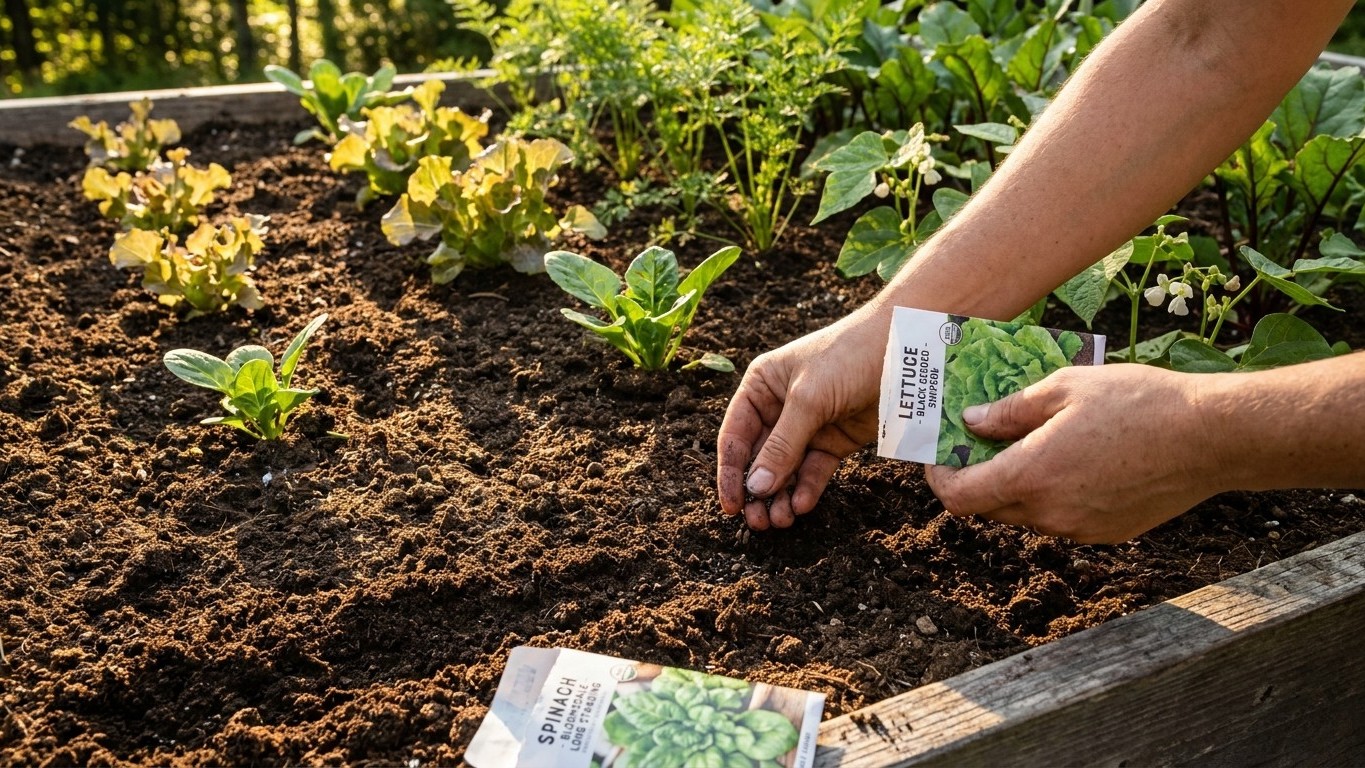

August in Connecticut sits in the heart of the growing season, well past the last spring frost and still weeks away from the first fall freeze. This is the month for succession sowing fast-maturing crops like lettuce, spinach, beets, carrots, and bush beans, not for starting new tomatoes or peppers. It’s also the month the garden hands back the most food.
What goes in the ground in August

The math that matters this month isn’t the calendar, it’s the countdown. Connecticut’s first fall frost lands somewhere between October 28 and November 10, depending on where you garden (source: NOAA NCEI 1991-2020 Climate Normals, station USW00094702). That gives a gardener sowing in early August roughly 12 to 14 weeks of open ground left, sometimes less inland where cold settles into valleys earlier. The question for every seed packet is simple: does this crop’s days-to-maturity number fit inside that window, with a little buffer for a cool, cloudy stretch?
For crops that answer yes, August is a green light. Beets, carrots, turnips, and radishes all mature fast enough to go from seed to harvest before the ground freezes. Bush beans can still go in during the first week or two of the month, since they typically need only 50 to 60 days. Lettuce, spinach, arugula, kale, collards, and kohlrabi are all safe direct-sow choices, and many of them actually improve in flavor once the nights turn cool. Peas sown now for a fall crop, rather than the classic spring planting, often outperform their spring cousins because they mature into cooler weather instead of bolting heat.
For anything needing 70 days or more, especially warm-season crops like squash, melons, or a fresh round of tomatoes, August direct-sowing is a gamble that usually loses. Those plants either won’t size up before frost, or they’ll still be flowering when the first freeze hits. Connecticut’s USDA hardiness zones range from 6a to 7b, with the mildest pocket near the coast at stations like Bridgeport and the coldest in the northwest hills, so a gardener in Litchfield County should treat the later end of that frost window as the realistic deadline, not the earlier one.
What to start under cover
Starting seeds under cover in August is less about protecting plants from cold and more about controlling heat and timing a fall transplant. Peak summer soil temperatures can run hot enough to stall or scramble germination for cool-season crops like lettuce and spinach, so starting those seeds indoors or in a shaded cold frame, then moving the seedlings out once they have true leaves, often beats direct sowing during a heat spell.
The arithmetic works the same way as outdoor sowing, just with an extra step. Take the October 28 to November 10 frost window, subtract the days-to-maturity for the crop, then subtract another two to three weeks for the time the seedling needs under cover before it’s ready to transplant. A fall cabbage or kohlrabi wanting 60 days to maturity, started under cover in the first week of August and transplanted out two to three weeks later, still lands with room to spare even against the earlier end of the frost window.
Two mistakes show up every year. Starting too early in the month’s heat produces seedlings that stretch for light and get leggy fast, or that bolt straight to flowering before they ever reach the garden, especially with lettuce and spinach. Starting too late, closer to the end of August, leaves too few weeks between transplant and frost for the plant to size up, so it sits stalled in cold soil doing very little. Splitting the difference by starting in the first half of the month gives the most margin either way.
What is ready to pick
August is the single most productive harvest month in a Connecticut garden. Tomatoes hit their stride, sweet corn comes in tight and milky when the kernels pop under a fingernail, and summer squash and cucumbers need checking every day or two since both go from perfect to oversized in what feels like hours. Green and wax beans are ready when the pods snap cleanly rather than bend.
Peppers can be picked green or left on the plant to color up to red, yellow, or orange, which takes another two to three weeks and sweetens the flavor considerably. Blueberries planted in earlier years are usually finishing their run, while early apple varieties start coloring on the tree. Garlic and onions harvested in July should be curing in a dry, airy spot by now, out of direct sun, with the papery skins tightening around the bulb as a sign they’re ready for storage.
Basil and other tender herbs are at their peak, but they bolt to flower fast in August heat, so regular cutting keeps the plant producing leaves instead of seed. Anything left unpicked for more than a few days, particularly zucchini and cucumbers, turns tough and seedy fast, which is the main reason gardens feel like they’re overflowing one week and picked clean the next.
The jobs that matter this month
Watering rhythm decides more outcomes in August than almost any other task. A deep soak two or three times a week beats a light daily sprinkle, since shallow watering trains roots to stay near the surface where they dry out fastest. Tomatoes especially punish inconsistent watering with blossom end rot and cracked skins, both signs of uneven moisture rather than disease.
Staking and tying should already be done by August, but any tomato or pole bean that’s started to sprawl needs support now, before the weight of ripening fruit snaps a stem. Mulch pays for itself twice this month, holding soil moisture during dry stretches and keeping weeds from competing with plants for water at the exact point when both are stressed by heat.
Pest scouting matters because August is when Japanese beetles, squash vine borers, and tomato hornworms do the most damage in the shortest time. Checking the undersides of squash leaves and the base of stems every few days catches borer damage before a whole plant collapses. Powdery mildew shows up on squash and cucumber leaves as a white dusting, and thinning crowded foliage for airflow slows it down.
Succession sowing ties the whole month together: as beds finish producing lettuce, peas, or garlic, that same ground can go straight into a fall crop of spinach, beets, or turnips rather than sitting empty for the rest of the season.
What not to do in August
The classic mistake is planting warm-season transplants, tomatoes, peppers, basil, because a stretch of hot weather feels like summer is just getting started. It isn’t. With the first fall frost landing between October 28 and November 10, a tomato transplanted in mid-August needs 60 to 80 days just to set and ripen fruit, and that math rarely works out before the season ends.
Skipping water during a dry, hot stretch is the second big error. Plants that look fine on a Monday can be wilted and stressed by Thursday, and the damage, cracked tomatoes, bitter cucumbers, bolted lettuce, shows up in the harvest even after the plant recovers visually. A regular deep-watering schedule matters more than reacting to wilted leaves after the fact.
Heavy nitrogen fertilizing this late in the season pushes leafy growth at the expense of fruit and flowers, which is the opposite of what a tomato or pepper plant needs heading into its final stretch before frost. A balanced or lower-nitrogen feed supports ripening instead of foliage. And letting ripe produce sit uncollected, whether it’s beans going tough or zucchini turning into baseball bats, wastes food and signals the plant to slow down production, since most vegetables stop setting new fruit once mature fruit is left hanging.
Checking this against your own county
A statewide frost window is a starting point, not a fixed instruction. The dates in this article come from a coastal station in Bridgeport, the mildest part of Connecticut, and inland counties, higher elevations, and the northwest hills typically see their first fall frost weeks earlier and their last spring frost weeks later. A garden in Litchfield County should plan around the earlier end of the fall frost range, not the later one.
For a planting calendar tuned to local conditions, the UConn Extension is the right next stop, along with the state’s own frost and planting data for a specific county or elevation.
Common questions
Can I still plant tomatoes in Connecticut in August?
Not as a realistic bet. Tomatoes need 60 to 80 days from transplant to ripe fruit, and with first fall frost arriving between October 28 and November 10, a mid-August planting rarely finishes before the season ends.
What vegetables can I direct sow in August in Connecticut?
Beets, carrots, turnips, radishes, bush beans (early in the month only), lettuce, spinach, arugula, kale, collards, kohlrabi, and fall peas all have enough days-to-maturity to fit the remaining season.
Why is my August garden so hard to keep watered?
Heat and longer daylight increase water loss through leaves faster than most gardeners expect, and shallow, frequent watering makes it worse by keeping roots near the dry surface instead of encouraging them deeper where moisture lasts longer.
Does the frost date apply the same way across Connecticut?
No. The October 28 to November 10 window comes from a coastal Bridgeport station, the mildest part of the state. Inland and northwest Connecticut see frost arrive earlier in fall and linger later in spring, sometimes by several weeks.