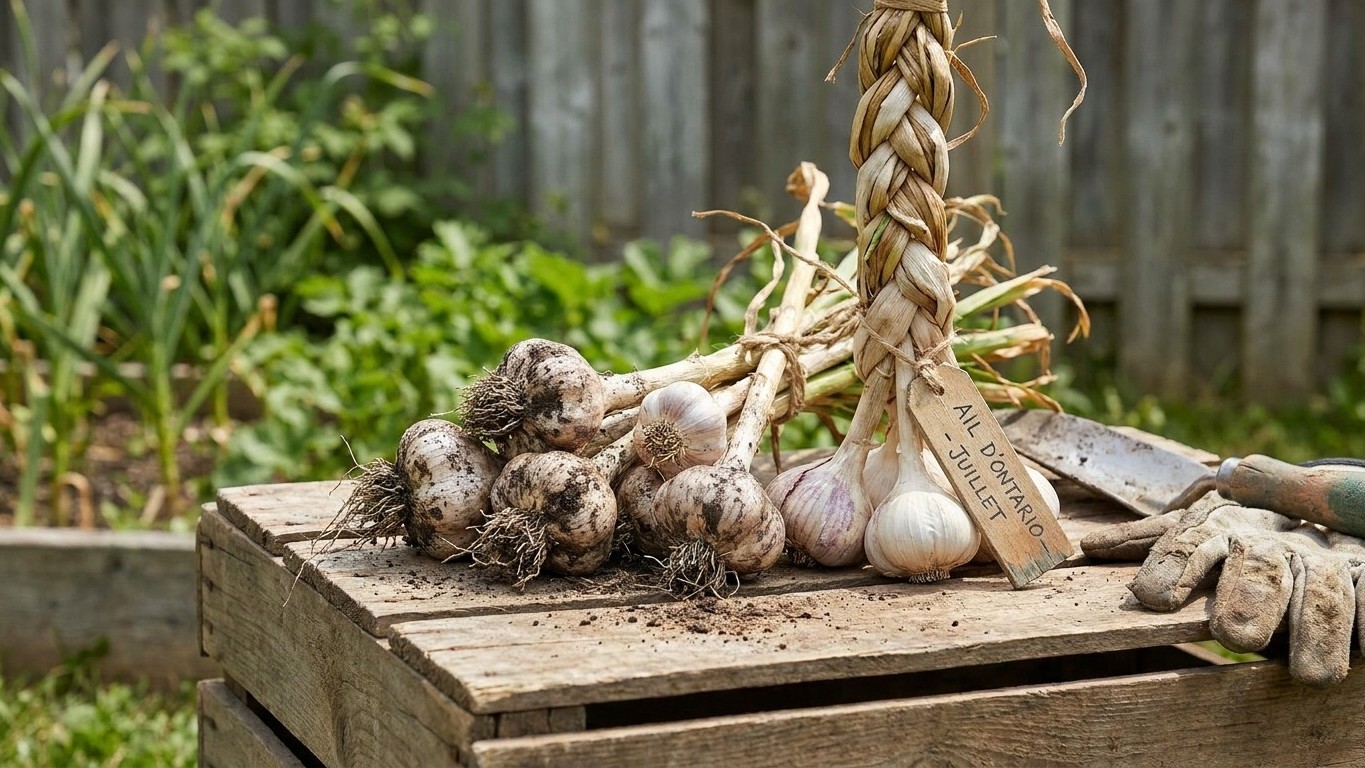

Most Ontario gardeners Plant Garlic in late September. That timing is set by working backward from the province’s average first fall frost, which Environment and Climate Change Canada’s 1981-2010 climate normals put at October 16 for the Toronto Pearson station. That date is a midpoint, not a guarantee: frost arrives later than average in half of all years. Check your own nearest weather station’s frost record before you commit a date, then aim to have cloves in the ground about three weeks ahead of it.
The short answer for Ontario

Plant Garlic in late September across most of southern and central Ontario, once the bed is prepared as described in Growing Garlic in Ontario. That’s the window the catalogue dates point to for every variety carried in this territory, from softnecks like Inchelium Red to hardnecks like German White. The date isn’t picked off a calendar at random. It’s counted backward from the province’s average first fall frost, which Environment and Climate Change Canada’s 1981-2010 climate normals place at October 16, measured at the Toronto Pearson International Airport station.
Three weeks before that average lands in late September, and that’s why every cultivar on the local list carries the same set-out window regardless of days to maturity. Garlic planting date is driven by soil cooling and root establishment, not by the maturity count printed on the seed packet, which instead tells you when to expect harvest the following summer.
Treat October 16 as a midpoint, not a deadline. Environment and Climate Change Canada’s normals describe an average across three decades of records: in roughly half of those years the first frost fell after October 16, and in the other half it fell before. A grower who waits for frost in the forecast has already missed the better part of the planting window in years when frost runs late, and lost time to freeze-up in years when it runs early.
Ontario’s winters supply plenty of cold once cloves are in the ground. Measured cold here totals 30.4 weeks below 40°F, which comfortably clears the six to eight weeks garlic needs after planting to vernalize and split into cloves, according to University of Georgia Extension bulletin C854. That’s not a reason to plant late. It’s a reason not to worry about a hardneck like Duganski failing to size up from insufficient cold, the way growers further south sometimes do.
Working it out for your own garden
The arithmetic behind that late-September window is simple enough to redo for your own address. Take your local average first fall frost date, subtract about three weeks, and that’s your target planting window. For the Toronto area, Environment and Climate Change Canada’s normals put that frost at October 16, so October 16 minus three weeks lands in late September, roughly the last week of the month depending on how you round it.
Why three weeks, not two or four
Three weeks gives cloves enough time to push roots into the soil before the ground cools past the point where root growth stops, without so much time that top growth breaks the surface and gets caught by a hard freeze. Garlic planted too early sends up green shoots that winterkill back; garlic planted too late enters winter with no root system at all, and can heave out of the soil during freeze-thaw cycles. Neither is automatically fatal, but both cost yield.
Your own three-week window shifts if your local frost date differs from the Pearson station reading, and it likely will. A single weather station some distance from your garden is not your garden’s climate. If your county’s average first frost lands two weeks earlier than Toronto’s, plan to plant two weeks earlier too. If it lands later, you get more room.
What else moves the number
- Elevation: gardens on higher ground cool faster in autumn and want an earlier planting date than a valley garden nearby.
- Proximity to a large lake: Lake Ontario, Lake Erie and Lake Huron all hold summer heat into fall and can push a local frost date later than an inland reading.
- Soil type and drainage: heavy clay holds cold and moisture longer into fall, which argues for planting a little earlier so cloves aren’t sitting in cold, wet ground before they root.
- Wind exposure: an open, exposed bed loses heat faster overnight than one with windbreaks, and can run a frost date a few days ahead of an official station reading.
None of these factors carry a number you can look up for your specific plot. They’re reasons to treat the Pearson-station October 16 average as a starting point, watch your own garden’s frost history if you’ve kept notes, and lean early rather than late if you’re unsure. Garlic tolerates an early planting far better than a late one: the worst case with early planting is some shoot growth that winter cuts back, while the worst case with late planting is a clove that never rooted at all.
What changes across Ontario
Ontario spans a long stretch of latitude and several distinct climate influences, and the late-September figure describes the Toronto Pearson station. Other parts of the province run measurably ahead of or behind it.
Where it runs later
Southwestern Ontario, close to Lake Erie and Lake Huron, tends to hold heat later into fall than inland stations, because a large body of water cools more slowly than open ground or air. Gardeners around Windsor and the Niagara Peninsula, both moderated by Great Lakes water, often see their first frost arrive later than the Toronto-area average, which can push a garlic planting date toward early October rather than late September.
Where it runs earlier
Move north or east and the pattern reverses. The Ottawa Valley and eastern Ontario sit farther from large-lake moderation and see colder autumns arrive sooner. Northern Ontario, around Thunder Bay, Sudbury and Timmins, runs weeks behind southern Ontario in spring and correspondingly weeks ahead of it in fall: frost there typically arrives earlier than at Pearson, and a garlic bed in those districts should go in earlier than late September, not on the calendar date used near Toronto.
Elevation change inside a single county matters too. A garden on an escarpment or on high ground away from lake influence can run a week or more colder in autumn than a sheltered valley garden a short drive away. None of these regional shifts have a single official figure attached in this article, because the only station named in the source data is Toronto Pearson. Treat every direction above as qualitative: a reason to check your own district’s numbers, not a substitute for them.
The mistakes this climate punishes
Two mistakes account for most of the failed garlic beds this climate produces, and they pull in opposite directions.
Planting too late
Waiting for a frost warning before planting is the single most common error gardeners make here. Because the October 16 average from Environment and Climate Change Canada is a midpoint, not a deadline, a grower who waits to see frost in the forecast has, in half of all years, already lost two or three weeks of root-growing time. Cloves planted in mid-October instead of late September go into winter with a fraction of the root mass they need, and thin roots mean smaller bulbs the following summer, sometimes bulbs that never split into cloves at all.
Skipping mulch once the ground starts to cool
Ontario’s cold, often snow-covered winters make frost heaving a real risk for shallow-rooted cloves. Repeated freeze-thaw cycles push cloves that haven’t rooted deeply up out of the soil, exposing them to desiccation and cold injury. A layer of straw mulch, applied once the ground has started to cool but before it freezes solid, buys the root system time and evens out the freeze-thaw swings regardless of how deep the freeze runs in a given winter.
Ignoring seed stock disease in the planting window
Autumn planting doesn’t sidestep soilborne disease, and it’s a mistake to assume a hard Ontario winter kills off pathogens sitting on infected cloves. According to the University of California’s IPM guidelines for onion and garlic (UC ANR Publication 3453), white rot, caused by the fungus Sclerotium cepivorum, has a published soil temperature range of 50 to 75°F, and Ontario’s growing season sees mean air temperatures fall inside that range in four separate months including September, the month most local garlic goes into the ground. Fusarium basal rot, caused by Fusarium oxysporum f. sp. cepae, has a published range of 59 to 90°F, and Ontario’s mean air temperatures sit inside it for three of those months.
These are counts of air temperature against thresholds published for soil temperature, not a forecast, a single month’s average hides day-to-day swings, and the count comes from one reference station rather than a province-wide reading. None of that means white rot or fusarium can’t turn up in a given garden. It means the safest practice, whatever the numbers say, is to plant only clean, disease-free seed garlic and avoid replanting cloves from a bed that showed stunted or yellowing plants the year before.
Checking this against your county
Every figure in this article comes from one station, Toronto Pearson, and one set of climate normals. A grower in Essex County and a grower near Timmins are working with different frost calendars entirely. Before committing to a planting date, check current growing and climate information through Ontario’s Ministry of Agriculture, Food and Rural Affairs, which tracks provincial conditions and advisories.
Planting date sits between bed preparation and cultivar choice, so it’s worth reading Garlic Varieties That Suit Ontario Winters before you order seed stock, especially if you haven’t decided between a softneck and a hardneck for your district.
Common questions
Can I still Plant Garlic in October if I miss the September window?
Yes, and it’s still better than not planting at all. Expect reduced root establishment before winter and correspondingly smaller bulbs the following summer, and mulch heavier than you would for a September planting to compensate for the shorter rooting period.
What happens if I plant garlic too early, in early September?
Cloves planted well ahead of the late-September window sometimes push green shoots above ground before winter sets in, and that top growth gets cut back by hard frost. The plant usually survives and regrows in spring, but it wastes energy on regrowth that a properly timed planting doesn’t need to spend.
Does the frost date matter differently for raised beds or containers?
It does. Raised beds and containers have more surface exposed to air than ground soil, so they warm and cool faster and can need mulch earlier than an in-ground bed at the same site. If you’re growing in a raised bed, lean toward the earlier end of your planting window rather than the later end.
Can Ontario garlic be planted in spring instead of fall?
Spring-planted garlic is possible in principle but generally produces smaller bulbs, since the cloves miss most of the fall root-establishment period this article is built around.
Some gardeners also time this by the Moon: when to plant garlic by the moon, as almanac tradition rather than fact.