
By June, Manitoba’s growing window is wide open. The province’s average last spring frost, May 23, is already behind most gardeners, which means direct-sown beans, squash and corn can go into the ground, and tender transplants like tomatoes and peppers can finally move outside. Cold-hardy crops planted earlier are already producing.
What goes in the ground in June

The May 23 average last-frost date from Environment and Climate Change Canada’s Winnipeg Richardson International Airport station is a mean, not a guarantee. In one year out of two, frost arrives after that date. So the first week of June still carries some residual risk in low-lying or northern parts of the province, even though most seasons are clear by then. Soil temperature, not the date on the calendar, decides whether seed germinates or rots.
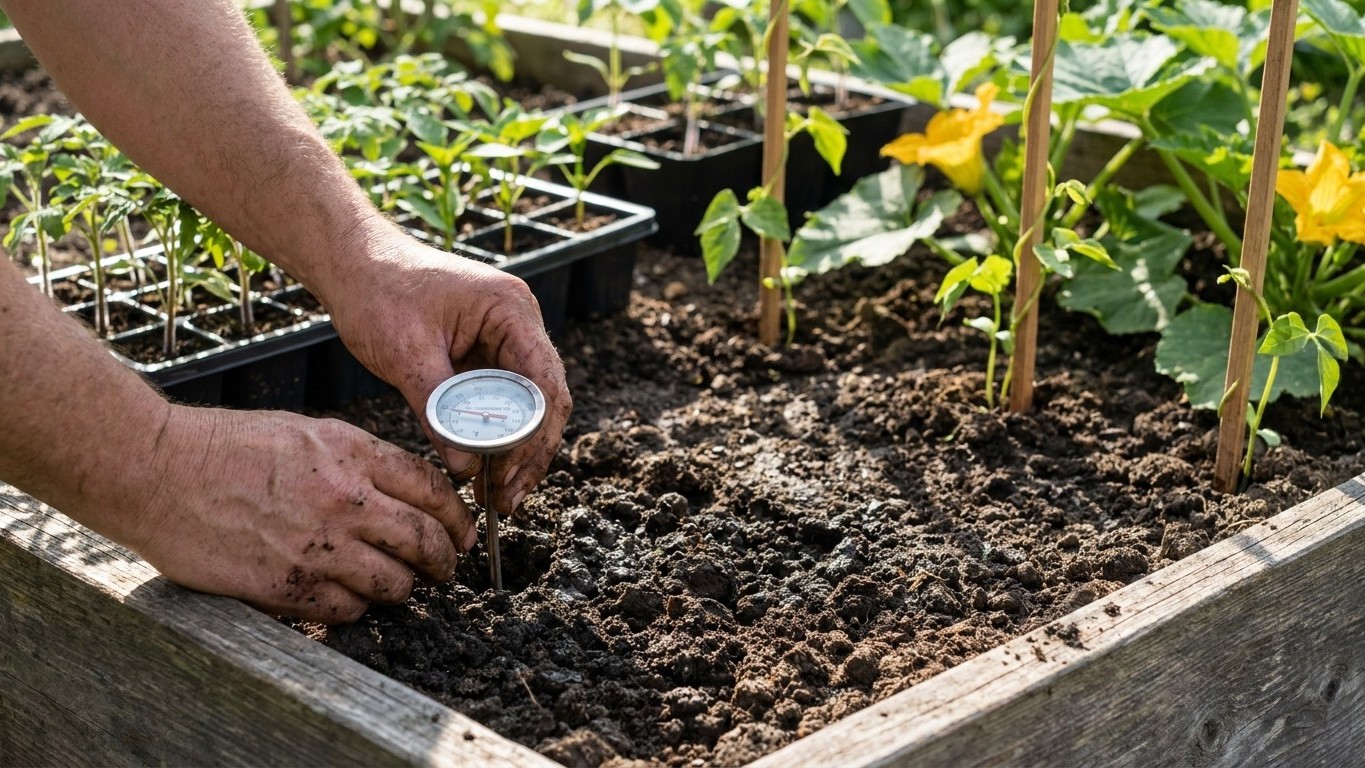
Warm-season crops need soil in the 60 to 70 degree Fahrenheit range to germinate reliably. Push a soil thermometer four inches down before committing a packet of corn or bean seed to open ground. If the reading is still in the low 50s, wait. A week’s delay costs far less than a reseeding after a cold snap rots the first sowing.
By this point in the season, most of what Manitoba gardeners plant can go directly outdoors:
- Beans, both bush and pole, direct-sown once soil has warmed
- Squash, cucumbers and melons, direct-sown or set out as transplants
- Sweet corn, direct-sown in blocks rather than single rows for pollination
- Tomato, pepper and eggplant transplants, hardened off over several days before their final move
- A second round of beets, carrots and bush beans for a later harvest
Alliums like leeks and onion sets, along with peas, should already be in the ground from earlier sowings; they tolerate cool soil far better than the crops above and don’t need to wait for June’s warmth. The table below separates what’s safe now from what still wants a few more warm days.
| Crop group | Status in June | Decision point |
|---|---|---|
| Peas, alliums, hardy greens | Already growing or safe to sow anytime | Tolerate soil in the 40s F |
| Beans, squash, corn | Safe to direct-sow once soil is warm | Soil at 60 F or higher |
| Tomatoes, peppers, eggplant | Transplant outdoors, hardened off first | Nighttime lows staying above 50 F |
| Melons, sweet potatoes | Wait for consistently warm nights | Best in the back half of June |
What to start under cover
Most spring starting is finished by June, but there’s still a reason to keep trays going, and it has nothing to do with spring. Count backward from the average first fall frost, September 22, and a second wave of sowing makes sense. Quick brassicas like bok choy or a fast cabbage need roughly 60 to 70 days to maturity; started indoors or in a cold frame now, they’re ready to move into the garden as earlier crops finish, and still have time to mature before frost returns.
Lettuce and other greens can be started in small batches every couple of weeks right through June, either in trays kept out of the hottest afternoon sun or direct-sown in a partly shaded bed. Starting too early in the season isn’t the risk here; the risk is starting too late for fall crops that need a long run, like storage cabbage or leeks meant to overwinter.
The two failure modes to watch for cut in opposite directions. Start fall brassicas too soon and they bolt in midsummer heat before ever reaching the garden. Start them too late, counting from that September 22 average, and they hit frost half-grown. A rough middle path, sowing fall brassicas indoors in the first half of June for transplant in July, gives most varieties enough runway without exposing them to peak heat stress as seedlings.
Herbs like basil and dill also do well started in successive small batches now, since a single early planting tends to bolt by midsummer and leave a gap in the kitchen garden.
What is ready to pick
June is when the garden starts paying back the early spring work. Asparagus beds established in prior years are in full production, and rhubarb stalks are thick enough for a first pull. Spinach and lettuce sown in April are at their peak before the heat turns them bitter; harvest whole plants or keep cutting outer leaves to stretch the season a little longer.
Radishes sown in early spring are ready within three to four weeks of sowing, so successive small plantings should be coming out steadily rather than all at once. Peas planted early are climbing and, toward the end of the month, the first pods should be filling out; check by feel rather than sight, since a pod that looks full can still be short on peas inside.
Green onions and the thinnings from carrot and beet rows are also worth using in the kitchen rather than composting; thinning a crowded row of carrots in June both improves the remaining roots and gives an early taste of the crop.
Anyone still working through stored crops from the previous season, potatoes, onions, winter squash, should be checking them regularly now. Warmer ambient temperatures speed up sprouting and rot in storage, so a weekly check for soft spots or sprouting eyes prevents one bad squash from spreading to the rest of the bin.
The jobs that matter this month
Mulching is the single job that pays off most in June. Soil that was bare and cool in May is now warming fast, and a two to three inch layer of straw or shredded leaves around tomatoes, squash and beans holds that moisture in before the first real heat arrives. Skip it now, and by midsummer the same beds need daily watering instead of two or three times a week.
Staking and trellising also belong on this month’s list, not next month’s. Tomatoes, peas and climbing beans grow fast once the weather turns warm, and a cage or trellis installed after the plant has sprawled damages roots and stems that a stake set at planting time would have avoided entirely. The same goes for corn: block planting needs to be laid out now, since a poor pollination pattern can’t be fixed once tassels appear.
Succession sowing keeps the harvest steady rather than concentrated into one overwhelming week. A fresh row of beans, beets or lettuce every two to three weeks through June means the kitchen gets a manageable trickle of produce instead of a glut followed by a gap.
Pest scouting matters more in June than almost any other month, since this is when flea beetles riddle young brassica leaves and cutworms cut off seedlings at the soil line overnight. A daily five-minute walk through the beds, checking undersides of leaves and the base of new transplants, catches both problems while a hand-removal or a simple collar around stems still solves them. Left until the damage is obvious, both pests can wipe out a planting in days.
Watering rhythm deserves attention too: deep, infrequent watering trains roots to grow down rather than staying shallow, which matters once July heat arrives and shallow-rooted plants are the first to wilt.
What not to do in June
The most common mistake this month is trusting warm air over cold soil. A string of 70-degree afternoons doesn’t mean the ground four inches down has caught up; soil warms slowly, and squash or corn seed dropped into cold, wet soil often rots before it germinates rather than simply sitting dormant. Check with a thermometer rather than a jacket.
Removing row covers or cold frames too early after a mild stretch is the second classic error. A few warm nights in a row can feel like summer has arrived, but a late cold snap, especially in low-lying areas that drain cold air more slowly, can still knock back tender seedlings that lost their protection a week too soon. Keep covers within reach until nighttime lows are reliably staying above 50 degrees.
Nitrogen timing trips up a lot of gardeners in June as well. A heavy dose of high-nitrogen fertilizer on tomatoes or peppers right as they’re setting their first flowers pushes leafy growth at the expense of fruit; the plants look lush and produce little. Save the nitrogen-heavy feeding for the leafy crops, and switch tomatoes and peppers to a lower-nitrogen, higher-phosphorus feed once flowering starts.
Overcrowding is the quieter version of the same problem. Seedlings that looked properly spaced on the day of planting fill in fast in June’s growing conditions, and beds left unthinned end up with weak, spindly plants competing for the same light and root space. A hard thinning now, even if it feels wasteful, produces a better crop than a crowded row left alone.
Checking this against your own county
Every figure above comes from a single weather station, Winnipeg Richardson International Airport, and Manitoba is not one climate. Elevation, distance from Lake Winnipeg and simple latitude can shift both the average last spring frost and the average first fall frost by two weeks or more in either direction. A garden in the Interlake region or farther north should treat these dates as a starting point to adjust from, not a fixed instruction.
The Canadian hardiness zone of 3b cited for the reference station is built on seven climate variables and doesn’t convert cleanly to a USDA zone used elsewhere; treat it as a regional signal rather than a precise match to zone maps used south of the border.
For local frost records and a province-specific planting calendar, Manitoba Agriculture keeps current guidance at gov.mb.ca/agriculture.
Common questions
Is it too late to plant tomatoes in June in Manitoba?
No. Since the average last frost falls on May 23, June transplanting is normal timing for tomatoes, peppers and eggplant across most of the province, provided the plants have been hardened off first.
Can I still direct-sow corn and beans in June?
Yes, and for many Manitoba gardens June is the better month than May for these crops, since soil needs to reach roughly 60 degrees Fahrenheit before the seed germinates well rather than sitting and rotting.
What should I do if a late frost hits in early June?
Since May 23 is only an average, keep row cover or old sheets on hand through the first week or two of June for tender transplants, and be ready to cover them on a night with a clear sky and calm wind, the conditions most likely to bring frost even after a warm stretch.
Why does my neighboring county seem a week or two ahead or behind?
Local frost dates shift with elevation, proximity to large lakes and latitude within the province; the Winnipeg-area average used here is a reference point, and Manitoba Agriculture’s own resources are the better source for county-level adjustment.