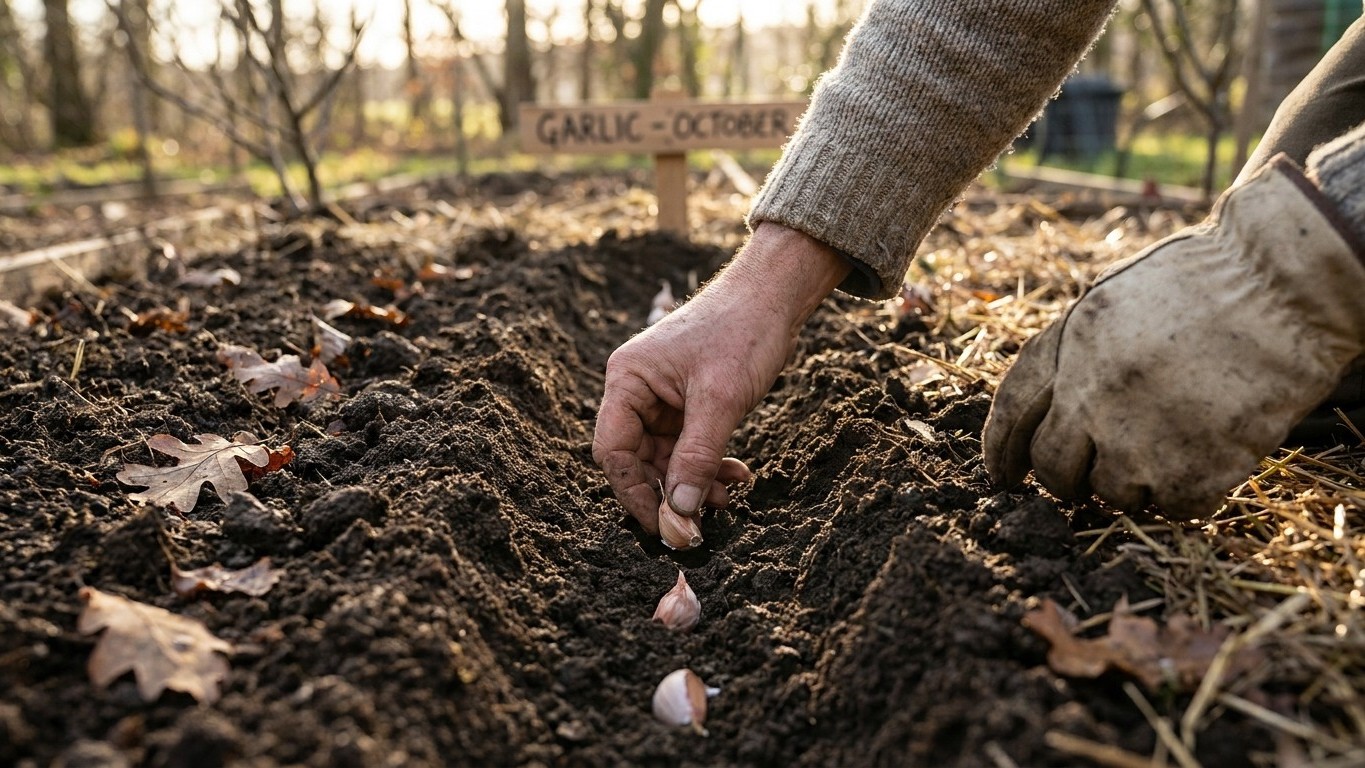

October in Massachusetts means garlic and shallot cloves going into the ground, spring bulbs like tulips and daffodils getting tucked in, and cover crops like winter rye seeded over cleared beds. It also means racing the first fall frost, which arrives November 3 to November 14 near Boston and noticeably earlier inland. Warm-season crops are done. Cold-hardy greens under cover and dormant bare-root plantings are still fair game through most of the month.
What goes in the ground in October

The decision this month turns on one thing: how close your yard is to that first fall frost, not what date is printed on a calendar. NOAA’s 1991-2020 normals put the 30-70% freeze probability window at November 3 to November 14 for the Logan Airport station in Boston, the mildest spot in the state. Inland valleys, the Berkshires, and low-lying frost pockets can see their first freeze weeks earlier. If your area has already frozen, October’s outdoor planting list narrows fast.
What survives the gamble is a short, specific list. Garlic and shallot cloves go in now regardless of frost, planted 2 inches deep and mulched after the ground cools, because they need the cold months to form proper bulbs by summer. Spring-flowering bulbs, tulips, daffodils, crocus, and alliums, go in on the same logic: they want a long chilling period, and October soil is usually still workable enough to dig.
Cover crops like winter rye or crimson clover can still be broadcast over cleared vegetable beds early in the month in most of the state, giving them time to establish roots before hard freeze locks the soil. Bare-root fruit trees, roses, and perennials can also go in while soil temperatures stay above roughly 40°F, since root growth continues even after top growth stops.
What is not worth risking
Direct-sowing anything meant for a fall harvest, lettuce, spinach, radishes, is a gamble once you’re within two to three weeks of your local frost date, since germination and growth slow sharply as soil temperatures drop. If you’re past your area’s typical first frost, skip outdoor sowing entirely and shift that energy to cold frames or indoor starts instead.
What to start under cover
October isn’t a month for starting much indoors for outdoor transplanting later, since the growing season is closing rather than opening. The exception is cold-hardy greens meant to overwinter in an unheated cold frame or low tunnel for a late-winter or very-early-spring harvest. Spinach, mache (corn salad), and claytonia are the standbys, because all three tolerate hard freezes once established and will sit largely dormant through the coldest weeks before resuming growth as daylight lengthens.
Count backward from your local frost window rather than from the calendar. If your area typically freezes hard around mid-November, spinach and mache sown under cover in the first half of October have roughly four to five weeks of mild soil temperatures to germinate and put on a few true leaves before growth stalls for winter. Sow later than that and seedlings may not size up enough to survive cleanly.
The two failure modes are mirror images of each other. Sow too early under cover and you risk lush, tender growth that gets hit hard by the first real freeze, since soft new tissue hasn’t had time to toughen up. Sow too late and seeds simply won’t germinate before the soil turns cold, leaving you with bare ground under your tunnel all winter. Microgreens and sprouts on a windowsill sidestep the whole problem, since they run their full cycle indoors in one to three weeks regardless of what’s happening outside.
What is ready to pick
October is one of the more generous harvest months in Massachusetts, not a lean one. Winter squash and pumpkins come off the vine once their skin resists a fingernail scratch and the stem has started to dry and corky. Leave a few inches of stem attached when you cut them, since a squash with a broken stem rots faster in storage.
Apples, depending on variety, are mid-to-late in their harvest window, and a ripe one should separate from the branch with a gentle upward twist rather than a hard pull. Brassicas, Brussels sprouts, cabbage, kale, and broccoli side shoots, are actually improved by a light frost, which converts starches to sugars and mellows their flavor, so there’s no rush to pull them before the first cold snap.
Root crops, carrots, beets, potatoes, and turnips, can stay in the ground later than most gardeners assume, protected by a few inches of soil, though a heavy mulch layer buys extra weeks before a hard freeze forces the issue. For anything already in storage from earlier harvests, this is the month to check onions, garlic, and winter squash for soft spots or sprouting; one rotting onion in a mesh bag can taint the ones around it faster than you’d expect.
The jobs that matter this month
Garlic planting sits at the top of the list, and it has a real deadline: cloves need roughly four to six weeks of cool soil before hard freeze to root in properly, so pushing this into November in most of the state means a weaker crop next summer. Mulching garlic and new bulb plantings should wait until after the ground has cooled, ideally after a couple of frosts, since mulching too early traps warmth and can attract rodents looking for a cozy winter spot.
Cleanup and cover crops
Clearing spent tomato, squash, and bean plants now, rather than leaving them to collapse under the first snow, cuts down on overwintering pests and disease spores that would otherwise carry into next season. Any bed that’s cleared and won’t be replanted with a cover crop benefits from a couple of inches of shredded leaves or compost, which protects soil structure over winter without the fertility risk of raw manure.
Tools, storage, and planning
Draining and coiling hoses before a hard freeze cracks the fittings is a five-minute job that saves a replacement purchase every spring. Tender perennials in containers, and any tropical houseplants that spent the summer outdoors, need to come in before nighttime temperatures dip into the 40s, since sudden cold shock does more damage than a gradual transition indoors. Dormant pruning of fruit trees and berry canes can begin late in the month once leaves have dropped, though the bulk of that work is better saved for deeper winter when the plant is fully asleep. This is also a smart window to test soil pH and order seed for spring, since popular varieties from smaller seed companies do sell out over winter.
What not to do in October
The most common mistake is treating a warm afternoon as permission to keep tender crops in the ground. A 65°F day in early October doesn’t mean the soil has warmed back up, and it doesn’t undo the fact that a frost can arrive that same night once conditions align. Trust the forecast for your specific area over how the air feels on your skin.
Mulching too early is a close second. Piling straw or leaves over garlic, bulbs, or perennial beds while the soil is still warm traps heat and moisture, which can rot cloves and roots or invite voles and mice looking for shelter before the cold really sets in. Wait until after the ground has had a hard frost or two before mulching heavily.
Feeding nitrogen fertilizer this late is another classic misstep. Nitrogen pushes soft new growth, and soft new growth is exactly what gets killed fastest by an early freeze, whether it’s on a lawn, a shrub, or a vegetable bed. If you’re feeding anything in October, a low-nitrogen, phosphorus-and-potassium-leaning product supports root development instead, which is what plants actually need heading into winter.
Finally, don’t wait too long to bring in winter squash and pumpkins. A light frost won’t hurt most mature squash sitting on the vine, but a hard freeze can damage the skin and shorten storage life significantly, so it pays to track the forecast rather than assume you have unlimited time.
Checking this against your own county
A statewide October guide is a starting point, not a set of instructions for your specific yard. Massachusetts spans USDA Hardiness Zones 5a to 7b, and elevation, distance from the coast, and low-lying frost pockets shift real-world planting and frost windows by two to three weeks in either direction from what a coastal Boston station reports. A garden in the Berkshires or a rural inland valley should plan on frost arriving well before the Logan Airport dates cited here.
For localized frost data, soil testing, and planting calendars tuned to your county, the UMass Amherst Extension service is the reliable next stop.
Common questions
Is it too late to plant garlic in October in Massachusetts?
No. October is actually the classic month for it, since cloves need roughly four to six weeks of cool soil to root before the ground freezes hard, and most of the state still has that window open through the month.
Can I still start a fall vegetable garden in October?
Direct-sowing for an outdoor fall harvest is risky once you’re within a couple weeks of your local first frost. Cold-hardy greens like spinach or mache under a cold frame or low tunnel are a better bet for anything sown this late.
When should I mulch my garlic or bulb beds?
After the ground has had at least one or two hard frosts, not before. Mulching while soil is still warm can trap heat, encourage rot, and attract rodents looking for winter shelter.
How do I know if the frost dates for my area differ from the state average?
Elevation and distance from the coast matter more than the calendar. Inland and higher-elevation areas freeze earlier than coastal Boston, so check with the UMass Extension service for data closer to your specific county.
Gardeners who plant by the Moon can check the October 2026 moon planting calendar, a tradition rather than a proven method.
Related guides
Elsewhere? See what to plant in October in every state and province.