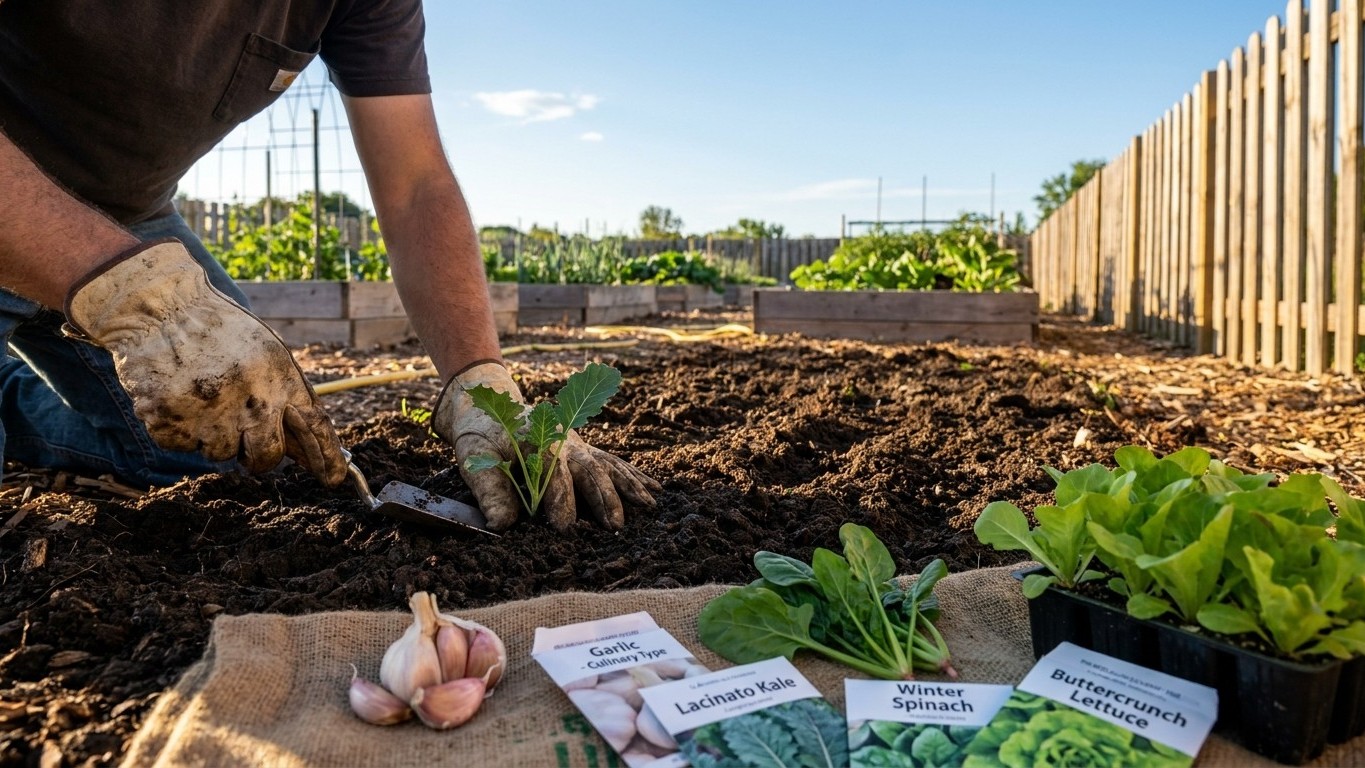

October is a working month in Mississippi gardens, not a wind-down. With the first frost still four to six weeks away across most of the state, there’s time to fill beds with cool-season crops, harvest the last of summer’s bounty, and get garlic in the ground before winter sets in.
What goes in the ground in October

The decision here isn’t the calendar, it’s the thermometer and the frost clock. At the reference weather station used for state climate data, the first fall freeze lands somewhere between November 7 and November 22 (NOAA NCEI 1991-2020 Climate Normals). That leaves a real window, four to six weeks of frost-free growing, which is enough time for a long list of cool-season crops to establish and produce before cold shuts them down.
Direct-sow turnips, mustard greens, collards, kale, spinach, lettuce, radishes, carrots, and beets now. All of these germinate fine in cooling soil and most reach harvestable size well within the frost window. English peas can go in early in the month too, especially in the southern part of the state where the season runs a little longer. Garlic and shallot cloves are usually planted toward the back half of October or into November, once nights have cooled but before the ground turns cold and hard.
Transplants matter here as much as seeds. Broccoli, cabbage, cauliflower, and Brussels sprouts started indoors back in late summer should be going into the ground now as young plants, not seeds, because starting them from seed outdoors in October would run out of time before a hard freeze.
Mississippi’s hardiness range spans zone 7b to 9a under the USDA Plant Hardiness Zone Map, and that spread matters more in October than almost any other month. A gardener near the Gulf Coast in zone 9a might still coax a fall crop of bush beans to maturity; a gardener in the Hill Country at zone 7b is already past that window and should stick to the cold-hardy list. Treat the frost dates above as a reference-city estimate, not a guarantee for your particular yard.
What to start under cover
Counting backward from the first frost window is the only reliable method here, because the calendar date means nothing without knowing how many weeks a given crop needs to reach transplant size. If your first freeze typically lands in mid-November, and a batch of lettuce or spinach transplants needs four to five weeks under cover before they’re ready to move outside, then October openings are still workable for succession plantings meant to fill gaps in the fall bed.
Cool-season flower seedlings, pansies and snapdragons among them, are commonly started under cover this month too, timed to go into beds once the worst of the October heat has broken.
The two ways this goes wrong are opposite problems. Start too early, while soil and air are still warm from September, and greens started indoors get leggy and rootbound sitting in trays waiting for planting-out weather to arrive, or they bolt before they even reach the garden. Start too late, and transplants don’t have enough weeks of growth left before cold slows everything down, leaving you with small, disappointing plants that never size up. The fix is the same conversation every time: count the weeks a variety needs on the seed packet, count backward from your local frost window, and split the difference rather than guessing.
In the far southern parts of the state, where frost tends to arrive at the later end of the range, there’s sometimes room for one more wave of broccoli or cabbage transplants started under cover this month. Farther north, that window has usually already closed, and the safer bet is to focus indoor starting on crops with shorter timelines to harvest.
What is ready to pick
Sweet potatoes are the headline harvest this month across most of Mississippi. They need to come out of the ground before soil temperatures drop and before the first hard freeze damages the tubers, so digging typically happens well ahead of that Nov 7 to Nov 22 window rather than right up against it. After digging, they need to cure in a warm spot for a couple of weeks before storage, which turns starchy roots sweeter and toughens the skin for longer keeping.
Pecans are dropping through Mississippi orchards and yards this month, and homeowners with mature trees should be gathering nuts regularly rather than letting them sit on wet ground, where mold and squirrels both take a toll fast.
Peppers, eggplant, and okra are often still producing into October, especially in the southern half of the state, and picking them regularly keeps the plants going a little longer before cold finally ends the season. Basil in particular is worth harvesting hard now, since it’s one of the first things a light frost will blacken.
Fall greens sown back in September, mustard, turnip greens, and baby lettuce among them, are usually ready for their first cutting by mid to late October. Check them by leaf size rather than by the calendar: most greens are ready for a first light harvest once outer leaves reach four to six inches, which lets the plant keep producing from the center.
The jobs that matter this month
Empty beds left behind by finished summer crops shouldn’t sit bare through fall. Sowing a cover crop like crimson clover or cereal rye now gives roots time to establish before winter, protects soil from erosion over the cold months, and adds organic matter back in come spring. Skip this step and those beds lose structure and nutrients they didn’t need to lose.
Mulch matters differently in October than it did in July. Instead of just holding moisture, a fresh layer around fall greens and brassicas buffers soil temperature swings and buys a few extra degrees of frost protection on the first cool nights. Put it down before the first real cold snap, not after.
Pest pressure shifts with the weather. Cool-season brassicas draw aphids and cabbage worms even as the tomato hornworms and squash bugs of summer fade out, so scouting the undersides of kale and cabbage leaves weekly catches problems before they spread through a whole bed.
Garlic beds need prep before planting, not on planting day. Working compost into the soil a couple of weeks ahead of setting cloves lets the amendment settle and gives roots a head start once the cloves go in.
This is also the month to start ordering seed for the coming spring, particularly for garlic varieties and specialty vegetable seed that tend to sell out over winter, and to pull soil samples for testing since results can take a couple of weeks to come back and inform any amendments before the ground freezes solid. Cleaning and sharpening tools now, before storage, saves time come spring.
What not to do in October
Warm-season crops are the classic October mistake. A stretch of eighty-degree afternoons can trick a gardener into thinking there’s time for one more round of tomatoes or peppers, but with only four to six weeks left before frost, and warm-season transplants needing eight to ten weeks to fruit, the math simply doesn’t work. Those plants will still be flowering, not fruiting, when the first freeze hits.
Pulling row cover or mulch off fall greens after a mild week is another common misstep. A warm spell in early or mid-October doesn’t mean frost risk has passed, it just means it hasn’t arrived yet, and uncovering tender seedlings too soon leaves them exposed the night temperatures drop again.
Heavy nitrogen feeding is worth backing off this month, particularly on shrubs, fruit trees, and perennials headed into dormancy. A late nitrogen push forces soft new growth that a freeze will kill outright, wasting the plant’s energy on tissue that never has a chance to harden off.
Stored produce from earlier harvests deserves a check-in too. Potatoes, onions, and winter squash tucked away in storage should get a quick look for soft spots or mold now, before one bad squash spreads rot through the whole bin.
Checking this against your own county
A state-wide October guide is a starting point, not a set of instructions for your particular yard. Mississippi’s elevation changes, the gap between the Delta and the coastal counties, and local microclimates can shift frost timing by a week or two in either direction from the reference dates above. A hardiness range of zone 7b to 9a across one state is itself a signal that no single planting date fits everywhere.
For county-level guidance, the Mississippi State University Extension Service publishes planting calendars and frost data tailored to specific regions of the state, and it’s worth checking those before committing a bed to any one crop.
Common questions
When is the first frost in Mississippi?
At the reference weather station used for state climate normals, the first fall freeze falls between November 7 and November 22 (NOAA NCEI 1991-2020 Climate Normals). Local conditions, especially elevation and distance from the coast, can push that date earlier or later by a week or more.
Can I still plant tomatoes in October in Mississippi?
Generally no. Tomato transplants need eight to ten weeks to reach fruiting, and October only leaves four to six weeks before the typical first frost. Focus on cool-season crops instead.
What vegetables can I harvest in October in Mississippi?
Sweet potatoes, fall greens sown in September, and late-season peppers, eggplant, and okra are typically ready. Pecans are also dropping and worth gathering regularly.
Is it too late to plant garlic in October?
No. Garlic cloves are commonly planted toward the back half of October or into November across most of the state, once soil has cooled but before it turns cold and hard.
Gardeners who plant by the Moon can check the October 2026 moon planting calendar, a tradition rather than a proven method.
Related guides
- What to Plant in Mississippi in January
- When to Plant Melons in Mississippi
- When to Plant Asparagus Crowns in Mississippi
- What to Plant in Mississippi in November
Elsewhere? See what to plant in October in every state and province.