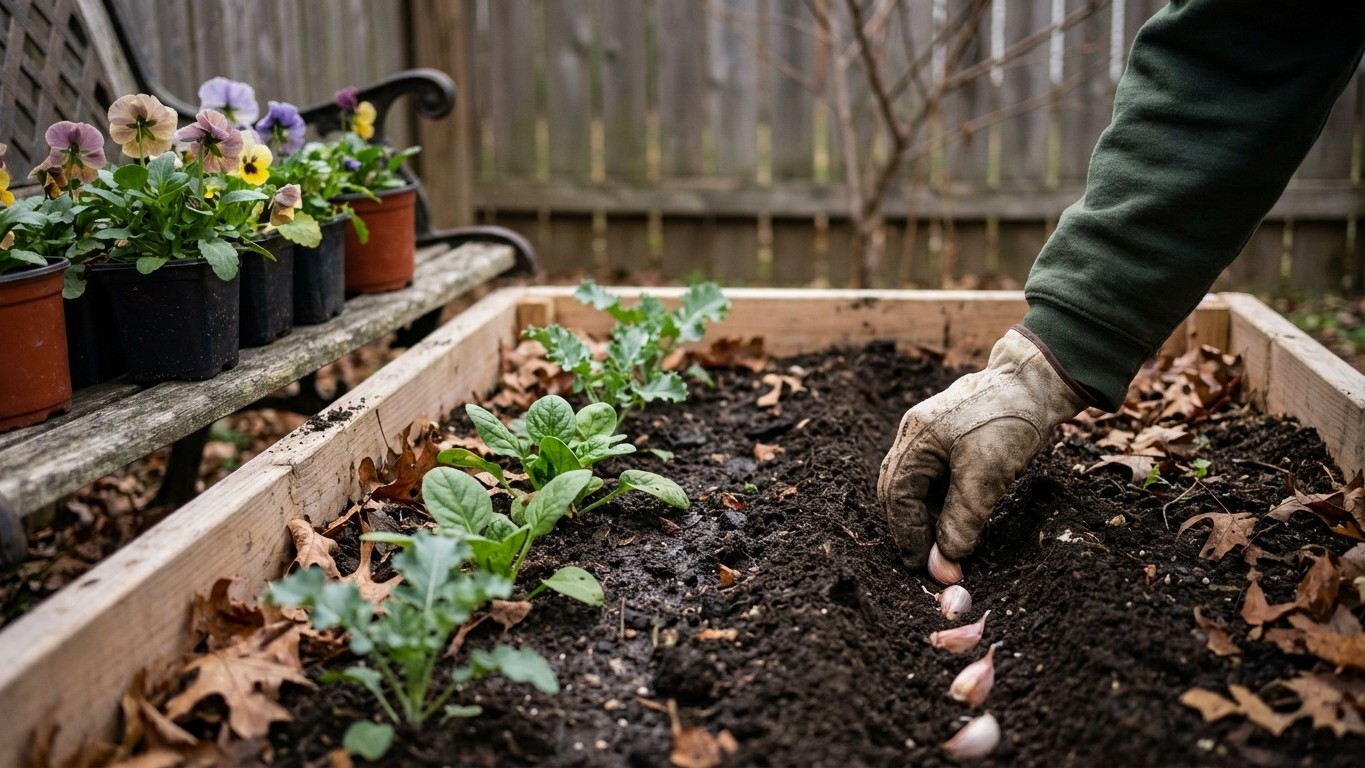

Garlic goes in the ground this month across most of Newfoundland and Labrador, and it’s the single most important planting date on the whole calendar here. But October also straddles the average first fall frost, so timing matters more than usual: plant too early and shoots emerge before winter, plant too late and the ground may already be locking up.
What goes in the ground in October

The number that governs this whole month is October 17, the average first fall frost recorded at the ST JOHN’S A station under Environment and Climate Change Canada’s 1981-2010 climate normals. That’s an average, not a guarantee: in roughly half the years on record, frost arrives later, and in the other half it arrives sooner. Early October still behaves like late growing season in a mild year; by the third week, a hard frost is entirely plausible. Treat the date as a midpoint of a window, not a line on a calendar you can plan against.
Garlic and shallots are the safest bets right now. Both go into the ground as cloves or sets, root before the soil freezes solid, then sit dormant until spring growth resumes. Push cloves 2 inches deep, pointed end up, and mulch heavily with straw or shredded leaves once the surface starts to firm up. That mulch layer does double duty: it insulates the cloves through winter and suppresses early weeds when things thaw out.
Hardy alliums aside, this is also bare-root and dormant-planting season for fruit trees, berry canes, and ornamental shrubs, provided the ground is still workable with a spade. Roots establish while the soil holds some residual warmth, giving plants a head start before the ground locks up for winter. If you’re on the Avalon Peninsula where soils stay workable longer, you have more room here than growers further inland or at higher elevation.
Cold frames and low tunnels stretch the window for a short list of frost-tolerant greens: spinach, mâche, and some hardy lettuce varieties will still germinate in cool soil if the cover holds a few extra degrees. Skip anything that needs sustained warmth to germinate. If the calendar has already tipped past the average frost date where you live, don’t force it: name what tolerates cold rather than gambling on crops that won’t make it.
What to start under cover
Nothing started under cover this month is aimed at an outdoor transplant date. October sowing under glass or plastic is about squeezing one more cut of greens out of the season, not preparing for spring planting, which is months away. The arithmetic here runs backward from the season’s remaining daylight rather than from frost: with light dropping fast through fall, growth slows even inside a cold frame, so anything sown now needs to be fast-maturing and cold-tolerant from the start.
Spinach, mâche, and winter density lettuce are the reliable choices. Sown under a cold frame or low tunnel in the first half of the month, they’ll germinate on residual soil warmth and put on enough growth to survive as small, hardy plants through winter, resuming quickly once light returns. Sown later, after soil temperatures have dropped hard, germination slows to a crawl and plants may not size up before真 cold shuts things down.
The two failure modes here mirror each other. Sow too early relative to available light and warmth, and you get leggy, stretched seedlings that rot in a cold frame’s damp air before they toughen up. Sow too late, past the point where soil temperature supports germination, and seed simply sits ungerminated until spring, if it survives rot and rodents at all. The safest window is the first two weeks of the month, adjusted a week earlier if you’re further inland or at elevation, where cold sets in sooner than it does around St. John’s.
If you’re bringing tender potted herbs or citrus indoors for winter, do it before the first frost rather than after damage has already set in. A few days of transition on a porch or unheated entry lets plants adjust to lower light before they hit full indoor heat, which reduces leaf drop.
What is ready to pick
Main-crop potatoes come out this month, and timing the dig matters more than it seems. Wait until the foliage has died back and the skins have set, which you check by rubbing a thumb across the surface: if skin scuffs off easily, give it another week or two before digging for storage. Rushed potatoes bruise and rot faster in the root cellar.
Winter squash and pumpkins need to come in before a hard frost damages the skin, even though the vines may look ragged already. Cut with a few inches of stem attached, then cure in a warm, dry spot for a week or two before moving to cold storage; skipping the cure step shortens storage life considerably.
Cabbage, kale, and Brussels sprouts actually improve after a light frost touches them, converting starches to sugars and softening some of the bitterness. Leave them in the ground as long as the soil stays workable and harvest as needed rather than pulling everything at once. Carrots, parsnips, and beets can stay in the ground under a thick mulch layer well past this point, giving you fresh digging through much of the coming weeks rather than a single harvest day.
Check anything already in storage, root cellar, garage, or basement, for the first signs of trouble: a soft spot on a squash, a sprouting onion, a potato going soft at the eye. Pull those out now rather than later; one rotting squash in a bin will take neighbors with it faster than most people expect.
The jobs that matter this month
Mulching garlic and any overwintering greens is the single job with the shortest deadline here: do it before the ground freezes hard, or the insulating value drops sharply. Straw, shredded leaves, or seaweed (still gathered along parts of the coast) all work; aim for a layer thick enough that you can’t easily see soil through it.
Protect anything still producing outdoors ahead of frost nights. Row cover thrown over late lettuce, chard, or herbs on a night with a frost warning can buy another week or two of harvest, which matters when the growing season is this short to begin with. Don’t leave the cover on permanently, though: pull it back on milder days so plants don’t rot from trapped humidity.
This is also prime dormant-pruning season for fruit trees and berry canes once leaves have dropped, though wait until growth has fully stopped rather than pruning while sap is still moving. Cut out dead, crossing, or diseased wood first; save major shaping cuts for deeper dormancy later in the season.
Order garlic and seed for the coming season now rather than waiting. Good hardneck garlic varieties suited to short, cool seasons sell out early, and by the time spring seed catalogs circulate, the best stock is often gone. Turning the compost pile before the weather turns wet and cold speeds decomposition and gives you finished compost to work into beds while the ground is still open. Test soil pH now too: amendments like lime take months to shift pH, so applying now gives them a head start before spring planting.
Clean and sharpen tools before storing them, drain and disconnect hoses and any irrigation lines before a hard freeze cracks fittings, and check raised beds and fencing for repairs while the ground still allows post-setting. None of these feel urgent in the moment, but each one costs real time and money if it slips into deep winter.
What not to do in October
The most common mistake is trusting a mild stretch of weather too far. A warm week in early October doesn’t mean the season has reset; it means frost is delayed, not cancelled. Tender crops left uncovered on the strength of a nice afternoon are often the ones lost to a sudden overnight frost a few days later.
Don’t uncover cold frames or row covers too eagerly after a mild spell either. Pulling protection off greens or garlic beds because the weather felt springlike exposes them to the very swings the cover was meant to buffer, and cold-hardy plants tolerate steady cold far better than repeated freeze-thaw cycles.
Avoid feeding nitrogen to anything at this point in the season. A dose of high-nitrogen fertilizer pushes soft new growth that has no time to harden off before frost, and that growth is usually the first tissue killed when cold does arrive. If beds need feeding, compost or a balanced amendment worked in now for spring uptake is the better move.
Resist pruning spring-flowering shrubs like lilac or forsythia this month. They’ve already set next spring’s flower buds on this season’s wood, and pruning now simply cuts off the coming display. Save that job for right after they bloom instead.
And don’t leave storage crops in the ground or on the vine past the point of real risk. Waiting “just one more week” to dig potatoes or cut squash is a common way to lose a chunk of the harvest to a frost that arrives earlier than the average date suggests it should.
Checking this against your own county
A province-wide month is a starting point, not an instruction. Newfoundland and Labrador spans coastal Avalon communities, inland valleys, the west coast, and Labrador itself, and those areas do not share a single frost window. Elevation alone can shift timing by weeks, and communities further from the moderating effect of the ocean tend to see frost earlier and harder than St. John’s does. The Canadian plant hardiness zone of 6a cited here applies specifically to the St. John’s reference area under Natural Resources Canada’s system, built on seven climate variables rather than the single minimum-temperature measure the USDA scale uses; it isn’t interchangeable with a USDA zone number, and it won’t match conditions in Labrador or at higher elevation inland. For local guidance, the province’s Department of Fisheries, Forestry and Agriculture maintains extension resources worth checking against whatever you’re planning.
Common questions
Is October too late to plant garlic in Newfoundland and Labrador?
No. Garlic is meant to go in during fall so it can root before the ground freezes, then stay dormant through winter. Early to mid-October is a reasonable window in most areas, adjusted earlier if you’re inland or at elevation where the ground firms up sooner.
Will frost kill my late-season vegetables outright?
It depends on the crop. Kale, cabbage, Brussels sprouts, and carrots tolerate frost well and often taste better afterward. Tender crops like tomatoes, squash vines, and basil are damaged or killed by even a light frost and should be harvested or covered beforehand.
Should I fertilize my garden beds in October?
Skip nitrogen-heavy fertilizer this late; it encourages soft growth that frost will damage. Compost or a soil test-guided amendment applied now for spring uptake is a better use of the remaining workable-ground window.
How do I know when to dig my potatoes for storage?
Wait until the foliage has died back, then check by rubbing the skin: if it scuffs off easily, the skin hasn’t set and the potatoes will store poorly. Give it another week or two, monitoring the weather, before digging.
Gardeners who plant by the Moon can check the October 2026 moon planting calendar, a tradition rather than a proven method.
Related guides
- the Newfoundland and Labrador planting calendar
- What to Plant in Newfoundland and Labrador in September
- What to Plant in Newfoundland and Labrador in November
Elsewhere? See what to plant in October in every state and province.