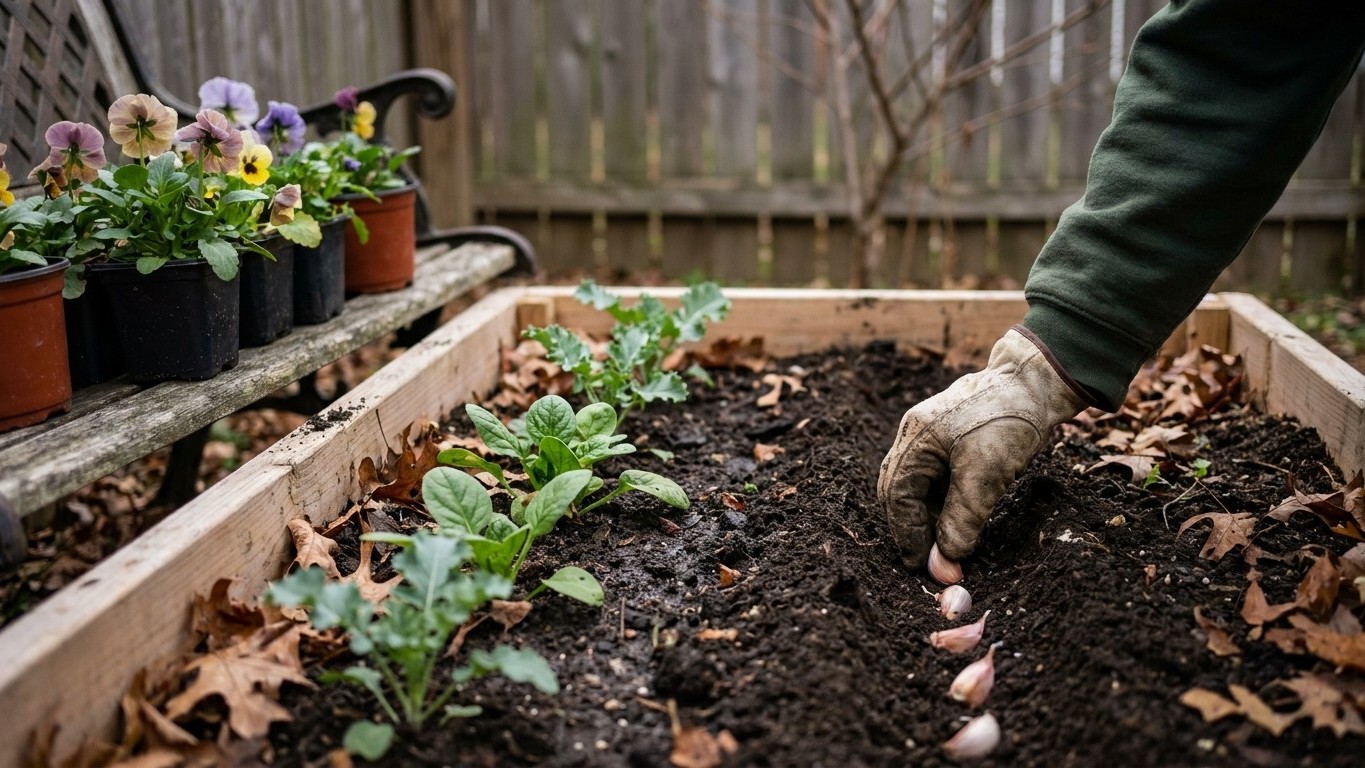

October in Nova Scotia sits right at the edge of the frost line. Garlic and shallots still go into the ground, hardy greens sown early in the month can mature before the cold arrives, and spring bulbs get tucked in for a payoff months away. Past mid-month, the safe list narrows fast as the average first fall frost approaches on October 18.
What goes in the ground in October

The decision this month turns on one number: October 18, the average date of the first fall frost at the Halifax Stanfield reference station. That is a mean, not a guarantee. In roughly half of years frost arrives later, which is why early October still allows real planting, while the back half of the month is a different game entirely.
Garlic and shallots are the anchor crop. Cloves and bulbs go into workable soil now so roots establish before the ground locks up, without top growth that would only get burned back. Spinach sown in the first two weeks of the month has a real shot at overwintering under a thick mulch or a cold frame, ready to resume growth before anything else in spring. Cover crops such as winter rye or fall rye can still be broadcast on cleared beds to hold soil through winter.
What is a gamble past mid-month
Transplanting anything tender, or direct-sowing lettuce and radish for a fall harvest, is a bet against a date that has already passed on average by month’s end. Hardy items tolerate a light frost and keep going regardless: kale, leeks already in the ground, and the alliums mentioned above. Spring-flowering bulbs (tulips, daffodils, crocus) are the other safe October planting, since they need the cold ahead to bloom and have no interest in this season’s frost window at all.
What to start under cover
New sowings for this season are mostly finished by October, but two things still make sense under glass or plastic. The first is a late cold-frame sowing of spinach or corn salad, timed so seedlings reach a few true leaves before growth slows for the winter rather than racing to maturity. Count backward from October 18: a crop needing five to six weeks to reach a hardy stage should already be in by the first week of the month, or it risks being caught mid-growth by the frost.
The second is bulb forcing indoors, paperwhites and amaryllis potted now for bloom well before spring. This is not a food crop, but it is the one legitimate “start under cover” job that belongs entirely to October rather than to September or November.
The two failure modes both show up here. Sow too early under cover and seedlings get leggy and rootbound waiting for a planting-out date that never really arrives before winter. Sow too late and there is no season left for them to use at all, cold frame or not. Since the reference frost date is a mean drawn from a single Halifax-area station, gardeners further inland or at higher elevation should push their own count a week or two earlier as a buffer, not later.
What is ready to pick
October is a harvest month more than a planting one in most gardens. Winter squash and pumpkins come in once their skin resists a fingernail scratch and the vine has started to dry back. Potatoes are lifted once the foliage has died down, on a dry day so the skins can cure before storage. Root crops like carrots, beets and parsnips can stay in the ground through several light frosts; parsnips in particular turn sweeter after cold exposure, so leaving them a little longer is a genuine improvement, not a delay.
Brussels sprouts and cabbage hold in the field and often taste better once touched by frost, which converts some of their starches to sugar. Kale behaves the same way, and a stand left in place through October can keep feeding the household well past the point most other crops are done. Apples on backyard trees are typically finishing their harvest window now, checked for readiness by how easily they part from the branch with a slight twist.
Anything already in storage from earlier harvests, squash, onions, and potatoes among them, is worth a hands-on check this month. Soft spots, a sweet smell, or shriveling skin mean that item should be used first, not left to spread rot to the rest of the bin.
The jobs that matter this month
Cleanup and protection do more for next season than any new planting at this point in the year. Clearing spent tomato and squash vines removes overwintering spots for pests and disease before the first snow buries the problem until spring. Mulching garlic beds and any overwintering spinach with straw or shredded leaves insulates roots right as the ground starts to cool, and doing it now, before a hard freeze locks the soil, is far easier than trying to mulch over frozen ground later.
Dormant pruning does not belong to October in most of Nova Scotia since trees have not fully entered dormancy, but assessing which limbs need attention, and marking them, saves guesswork once real pruning weather arrives in late winter. Seed catalogs for spring start circulating around now too, and ordering early avoids the disappointment of a sold-out variety come February.
Soil testing is worth doing on any bed that underperformed, since amendments like lime take months to adjust pH and are best worked in before winter rather than rushed in spring. Turning the compost pile one more time before cold weather slows the microbes down keeps it breaking down through winter instead of stalling solid. Tools deserve the same attention: a clean, sharpened blade on pruners and hoes now means no scrambling to fix rusted equipment when the ground finally opens again. Raised beds, fencing, and cold frame frames are also easiest to repair while the weather still allows outdoor work in shirtsleeves.
What not to do in October
The most common mistake is trusting a warm afternoon over the calendar’s approach to the average frost date. A mild stretch in early October does not mean the season has been extended, and tender crops left uncovered on the strength of a warm week are usually the ones lost to a sudden overnight drop. The fix is straightforward: keep row cover or frost cloth on hand and use it at the first forecast of a cold night, rather than waiting to see how bad it gets.
Uncovering cold frames or mulched beds too eagerly after a spell of mild weather is the reverse version of the same error. Soil and roots that have started adjusting to cooler conditions get shocked by a return to exposure right before the next cold snap arrives.
Nitrogen fertilizer applied now is close to wasted effort. Plants heading into dormancy are not using nitrogen to build new growth, and a late feed can actually push soft new shoots that then get damaged by the very frost the calendar is warning about. Anything applied this month should be slow-acting, like compost, not a quick-release nitrogen product meant for active growing season.
Checking this against your own county
Every date and zone here comes from a single reference station near Halifax, and Nova Scotia is not one climate. Coastal areas moderate temperature swings, inland valleys can run several degrees colder overnight, and higher elevations lag the coast by weeks in both spring and fall. Treat the October 18 average frost date as a starting point to adjust from, not a fixed instruction for a specific property. For a local read, the Nova Scotia Department of Agriculture is the place to check current advisories and regional guidance before finalizing plans for a given county.
Common questions
Is it too late to plant garlic in October in Nova Scotia?
No. October is the standard planting window for garlic and shallots across the province, since cloves need several weeks of root growth in cool soil before the ground freezes solid.
Can vegetables started in October survive the first frost?
Hardy crops like kale, leeks, spinach, and the alliums tolerate a light frost without damage, and some, like parsnips and Brussels sprouts, improve in flavor from it. Tender crops do not survive and should be harvested or protected before frost arrives.
What is the Canadian hardiness zone for Nova Scotia and how does it compare to US zones?
The reference city sits in Canadian zone 6b, based on Natural Resources Canada’s system, which uses seven climate variables rather than the single minimum-temperature measure behind the USDA system. The two scales do not convert directly, so a Canadian zone number should never be read as if it were a USDA zone from a US planting guide.
Does the October 18 frost date mean frost always arrives that day?
No. It is a long-term average from Environment and Climate Change Canada’s climate normals, meaning frost arrives later than that date in roughly half of years and earlier in the other half. It is best used as the midpoint of a risk window, not a safe cutoff.
Gardeners who plant by the Moon can check the October 2026 moon planting calendar, a tradition rather than a proven method.
Related guides
Elsewhere? See what to plant in October in every state and province.