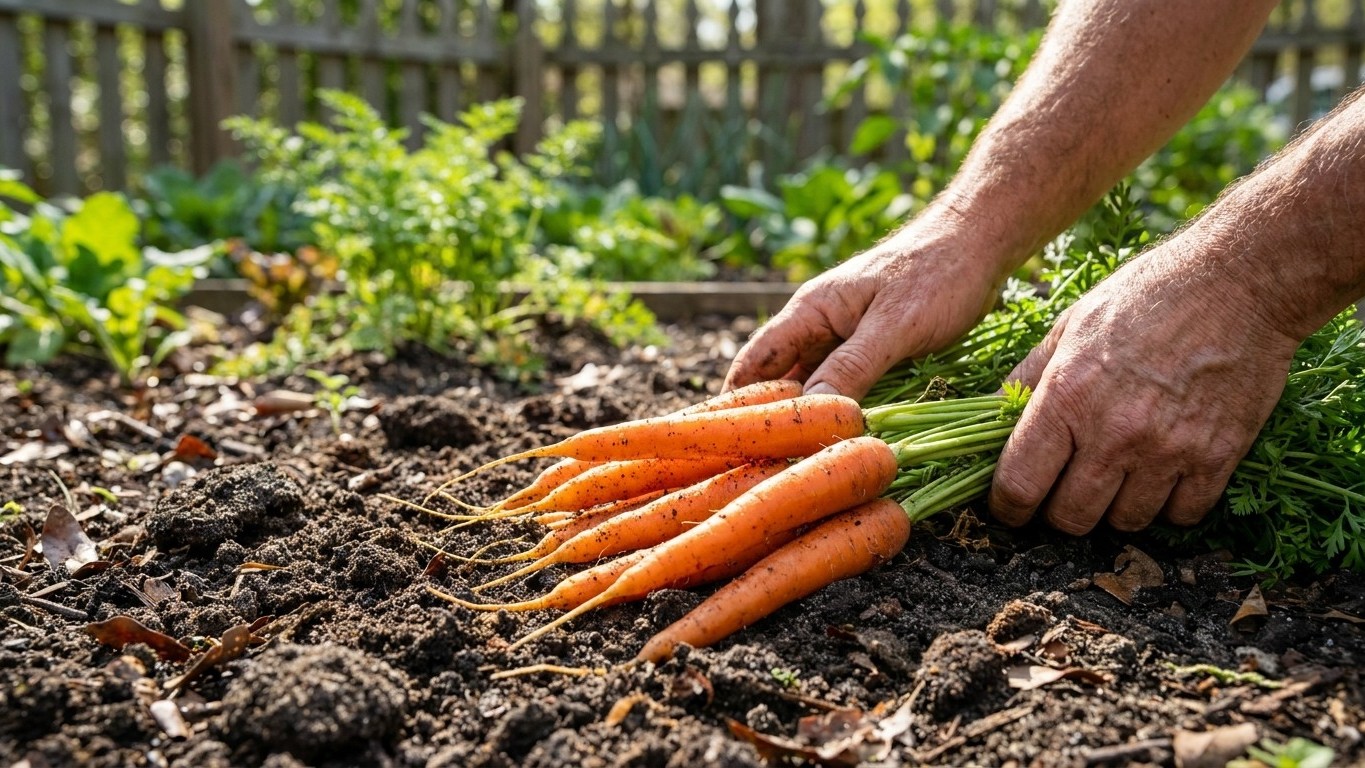

Alabama’s official state soil, the Bama series, is sandy and well drained but strongly acid and low in organic matter. That combination means carrots can grow straight in the ground in a lot of Alabama backyards without forking, but they’ll struggle to size up unless you feed the bed. The fix is compost, not a raised box, in most cases.
The short answer
The Bama series carries 67 percent sand, 14 percent clay and 19 percent silt in its surface horizon, according to USDA NRCS Soil Data Access records for the series. That’s a sand-dominant profile, and it’s the reason Alabama picked Bama as its official state soil back when the legislature made the designation in 1997. Sandy ground like this drains well, and well-drained, loose ground is exactly what a carrot root wants when it’s pushing straight down through eight or ten inches of earth looking for the path of least resistance.
So on texture alone, a lot of Alabama gardens sitting on soil like this shouldn’t see much forking. Will Carrots Fork in Alabama Soil? The answer largely comes down to what’s below the surface: forking happens when the taproot hits something it can’t push through, a rock, a clay lens, compacted subsoil, and splits around it. At 14 percent clay, Bama series ground isn’t the kind of dense, sticky soil that stops a root cold. The surface horizon is classified well drained, which also matters, because carrots rot and split in soil that stays soggy.
The catch is the rest of the profile. Bama is an Ultisol, which in plain terms means it’s old, heavily weathered, and stripped of a lot of its natural fertility by centuries of rain leaching nutrients downward. Surface pH runs around 5.3, strongly acid, and organic matter sits at roughly 0.8 percent. Carrots aren’t fussy about acidity in the way some crops are, but that low organic-matter number is the real problem, and getting When to Sow Carrots in Alabama right can help offset it by giving roots the best possible window to establish before the sandy soil dries out. Sandy soil with almost no organic matter drains so fast it can’t hold moisture or nutrients long enough for a root vegetable to bulk up. You’ll get a carrot. You might not get much of one.
The answer isn’t a raised bed by default here, the way it might be in a state with heavy clay. It’s compost, worked in generously, and worked in deep. A few inches of finished compost turned into the top ten to twelve inches of bed before you sow gives the sand something to hold onto. If you’re gardening on genuinely compacted or clay-heavy ground, double digging to loosen the root zone before you plant still applies, same as anywhere.
None of this is a diagnosis of your yard. Alabama spans hundreds of mapped soil series, and Bama is one representative soil, not a prediction of what’s under your grass. River bottoms run heavier and richer. Hill country in the northern part of the state can carry more clay and rock. Anywhere a house was built, the topsoil was likely scraped off and replaced with subsoil or fill, which behaves nothing like a native series. Treat the state soil as a regional tendency, sandy, acidic, low in organic matter, and check your own dirt before you decide anything.
The test that settles it in your own garden
State-level soil data tells you what the region leans toward. It doesn’t tell you what’s eighteen inches under your tomato bed. A few minutes with a shovel settles that.
- Dig a hole where you plan to sow, at least twelve inches deep. Carrots need that much clear, unobstructed depth to grow straight; anything less and you’ll get short, stubby, or forked roots no matter how good the topsoil looks.
- Look at what you hit on the way down. Rocks, a hard clay layer, chunks of construction debris, or a sudden color change to dense gray or orange clay all mean trouble for a root pushing straight down. Note the depth where it starts.
- Grab a handful of soil from the top few inches and rub it between your fingers. Gritty and loose means sandy, closer to what the state soil suggests. Slick, sticky, and moldable into a ribbon means clay, which raises the odds of forking and calls for compost and looser bedding regardless of what the regional data says.
- Water the hole and watch how fast it drains. If standing water is gone within a few hours, drainage is workable. If it’s still sitting there the next day, you’re dealing with a drainage problem that compost and raised planting will need to solve before carrots have any chance.
- Repeat the check in two or three spots in the same bed. Soil can change over a few feet, especially near a foundation, a driveway, or an old fill area, so one hole isn’t the whole story.
When to sow here
Carrots go into the ground as seed, directly where they’ll grow. There’s no transplanting step to count from, so every date here runs from the day you sow, not from any seedling stage. Whatever the seed packet says for days to maturity, usually somewhere in the 70 to 100 day range depending on variety, that clock starts at seeding.
- Start from the reference last spring frost window for the area, which NOAA’s 1991-2020 climate normals put at March 19 to April 3, based on freeze-probability data from a monitored weather station. That’s an airport-station figure. Gardens outside city centers, in low spots, or at any elevation typically see frost linger later, sometimes by a week or two, so treat this as a starting point, not a guarantee for your specific yard.
- Count backward two to three weeks from that window. Carrot seed tolerates cool soil better than a lot of garden crops, so sowing ahead of the last frost, rather than after it, is standard practice for this crop.
- Before you sow, check that the soil itself has warmed to at least 40 F. Carrot seed simply won’t germinate in colder ground, no matter how promising the calendar date looks.
- Watch the forecast for a stretch where soil temperatures are trending toward the 55 to 65 F range, which is where carrot germination performs best. Early sowings ahead of the frost date may sit in the ground longer before sprouting; that’s normal, and better than waiting and running into the heat that follows spring in the region.
- If you miss the early window, a fall sowing timed backward from the first fall frost is the other option, though this page focuses on the spring count.
What goes wrong here
- Forking in heavy or disturbed ground. Even where the regional soil leans sandy, plenty of Alabama yards sit on fill dirt, compacted clay near a foundation, or rocky patches that split the taproot. The remedy is the same everywhere heavy soil is the culprit: work in plenty of compost and double dig the bed before sowing, or switch to a raised bed if the native ground underneath is too shallow or too dense to fix easily.
- Poor germination during a hot spell. Carrot seed germinates best in the 55 to 65 F range, and Alabama spring can swing into much warmer stretches fast. A sudden hot snap right after sowing can stall germination or produce a spotty, uneven stand. Sowing on the early side of the recommended window, and keeping the seedbed consistently moist through any warm stretch, helps the seed come up before heat becomes a problem.
- Splitting from uneven watering. Carrots that dry out and then get soaked, whether from an irregular watering habit or a heavy rain after a dry stretch, tend to split as the root swells too fast. Sandy soil low in organic matter, like the state’s representative soil, drains and dries quickly, which makes this swing more likely unless the bed holds moisture better after compost has been worked in. Even, regular watering rather than a feast-or-famine schedule keeps the root growing steadily instead of lurching.
Checking this against your own county
Everything above is regional groundwork, not a reading of your specific plot. The Alabama Cooperative Extension System, at aces.edu, is the place to take it from here. County extension offices can run an actual soil test on a sample from your garden, telling you the real pH and nutrient levels instead of a statewide estimate, and they track local frost timing and planting guidance that accounts for how your particular county differs from an airport weather station. A soil test costs little and settles the acidity question a lot faster than guessing.
Common questions
Do carrots need raised beds in Alabama?
Not automatically. The state’s representative soil is sandy and well drained, which is friendly ground for carrots once compost is added. Raised beds make more sense where a test hole turns up shallow clay, rock, or standing water rather than as a default statewide fix.
Why is my Alabama soil so acidic for carrots?
The Bama series, Alabama’s official state soil, runs around pH 5.3 at the surface, which is strongly acid, a result of the soil being an old, heavily weathered Ultisol that’s lost much of its natural buffering over time. That’s a regional tendency, not a confirmed reading for your yard; a soil test through your county extension office gives the real number.
How deep should the soil be for straight carrots?
At least twelve inches of loose, unobstructed ground gives most carrot varieties room to grow straight without hitting rock, clay, or compacted subsoil that would force the root to fork.
When exactly should I sow carrot seed in Alabama?
Aim for two to three weeks before the last spring frost date for your area, with soil that’s reached at least 40 F. The reference frost window for one monitored Alabama station runs March 19 to April 3, but check your own county’s typical timing since outlying areas usually run later than that figure.