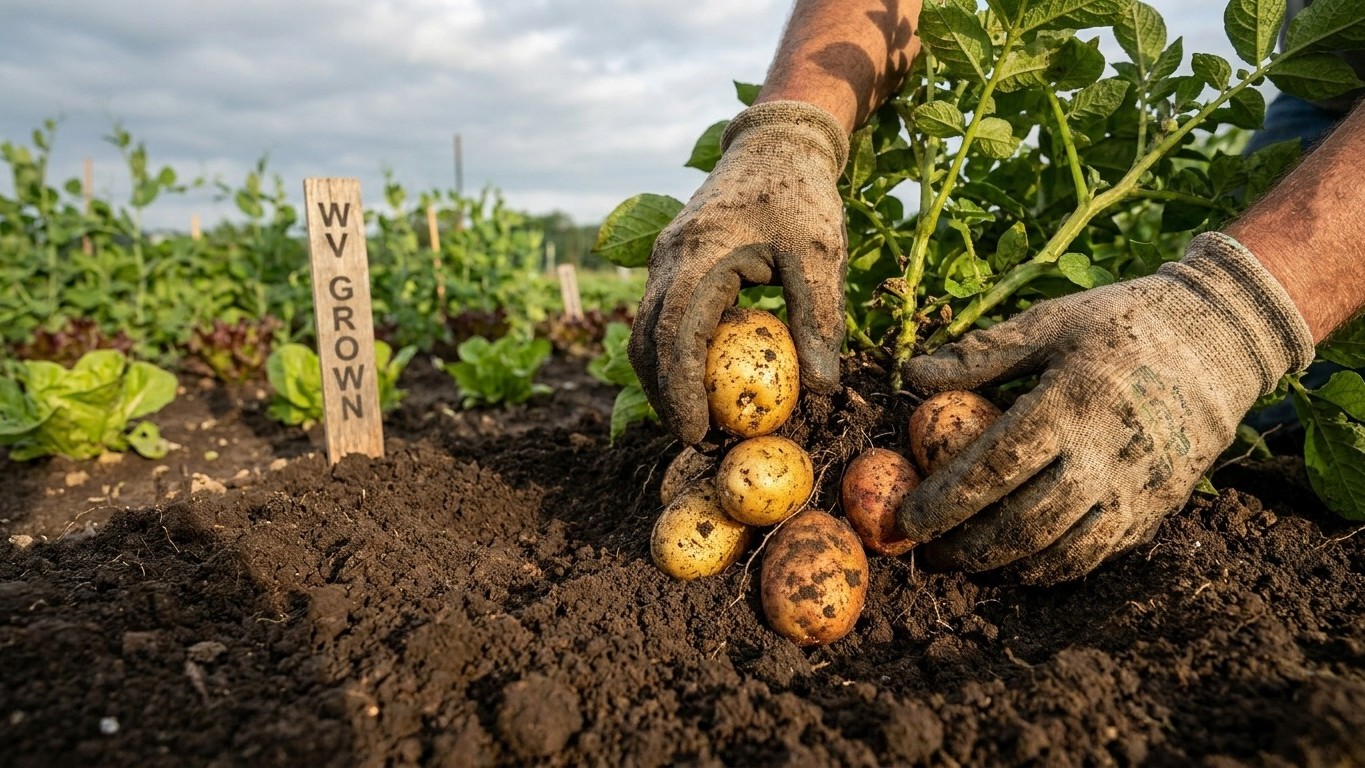

West Virginia’s summer heat is not the problem most gardeners assume it is. Charleston averages just 16.0 days a year at 90°F or higher, according to NOAA NCEI Climate Normals, a heat load light enough that potatoes can size normally through most of the season. The real work is timing the planting date around a last frost window that runs from April 9 to April 23, and choosing an early-season variety if you want to dig ahead of the hottest stretch of July — see Potato Varieties That Suit West Virginia for which ones fit that timeline best.
The short answer
Two numbers decide whether a potato crop succeeds in this state, and neither of them is a mystery once you know where to look. The first is heat load: Charleston records a mean of 16.0 days a year reaching 90°F or more, based on NOAA NCEI Climate Normals for 1991-2020. Utah State University Extension identifies 90°F soil temperature as the threshold where tuber set and fill stop. With only 16 days a year crossing that mark at the reference station, West Virginia sits well under the ceiling that shuts down potato production in hotter states. This is not a state where growers dig a spring crop out of desperation before summer arrives, the season has room for a full-length crop in most years.
The second number is the frost window. NOAA NCEI puts the last spring freeze at Charleston (station USW00013866) somewhere between April 9 and April 23, based on 32°F freeze probabilities in the 30 to 70 percent band. That’s a two-week spread, not a single date, and it matters because potato planting is timed backward from it, not forward from a calendar month.
What this means for the crop itself
Because the 90°F threshold is rarely crossed and rarely crossed for long, tuber bulking has weeks of favorable soil temperature to work with after the plants emerge. That’s the difference between a state like this one and a Deep South or desert state where growers are forced to squeeze the whole crop into a narrow cool window before soil temperatures climb past what the plant can tolerate. Here, the constraint runs the other direction: get the seed potatoes into the ground early enough that the plants are established and tubers are already forming before the handful of 90°F days show up, typically in mid to late summer. A late-planted crop still has a reasonable shot at finishing, but an early-planted one has more buffer, and buffer is what protects yield when a hot stretch does arrive, which is also why the digging window matters as much as the planting one — see Harvesting and Storing Potatoes in West Virginia for how that plays out at the other end of the season.
None of this means heat is irrelevant. It means the heat load is manageable if the planting date is set correctly, which is the actual decision point for anyone growing potatoes in this state.
When to plant here
Work backward from the frost window instead of picking a date off a calendar. The logic is the same one Utah State University Extension and the University of Maine Cooperative Extension both use for cool-season crops: soil temperature drives the planting date, not air temperature and not the calendar month. For a full breakdown of dates by region, see this guide on When to Plant Potatoes in West Virginia.
- Start with the last spring frost window. For the Charleston area, NOAA NCEI’s 1991-2020 Climate Normals place it between April 9 and April 23. That’s your anchor point.
- Count backward 14 to 21 days from that window. Utah State University Extension recommends planting potatoes as soon as soil reaches 50°F, which lands 14 to 21 days ahead of the last frost date. Applied to Charleston’s window, that puts the earliest planting dates somewhere in the last week of March to the first two weeks of April, depending on how the soil is warming that particular spring.
- Check soil temperature directly rather than trusting the calendar alone. A simple soil thermometer pushed 4 inches deep, checked in the morning before the sun has warmed the surface, tells you more than any date on a chart. Once it reads 50°F for several consecutive days, the window is open.
- Adjust for your own ground. Heavy clay soils warm slower than sandy loam. A south-facing slope warms faster than a shaded, low-lying garden bed. Both push the safe planting date in opposite directions from the state average.
This backward count is the whole method. Anyone gardening in a different county can redo this same arithmetic with their own local frost date and get a defensible planting window, without needing a separate rule for every part of the state.
What the heat does to the crop
The mechanism is simple and it’s the one fact that decides everything else on this page: above 90°F, soil temperature interferes with tuber set and fill. Utah State University Extension is explicit about this threshold, and it applies regardless of how much water the plant receives. This is the detail gardeners in hotter climates learn the hard way, a heat-stressed potato plant that’s watered generously still won’t size tubers normally once soil temperature crosses that line, because the restriction is physiological, not related to drought stress. Irrigation keeps the plant alive and green. It does not restart tuber bulking once heat has shut it down.
In West Virginia, this matters less than it does in a state logging 60, 90, or 120 days a year above 90°F, because Charleston’s average of 16.0 such days a year means the soil rarely stays in that danger zone for long stretches. Even so, those 16 days tend to cluster in July, which is exactly when a spring-planted crop is bulking tubers. A grower who planted late, pushing establishment into May instead of April, gives the plant less of a head start before that heat arrives, and less established root and foliage growth to buffer against it.
The practical response isn’t more water during a hot spell. It’s an earlier planting date, mulch to buffer soil temperature swings, and, where the calendar allows it, choosing an early-season variety so that a larger share of tuber bulking happens before the hottest days of summer rather than during them. None of the sources here publish exact maturity lengths for individual varieties, but both Utah State University Extension and the University of Maine Cooperative Extension describe potatoes by season class: early, mid-season, and late. An early-season variety finishing its bulking earlier in the summer is the practical way to work around a heat window you can’t control, without needing a specific day count that neither extension service publishes.
What goes wrong here
- Planting uncertified seed potatoes. Seed saved from a grocery-store potato or an unlabeled bag carries a real risk of virus that can quietly cut yield year after year without an obvious symptom. Certified seed potatoes, sold specifically as disease-tested planting stock, remove that risk at the source, this is the single easiest failure to avoid.
- Planting into cold, wet soil before it reaches 50°F. Seed pieces sitting in cold, saturated ground rot before they sprout instead of establishing. Wait for the soil temperature check described above rather than a fixed date, especially in a wet spring.
- Skipping hilling and ending up with green tubers. Potatoes that develop near the soil surface and get exposed to sunlight turn green and produce solanine, a compound that makes them unsafe to eat. Hilling soil or mulch up around the base of the plant as it grows keeps developing tubers covered and prevents this entirely.
- Digging the crop too early. Pulling potatoes before the foliage has died back naturally means smaller tubers and thinner skins that bruise and store poorly. Waiting for the vines to yellow and collapse on their own gives the tubers their full sizing window and toughens the skin for storage.
Checking this against your own county
Charleston’s numbers are a starting point, not a rule for the whole state. West Virginia’s elevation changes fast over short distances, and elevation shifts frost dates by weeks, not days. A garden in a high-elevation county in the eastern part of the state can see its last frost run well past Charleston’s April 9 to April 23 window, while a low-elevation river valley might track close to it. North-facing slopes, valley bottoms where cold air pools, and higher-elevation ridges all behave differently from the reference station used for the state-wide figures here.
The fix is straightforward: check the planting window against your own local conditions through West Virginia University Extension, which can supply frost data and planting guidance specific to your county rather than the statewide reference point used in this article.
Common questions
Can potatoes handle a light frost after planting?
Potato foliage is sensitive to freezing temperatures, which is exactly why planting is timed around the last frost window rather than pushed earlier just because soil has warmed. The seed piece underground survives a light frost better than emerged foliage does, which is part of why the 14-to-21-day count before the last frost date works: the plant is usually still below ground or just emerging when the final frost risk passes.
Does mulch help against the 90°F soil threshold?
Mulch buffers soil temperature swings and keeps moisture more even, which supports the plant generally, but it does not raise the ceiling itself. Utah State University Extension’s threshold is about soil temperature crossing 90°F, and mulch’s role is moderating how fast and how far soil temperature climbs on a hot day, not eliminating the effect once that line is crossed.
Are baking potatoes and boiling potatoes handled differently at planting time?
Planting timing is the same regardless of what the potato is grown for. The difference described by Utah State University Extension and the University of Maine Cooperative Extension is in what the variety is suited for after harvest, baking or boiling, not in soil temperature requirements at planting.
Is it safe to Plant Potatoes from a bag bought at the grocery store?
It isn’t recommended. Grocery-store potatoes aren’t certified seed stock and often carry viruses that don’t show obvious symptoms in year one but reduce yield over time. Certified seed potatoes, sold specifically for planting, are tested for exactly this problem.