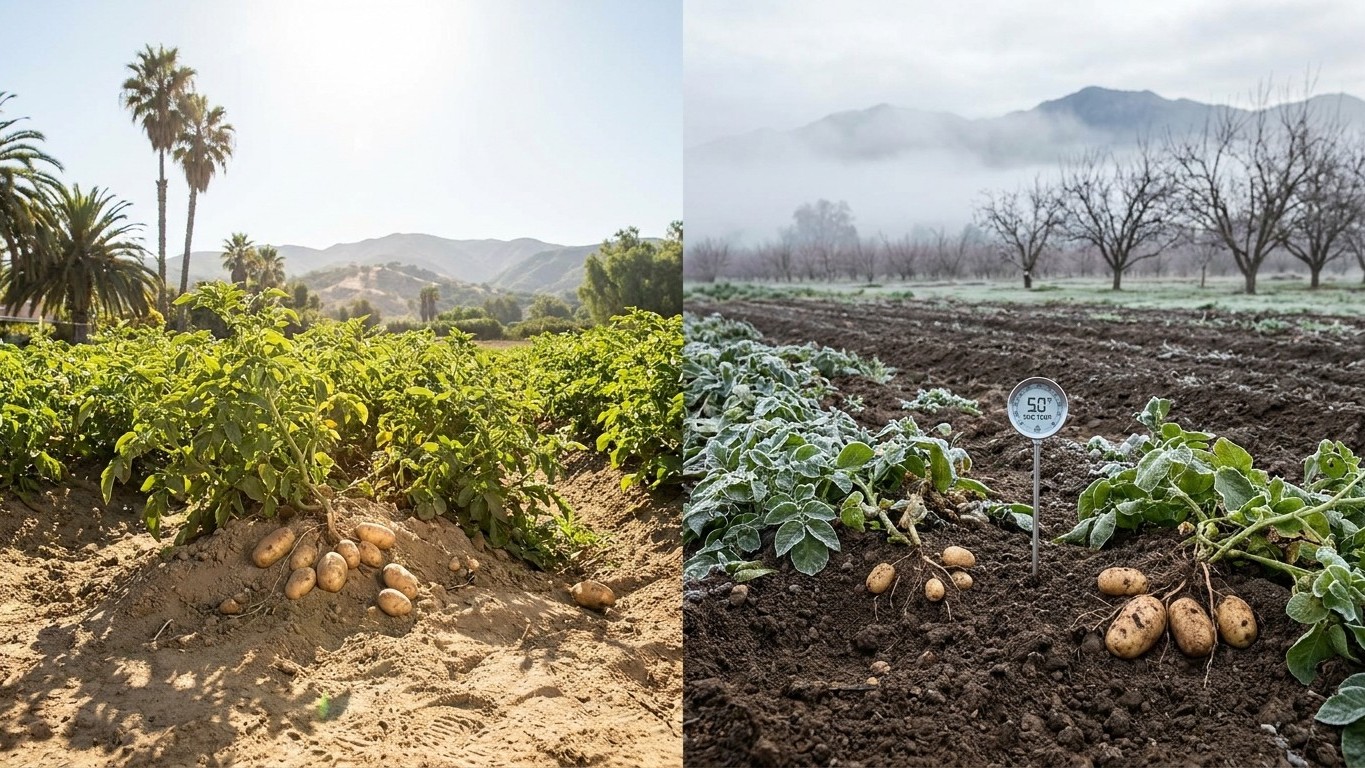

There’s no single planting date for potatoes in California, because there’s no single California climate. Coastal and Southern California gardeners work around heat and drought, not frost. Inland growers in the Central Valley, the foothills and the Sierra plant on a frost countdown instead. The right week depends entirely on which of those two Californias you’re gardening in, and how soon the ground warms past 50°F.
The short answer
For reference city Los Angeles, NOAA’s 1991-2020 Climate Normals can’t even compute a freeze normal. The dataset returns code -666, meaning no freeze occurred often enough in that 30-year record to generate a date at all. NOAA’s daily records back that up: zero days at or below 32°F in three decades, and a frost-free season listed as 365 days. If you garden anywhere along this pattern, coastal Southern California and much of the Southland, there is no last-frost date to count back from. Frost simply isn’t part of your growing math.
That’s a huge exception, and it doesn’t apply everywhere with a California zip code. The Central Valley, the northern interior and the Sierra foothills do freeze in an average year. This page doesn’t have a published last-frost date for those regions, and inventing one would be worse than saying nothing. What it does have is the rule that governs planting once you know your own local frost date: potatoes go in the ground 14 to 21 days before that date, timed to when the soil itself reaches 50°F. That guidance comes from Utah State University Extension’s potato fact sheet and from University of Maine Cooperative Extension Bulletin #2077, and it holds regardless of which state you’re standing in.
So the short answer splits in two. If you’re frost-free like Los Angeles, you plant by soil temperature alone, watching for that 50°F mark, and your bigger worry becomes the other end of the thermometer. If you’re inland or northern, you plant on the 14-to-21-day countdown once your soil crosses 50°F, using your own area’s last-frost record rather than a statewide guess. A state as long as California simply doesn’t have one number that’s honest for both ends of it.
What actually decides it
Soil temperature, not the calendar
The 50°F soil threshold isn’t a suggestion, it’s the trigger point both extension sources use to define the planting window itself. Air can feel like spring weeks before the soil agrees, especially in clay-heavy valley ground that holds cold longer than it looks like it should. Testing the soil directly, rather than trusting a date circled on a calendar, is what actually separates a strong stand of potatoes from a weak, uneven one.
The heat ceiling that ends the season early
Tuber set and fill stop when soil temperatures climb above 90°F, according to Utah State University Extension. This is the mechanism that decides the whole crop, and it’s the one gardeners most often miss because it doesn’t announce itself the way frost damage does. The plants can look green and healthy above ground while the tubers underground have simply quit sizing. Watering more doesn’t reverse it. Once that ceiling is crossed during the critical fill period, the size of your harvest is already capped.
Why the same crop needs opposite strategies across the state
Put those two thresholds together and you get the real logic of planting in California. In a hot inland location, the growing window between “soil finally hits 50°F” and “soil now exceeds 90°F” can be short, which pushes the whole planting decision toward an early spring crop, dug before peak summer heat arrives, rather than a slow-maturing summer planting. In a frost-free coastal spot, that same 90°F ceiling still applies, but there’s no frost countdown forcing an early start, so the planting window is set almost entirely by when you can keep soil temperatures moderate enough for tubers to size properly. Any California garden this page doesn’t cover, a mountain valley, a high desert lot, a narrow coastal canyon, can be reasoned through the same way: find your local last-frost record if you have one, find your stretch of soil-temperature days under 90°F, and plant inside whichever window is tighter.
How to do it
- Determine whether your garden is in a frost-free zone like the coastal and Southern California pattern NOAA shows for Los Angeles, or in a region that freezes, such as the Central Valley, the northern interior or the Sierra foothills.
- If your area does freeze, find your own local last-frost record rather than borrowing a date from a different part of the state.
- Check soil temperature directly with a soil thermometer and wait until readings hold at 50°F, since this is the trigger point both Utah State University Extension and University of Maine Cooperative Extension use to define planting time.
- In frost-prone areas, plant 14 to 21 days before your last-frost date once that 50°F soil mark is met; in frost-free areas, plant as soon as soil reaches 50°F without waiting on a frost calendar.
- Buy certified seed potatoes rather than saving grocery-store tubers or uncertified stock, since uncertified seed carries virus that can weaken or collapse a planting before it’s noticed.
- Choose a season class, early, mid-season or late, based on how much cool soil-temperature window you have before readings are likely to push past 90°F.
- Track soil temperature again as the season progresses, and plan harvest of an early-season crop before soil consistently exceeds 90°F during the tuber-fill stage.
What goes wrong
- Planting by a fixed calendar date instead of soil temperature. A date that worked one season can be too early or too late the next, because soil warms at its own pace. Use a soil thermometer and wait for a genuine 50°F reading instead of trusting the date alone.
- Applying a Central Valley or Sierra frost countdown to a coastal or Southern California garden. Reference city Los Angeles shows zero freeze days across 30 years of NOAA records, so a frost-based planting schedule simply doesn’t apply there. In that zone, plant on soil temperature and manage heat and drought instead.
- Assuming a Southern California frost-free pattern applies statewide. The Central Valley, northern interior and Sierra foothills do freeze in an average year. Check your own local record rather than generalizing one part of California to the whole state.
- Letting soil temperatures cross 90°F during tuber fill. Tuber set and sizing stop at that point, and extra irrigation won’t restart the process. The fix is choosing an early-season class and planting soon enough after soil hits 50°F to finish tuber fill before the heat ceiling arrives.
- Planting uncertified seed potatoes to save money. Uncertified seed can carry virus that reduces yield or spreads through a garden bed. Certified seed potatoes cost more up front but remove that risk from the start.
Common questions
Does the Central Valley have a published last-frost date I can use here?
No. The facts behind this page cover the frost-free pattern for reference city Los Angeles through NOAA records, not a specific inland or northern California city’s frost date. Gardeners in the Central Valley, the northern interior or the Sierra foothills need to check their own local frost record and then apply the 14-to-21-day, 50°F-soil rule from Utah State University Extension and University of Maine Cooperative Extension.
Can I really grow potatoes in coastal or Southern California with no frost at all to plan around?
Yes. NOAA’s 1991-2020 Climate Normals for Los Angeles show no computable freeze normal and a 365-day frost-free season. That removes frost as a planting constraint entirely; the limiting factors there are heat and drought, along with the same 90°F soil ceiling that limits tuber fill everywhere.
What actually happens once soil hits 90°F while tubers are filling out?
Tuber set and fill are inhibited above that point, according to Utah State University Extension. The plant doesn’t necessarily die, but the tubers stop increasing in size, and that loss isn’t recovered later in the season by watering or fertilizing.
Should hot inland gardens choose an early, mid-season or late potato variety?
An early-season class is the safer choice where the window between 50°F soil and 90°F soil is short, since it gives the crop the best chance of finishing tuber fill before heat shuts it down. Neither Utah State University Extension nor University of Maine Cooperative Extension publishes a specific days-to-maturity number for any variety, so plan around the published season class rather than a fixed day count.