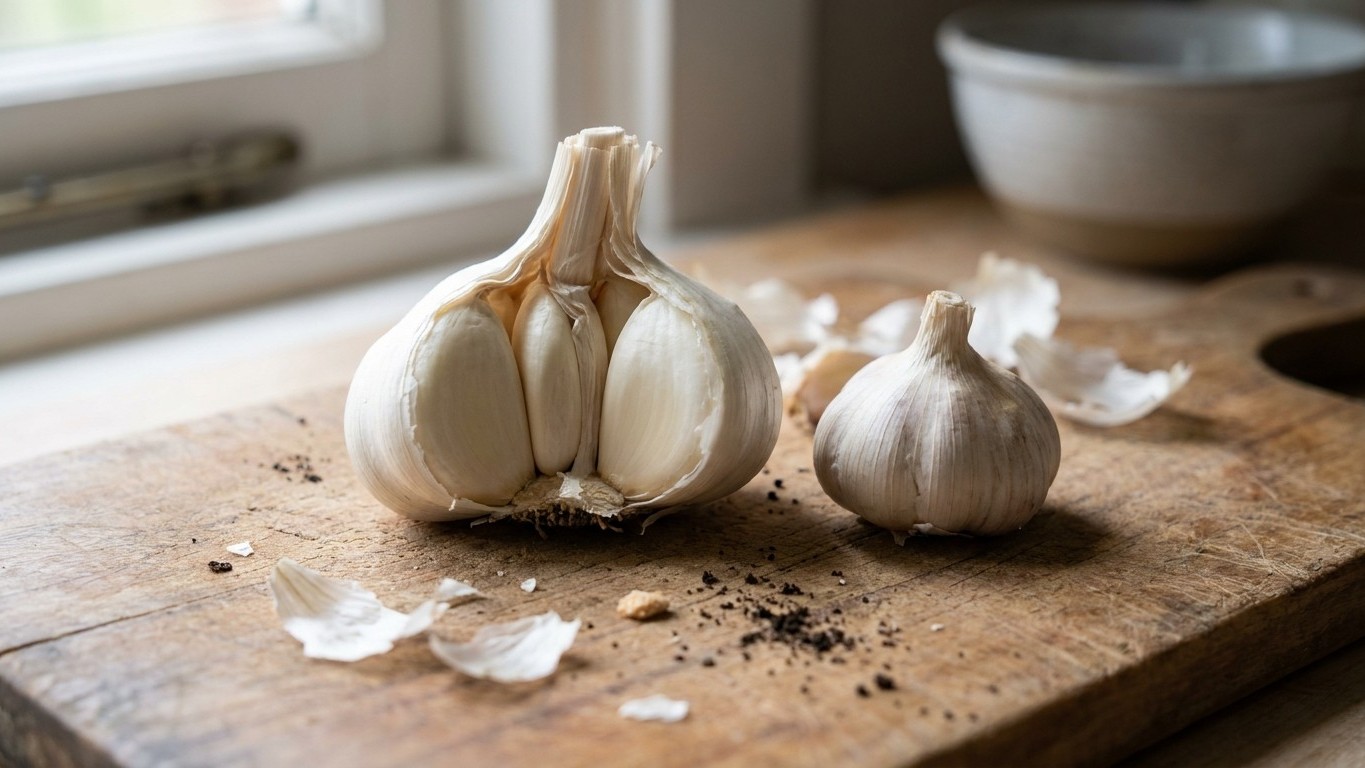

Elephant garlic isn’t garlic at all. It’s Allium ampeloprasum, the same species as leeks, not Allium sativum, the plant that gives us true garlic. That’s why the cloves grow to the size of a golf ball, why the flavor stays mild and sweet even raw, and why a recipe calling for garlic cloves falls flat if you swap in elephant garlic cup for cup. Everything about how this plant is grown, and how it isn’t, follows from that one fact.
What Music actually is
Every true garlic variety sold in the US falls into one of five groups: Porcelain, Rocambole, Purple Stripe, Artichoke or Silverskin. Elephant garlic sits outside all five, because it isn’t Allium sativum in the first place. It’s Allium ampeloprasum, the leek’s closest relative, and that single classification decision explains most of what a cook or a gardener needs to know before planting a clove.
The flavor follows straight from the plant it’s related to. Growers’ catalogs describe it as much milder and sweeter than garlic, closer to a leek than to anything in the sativum family. In the kitchen that means it doesn’t stand in for a garlic clove one for one; a dish built around three cloves of regular garlic needs adjusting, not a straight swap, if elephant garlic goes in instead.
The bulb itself gives away the disguise. Elephant garlic produces about 5 to 7 cloves per bulb, and each one is large enough that a single clove can do the work of an entire small garlic bulb in a roast or a braise. The color stays white, the same shade you’d expect walking past regular garlic in the produce aisle, which is part of why the mix-up persists at the grocery store and in the garden catalog both. No disease or pest resistance data is published for this plant, unlike many true garlic varieties that carry resistance codes right on the catalog page.
Will it get the cold it needs where you are
True garlic needs a real stretch of cold after planting, or the underground bulb never splits into cloves: skip the chill and a grower lifts one solid round instead of a head. Elephant garlic runs on the same mechanism, even though it isn’t in the same species, because both plants use cold as the trigger that switches growth from a single storage bulb into a divided one.
That shared mechanism is where the useful information for this variety runs out, at least in the numbers. Unlike the true garlic varieties in this collection, no set of measured winter temperatures or first-frost dates has been published specifically for elephant garlic, so naming a state, a hardiness zone, or a weather station here would mean inventing a crossing that doesn’t exist in the record. What can be said, based on how the plant behaves everywhere it’s grown, is where the general pattern lands.
Where the cold comes easily, and where it doesn’t
| Region type | Winter cold | What it means for elephant garlic |
|---|---|---|
| Coldest regions: Upper Midwest, northern New England, Mountain West | Consistently exceeds what’s needed | Divides reliably into cloves without any help from the grower |
| Mid-range regions: Mid-Atlantic, Ohio Valley, Pacific Northwest | Usually sufficient, not guaranteed | Works most years, but a genuinely mild winter can shortchange the crop |
| Warmest regions: Gulf Coast, peninsular Florida, coastal and Southern California | Often insufficient | Risk of an undivided single bulb instead of a cluster of cloves |
The real risk sits in that warmest row. Winters there can pass without enough sustained cold, and the plant responds by putting all its energy into one undivided bulb instead of a cluster of large cloves. That bulb is still edible, still mild, still the same species, it simply isn’t what a gardener expecting a head of cloves was hoping to lift.
Two real fixes for a mild winter
Two options exist for that gap, and neither means giving up on the plant. The first is to refrigerate the cloves before planting, which mimics the cold spell a mild winter won’t deliver on its own; growers in warm climates commonly hold cloves in a home refrigerator for a stretch before they go into the ground for exactly this reason. The second is simpler: accept that a warm-winter crop may come up as a single round bulb rather than a divided head, and treat that as a smaller-scale harvest rather than a failed one. Either way, a mild winter is a reason to adjust the method, not a reason to skip the crop.
When to put the cloves in
Garlic, and elephant garlic along with it, goes into the ground in fall and comes out the following summer, which puts the planting decision months ahead of the harvest. The anchor point isn’t a date on a calendar; it’s the first fall frost for a given location, because the cloves need enough time to grow roots before the ground freezes solid, but not so much time that they push a lot of leafy growth above ground before winter sets in.
Why the window shifts by region
In the coldest regions, growers aim to get cloves in the ground while the soil is still workable in early-to-mid fall, well ahead of a hard freeze, so roots have time to establish before the ground locks up. In milder regions, where the ground rarely freezes deeply if at all, planting can wait later into fall, sometimes into early winter, since there’s less urgency to beat a freeze that may not arrive in force.
Sources on this point don’t fully agree, and that’s worth saying plainly rather than smoothing over. Extension offices and garden guides across different states set their own recommended windows based on local frost patterns, and a date that works well in one region can be too early or too late two states over. That’s less a contradiction than a reflection of how much climate varies within a single planting season across the country.
For elephant garlic specifically, no separate planting calendar exists apart from the general fall-planting pattern shared with true garlic. A grower working from a regional guide written for standard garlic in their own area is working from the closest available reference, since the plant follows the same fall-plant, summer-lift cycle regardless of which species it belongs to.
Hardneck or softneck: what this one asks of you
For every true garlic variety in this collection, hardneck versus softneck is the first practical fork in the road. Hardneck types send up a stiff central stalk that has to be cut before it saps the bulb’s energy, and in exchange the grower gets fewer, larger cloves that peel easily but don’t keep past a few months. Softneck types skip that stalk, produce more and smaller cloves in tighter layers, and reward the grower with braid-worthy bulbs that store for months longer.
None of that fork applies here. Elephant garlic isn’t Allium sativum, so it was never sorted into the hardneck and softneck groups that classification covers, and no published source assigns it to either camp. Asking whether elephant garlic is hardneck or softneck is a bit like asking whether a leek is hardneck or softneck: the question is built for a different plant entirely.
What that means practically is that a grower doesn’t have to weigh the trade-offs the rest of this collection walks through, big cloves versus many cloves, easy peeling versus long storage. Elephant garlic comes with its own fixed profile: about 5 to 7 very large cloves per bulb, regardless of climate or care. Anyone weighing the hardneck-versus-softneck decision for their own kitchen and storage needs is better served checking a true garlic variety elsewhere in this collection, where that choice actually changes the outcome.
Growing and curing it without losing the crop
Elephant garlic goes in deeper and spaced wider apart than standard garlic, simply because the clove and the eventual bulb are so much bigger; a planting hole sized for a regular garlic clove is too shallow and too cramped for one of these. Point the flat root end down, cover it, and firm the soil so the clove makes solid contact rather than sitting in an air pocket.
Mulch, water and reading the plant
Mulch matters more here than it would for a summer crop, because this clove sits in the ground through winter, exposed to freeze-thaw cycles that can heave a shallow-rooted plant right out of the soil. A layer of straw or shredded leaves over the bed insulates the ground, keeps weeds down through the cold months, and holds moisture once growth resumes in spring.
Watering carries the plant through spring growth, then needs to stop well before harvest. As the lower leaves begin to yellow and dry while the upper leaves stay green, that’s the plant signaling it’s shutting down, not that it’s thirsty, and continued watering at that stage risks staining the bulb wrappers and inviting rot rather than helping the crop finish.
Lifting and curing without losing the harvest
The lift itself is a judgment call: too early and the cloves haven’t finished sizing up, too late and the wrapper that protects the bulb in storage starts to split apart underground. Once lifted, the bulbs need to cure, sitting in a dry, shaded, well-ventilated spot out of direct sun for several weeks before the roots and tops get trimmed and the bulbs go into storage. Curing badly, rushing it or curing in damp conditions, is the single most common way a good crop rots in the pantry instead of lasting through winter.
Common questions
Is elephant garlic actually garlic? No. It’s Allium ampeloprasum, the same species as the leek, not Allium sativum, the species that includes every true garlic variety.
Does elephant garlic taste like regular garlic? Not really. It’s much milder and sweeter, closer to a leek than to garlic, which is why it doesn’t work as a straight one-for-one swap in a garlic-based recipe.
How many cloves does an elephant garlic bulb have? Typically about 5 to 7 cloves per bulb, and each one is large enough to stand in for far more than a single clove of true garlic.
Is elephant garlic hardneck or softneck? Neither classification applies. Hardneck and softneck describe groups within Allium sativum, and elephant garlic isn’t a member of that species, so no hardneck or softneck designation is published for it.