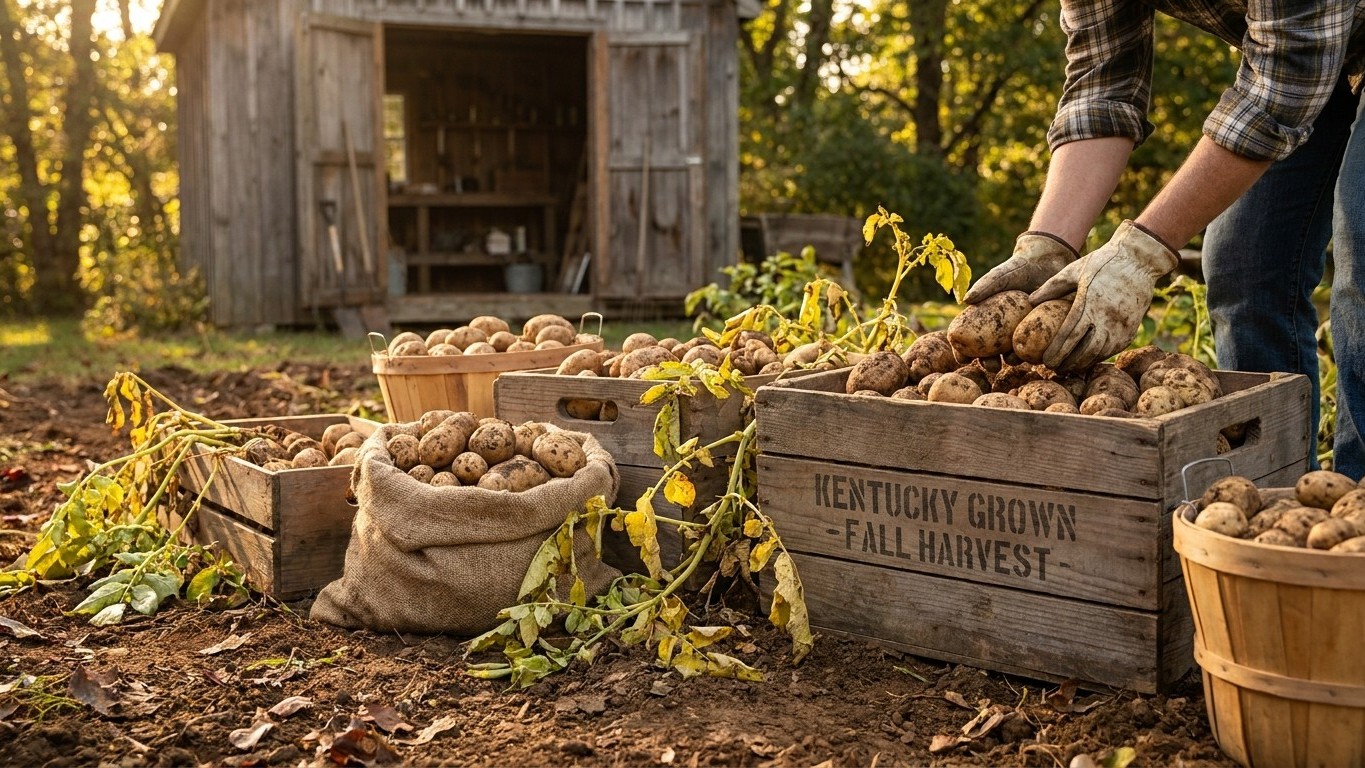

Kentucky gardeners should have potatoes out of the ground well before the first fall frost, which arrives statewide between November 2 and November 12. That timing matters less for the harvest itself than for what happens next: this state’s coldest month brings a mean daily minimum of just 27.8 F, which means an unheated shed or garage will not hold the 40-45 F that stored potatoes need. Winter storage here requires more planning than the dig.
The short answer
Two numbers frame everything about growing and keeping potatoes in Kentucky. The first fall frost falls somewhere between November 2 and November 12, based on NOAA NCEI’s 1991-2020 Climate Normals for the Louisville reference station. The second is the mean daily minimum temperature during the coldest month, which sits at 27.8 F. That’s not a record low and not a monthly average. It’s the typical overnight floor, the number that tells you what a plant, or a bin of potatoes, actually experiences on an ordinary cold night.
Those two figures point in opposite directions for anyone growing potatoes here. The frost date is comfortably late in the calendar, which gives vines plenty of time to die back naturally before digging. Most gardeners in the state pull their crop in the weeks leading up to that window, once foliage has yellowed and collapsed on its own. There’s no reason to rush a harvest against the frost date the way you might with tomatoes or peppers; potatoes underground are insulated from a light frost that would kill the top growth anyway.
The storage side is where the trouble starts. A mean minimum of 27.8 F during the coldest month means that any unheated space, a detached garage, a garden shed, an uninsulated porch, will regularly sit below freezing for stretches of the winter. Potatoes stored in those conditions don’t just get chilly. They freeze solid, and a frozen potato turns to mush and rot within days of thawing. The 40-45 F range that Utah State University Extension recommends for storage simply doesn’t happen on its own in an unheated Kentucky structure once the coldest month sets in.
NWS Louisville notes that this urban station tends to run later in spring and earlier in fall than the surrounding rural parts of Jefferson County, so gardeners outside the city, especially in low-lying or northern parts of the state, should treat the November 2 to November 12 window as generous and plan to dig on the earlier side of it. A tighter window means less margin if an early cold snap arrives ahead of schedule.
The practical takeaway: dig before the frost window closes, but don’t assume that once the potatoes are inside, the job is finished. Kentucky’s winter lows do the real damage, and they do it indoors, in whatever space you’ve chosen to store the crop.
Curing, and where
Before potatoes go into long-term storage, they need to cure. Utah State University Extension recommends holding freshly dug potatoes at 55-60 F with high humidity for 2 to 3 weeks. This heals the small cuts and abrasions that happen during digging and thickens the skin, both of which cut down on rot once the crop is in storage. Skipping this step, or curing in the wrong conditions, is one of the more common reasons a stored crop goes bad early.
Finding 55-60 F in Kentucky at harvest time takes some thought, because the window when potatoes typically come out of the ground, ahead of that November frost date, is also when outdoor temperatures are swinging widely from warm afternoons to cool nights. Here’s a workable sequence for curing in this climate:
- Dig on a dry day and let the potatoes sit on the soil surface for an hour or two to shed loose dirt, but no longer. Direct sun and warm afternoon temperatures common in early fall Kentucky can scald exposed tubers quickly.
- Move them out of direct light immediately into a spot that stays in the 55-60 F range. A shaded porch works in the cooler weeks of the harvest window, when daytime highs have already backed off from summer levels. A basement, particularly an unfinished one, often holds this range more reliably across the full curing period.
- Avoid an attached garage in early fall if it still traps daytime heat, and avoid an unheated outbuilding later in the window, when overnight lows can already dip closer to freezing as the season pushes toward that November frost date.
- Spread the tubers in a single layer, not piled, on newspaper, cardboard, or slatted crates, so air moves around each potato rather than trapping moisture against the skin.
- Hold high humidity around the curing tubers. A basement typically carries enough ambient moisture on its own; a porch or garage may need a damp cloth or burlap draped nearby to keep the air from drying out the skins before they’ve finished healing.
- Check after 2 to 3 weeks for skins that no longer rub off easily under light pressure. That’s the sign curing is complete and the crop is ready to move into its final storage spot.
A basement generally beats a porch or garage for consistency in this climate, since it isn’t swinging with the outdoor temperature the way an open or semi-open structure will over a three-week stretch in October and early November.
Storing through this winter
Once cured, potatoes need to go into a space that holds 40-45 F and stays dark, according to Utah State University Extension. The University of Maine Cooperative Extension gives a tighter target for longer-term keeping: 38 F at 95 percent humidity. Neither of those ranges shows up naturally in a Kentucky structure without some intervention, and the reason comes back to that 27.8 F coldest-month minimum.
A root cellar dug into the ground, or a basement corner away from heating ducts, tends to be the most realistic unheated option for hitting 40-45 F through a Kentucky winter. Soil several feet down stays far more stable than outdoor air, buffering against both the mean minimum in the coldest month and the occasional harder cold snap that pushes well below it. A finished basement with forced-air heat running through it, on the other hand, often runs too warm, sitting closer to 65-70 F, which will push potatoes toward sprouting well before spring.
Unheated garages and sheds are the riskiest option in this climate specifically because of that 27.8 F figure. That number is a mean minimum, meaning half the nights in the coldest month run colder than it, not warmer. A detached garage with no supplemental heat will very likely see stretches at or below freezing over the course of a Kentucky winter, and potatoes don’t recover from a hard freeze. The tissue breaks down, the potato turns soft and eventually liquefies, and there is no way to salvage a frozen tuber once it thaws.
For gardeners without a true root cellar, a partially insulated space monitored with a simple thermometer, and adjusted with something as basic as a low-wattage heat source on the coldest nights, can bridge the gap between an unheated outbuilding and the 40-45 F target. The key is checking regularly rather than assuming a space is stable just because it felt fine in October. Conditions in November and December, as the season moves toward and past that coldest-month mark, are a different environment entirely from the mild fall afternoons when the crop was cured.
Darkness matters as much as temperature. Light exposure, even indirect light from a nearby window, triggers greening and sprouting regardless of how well the temperature is controlled, so a covered bin or opaque container inside the storage space is worth the small extra effort.
What goes wrong here
- Digging too early, ahead of natural vine dieback. Potatoes pulled while foliage is still green often have thinner skins that don’t hold up through curing or storage. Wait for the vines to yellow and collapse on their own before harvesting, well ahead of the November frost window.
- Curing in a space that runs too warm. An attached garage or a sunny porch in early fall can climb well above the 55-60 F range Utah State University Extension recommends, which encourages rot rather than the skin-healing curing is meant to produce. Move curing potatoes to a basement or a shaded, unheated interior space if the porch is running hot.
- Storing in an unheated outbuilding once the coldest month arrives. With a mean minimum of 27.8 F, a garage or shed will regularly drop into freezing territory, and a single hard freeze ruins the batch. Move the crop indoors to a basement or insulated space before winter’s coldest stretch sets in.
- Storing in a heated basement or utility room. Ambient heat from a furnace or water heater can push storage temperatures well past the 40-45 F target, causing early sprouting. Choose the coolest, most isolated corner of the basement, away from heating equipment.
- Leaving stored potatoes exposed to light. Even a basement window can trigger greening over a winter’s worth of exposure. Cover bins or use opaque containers regardless of how dark the space seems day to day.
- Skipping a check for damaged tubers before storage. Cuts and bruises from digging can turn to rot in storage and spread to healthy potatoes nearby. Set aside any damaged tubers for near-term use rather than long-term storage, and treat any signs of disease with an appropriate fungicide or an appropriate insecticide as needed for pest damage, following label directions.
Common questions
When should potatoes be harvested in Kentucky?
Harvest once the vines have yellowed and died back on their own, well before the first fall frost, which arrives statewide between November 2 and November 12 based on NOAA NCEI’s 1991-2020 Climate Normals. Rural gardens, particularly outside the Louisville area, should plan for the earlier end of that window.
Can potatoes be stored in an unheated Kentucky garage over winter?
It’s risky. The coldest month here has a mean daily minimum of 27.8 F, which means an unheated garage will likely dip to or below freezing on many nights, well outside the 40-45 F range Utah State University Extension recommends for storage.
How long does curing take before storage?
Utah State University Extension recommends curing at 55-60 F with high humidity for 2 to 3 weeks before moving potatoes into long-term storage. A basement typically holds that range more consistently than a porch or garage during Kentucky’s fall temperature swings.
What temperature should stored potatoes be kept at?
Utah State University Extension recommends 40-45 F in a dark space, while the University of Maine Cooperative Extension specifies 38 F at 95 percent humidity for longer-term keeping. Neither range occurs naturally in an unheated Kentucky structure once the coldest month sets in, so a basement or insulated root cellar, monitored with a thermometer, is the more reliable choice.