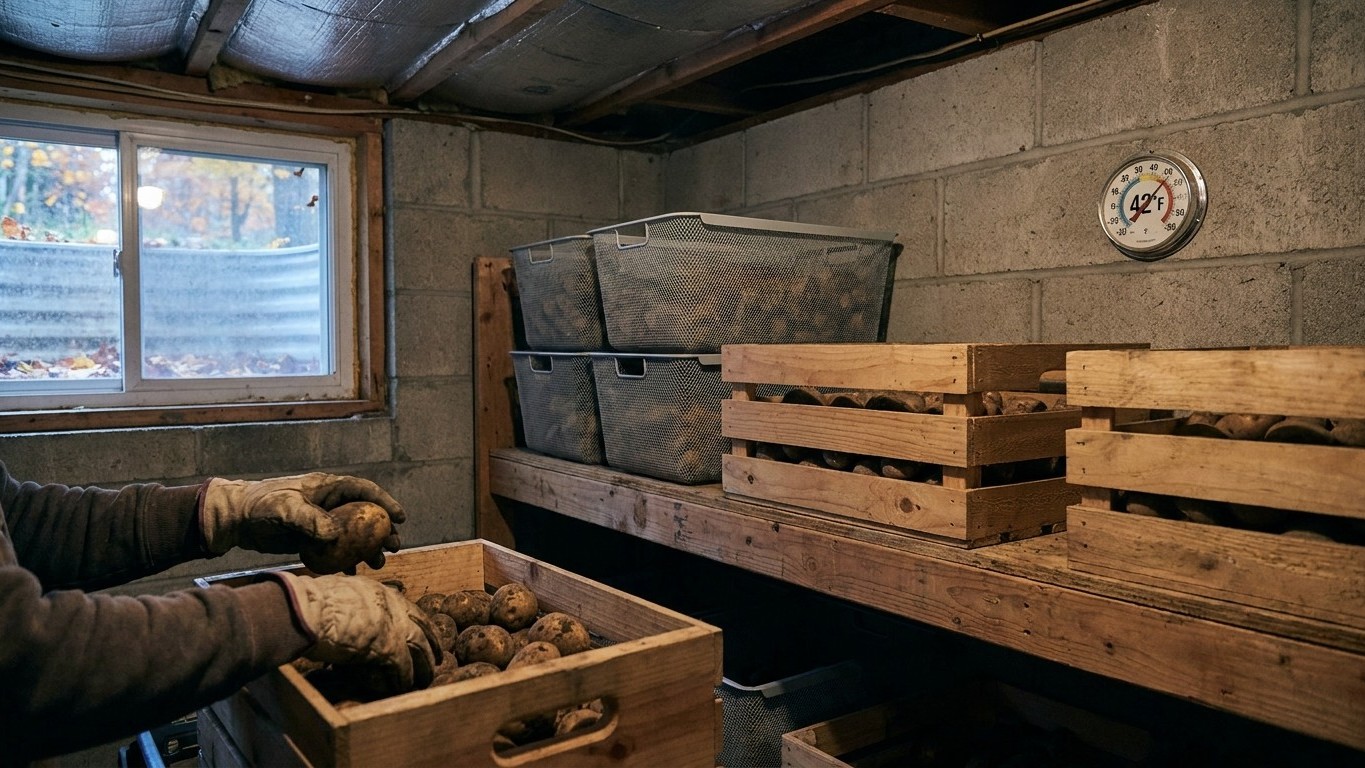

In most of Maryland, potatoes come out of the ground in the two or three weeks before the state’s first fall frost, then need a home that holds 40-45 F all winter without freezing. A conditioned basement or an insulated garage usually works. An unheated shed, garden shed, or detached garage often does not, because Maryland’s coldest month runs cold enough to freeze anything left unprotected.
The short answer
Two numbers set the calendar and the storage math here. The first fall frost across the state’s central and I-95 corridor, based on the 1991-2020 NOAA NCEI climate normals, arrives between October 26 and November 5. The mean minimum temperature of Maryland’s coldest month, again from those same NOAA NCEI normals (Baltimore reference station), is 25.4 F. That second figure is the one growers underestimate. It is not the record low for the winter; it’s the average nightly low across the whole coldest month, which means most nights in January routinely dip into the mid-20s even in a typical, unremarkable winter.
That has direct consequences for storage. A structure with no insulation and no heat source, a garden shed, an open carport, an unheated detached garage, tracks outdoor air closely. If outdoor air averages 25.4 F on a cold night, the inside of that shed will not stay at 40-45 F. It will freeze, and potatoes that freeze turn soft, sweet-tasting, and unusable within days of thawing. A basement, an attached garage that shares a wall with a heated house, or a root cellar dug below the frost line behave differently: they’re buffered by the surrounding soil or the house itself, and they can hold the 40-45 F range through a normal Maryland winter without any added heat.
The digging window follows the frost date, not a fixed day. Potato foliage dies back with the first hard frost, and the tubers should come out of the ground within a couple of weeks after that, before the soil turns cold and wet enough to invite rot. Growers on the Eastern Shore typically see milder conditions than this window suggests, while growers in Garrett and Allegany counties, up in the mountains, run weeks behind and should watch local conditions rather than the statewide date. Either way, the plan is the same: dig before hard freeze locks up the ground, cure promptly, then move the crop into a space that will actually hold winter-long cool, not a space that just happens to be unheated.
Curing, and where
Before potatoes go into long-term storage, they need to cure. Utah State University Extension specifies curing conditions of 55-60 F with high humidity for two to three weeks, a stretch of time that lets cut or bruised skin heal over and thickens the outer skin against moisture loss. Skip this step, and potatoes stored straight from the field will shrivel and rot faster no matter how good the storage space is afterward.
Finding 55-60 F in Maryland at harvest time, late October into early or mid-November, is not automatic. A shaded porch can work early in that window, when daytime highs are still mild, but nights are already dropping close to the coldest-month range and an open porch will often run too cool by the second week. A garage without insulation swings too widely, hot in the afternoon sun through a window, cold overnight. The most reliable spot for most Maryland households is an interior basement corner away from a furnace or water heater, where temperatures stay steadier day to night.
- Dig on a dry day and let the tubers sit on top of the soil for an hour or two so loose dirt can be brushed off without scrubbing.
- Do not wash them. Water on the skin at this stage promotes rot during curing, not less of it.
- Move the crop indoors, out of direct light, and spread the tubers in a single layer, not stacked, so air reaches all sides.
- Hold them at 55-60 F with high humidity for two to three weeks. A basement corner with a shallow pan of water nearby can raise humidity if the room runs dry.
- Check partway through and pull any tuber showing soft spots or breaks in the skin. One rotting potato in a curing batch spreads faster than most growers expect.
- After the two-to-three-week window, move the cured potatoes to their winter storage location before the coldest-month temperature swings set in.
Storing through this winter
Once cured, potatoes want a different set of conditions than they did during curing. Utah State University Extension gives a storage target of dark and 40-45 F. The University of Maine Cooperative Extension gives a related but slightly different figure, 38 F at 95 percent humidity, which trends colder and wetter than the USU range. Both point the same direction: cool, dark, and humid, well below curing temperature and well above freezing.
Set against Maryland’s coldest-month mean minimum of 25.4 F, this is where the choice of storage space decides the outcome. A basement that stays in the high 40s to low 50s year-round runs a little warm for ideal storage, which can push sprouting earlier than growers expect, but it will not freeze the crop, and warm-but-alive beats frozen-and-ruined. An attached garage, if it shares insulation with the house, often lands closer to the 40-45 F target through most of the winter, though a stretch of nights near or below the 25.4 F average can pull an attached garage’s temperature down further than owners assume, especially in a corner far from the shared wall.
A detached, unheated structure is the riskiest choice in this state. Without a heat source or the buffering mass of surrounding soil, its interior temperature tracks outdoor air closely enough that a normal January cold snap, well within the range implied by that 25.4 F coldest-month average, can freeze stored potatoes outright. A true root cellar, dug into the ground below frost depth, avoids this because soil several feet down stays far more stable than the air above it, but few Maryland homes built in the last several decades have one. For most households here, a basement location, checked periodically through winter and adjusted with a fan or a cracked door if it runs warm, is the dependable middle ground between the USU and University of Maine targets and the reality of what Maryland winters do to unheated space.
What goes wrong here
- Digging after a hard freeze hits the vines. Waiting too long past the first fall frost lets cold, wet soil damage tubers underground. Dig within roughly two weeks of vine die-back, and choose a dry day rather than waiting for perfect weather.
- Curing in a space that’s actually too cold. A porch or unheated garage in early November often sits below the 55-60 F curing target once nights lengthen. Move curing indoors to a basement corner if outdoor spots run cool.
- Storing in an unheated shed or detached garage. Given a coldest-month mean minimum of 25.4 F, these structures freeze stored potatoes in a typical winter, not just an unusually cold one. Use a basement, attached garage, or true root cellar instead.
- A storage spot that runs too warm. A basement near a furnace or water heater can sit well above the 40-45 F target, pushing early sprouting. Relocate the storage bin to the coolest, most distant corner of the basement.
- Light reaching stored tubers. Any light source, even a basement window or a bare bulb left on, turns exposed potato skin green over time. Store in a covered bin or opaque bag, not an open box near a window.
- Low humidity shriveling the crop. A dry basement heated through winter can pull moisture out of stored potatoes well before spring. A shallow water pan near the storage bin, checked and refilled periodically, helps maintain the humidity both USU and the University of Maine specify.
- Disease or insect damage skipped over at harvest. Tubers with existing insect damage or fungal spotting rot faster in storage regardless of temperature. Growers dealing with insect pressure during the growing season should follow label directions on appropriate insecticides, and those seeing fungal issues should apply an appropriate fungicide, before the problem reaches harvest.
Common questions
How soon after the first fall frost should Maryland potatoes come out of the ground?
Within about two weeks of the first fall frost date for the local area, generally between October 26 and November 5 for most of the state per NOAA NCEI climate normals, though Western Maryland runs later and the Eastern Shore tends milder.
Will an unheated garage keep potatoes cold enough without freezing them?
Not reliably. Maryland’s coldest month averages a nightly minimum of 25.4 F, and a detached or poorly insulated garage tracks close to outdoor air, which puts it below freezing on a routine basis, not just during rare cold snaps.
What’s the difference between the curing and storage temperature targets?
Curing, per Utah State University Extension, calls for 55-60 F with high humidity for two to three weeks to heal the skin. Storage afterward wants it colder: 40-45 F per USU, or 38 F at 95 percent humidity per the University of Maine Cooperative Extension.
Is a basement a good place to store potatoes all winter in Maryland?
Generally yes, since a conditioned basement stays buffered from outdoor swings and rarely approaches freezing even during the coldest month. It may run a bit warm compared to the 40-45 F target, which can bring on earlier sprouting, but that’s a far better outcome than the freezing risk in an unheated outbuilding.