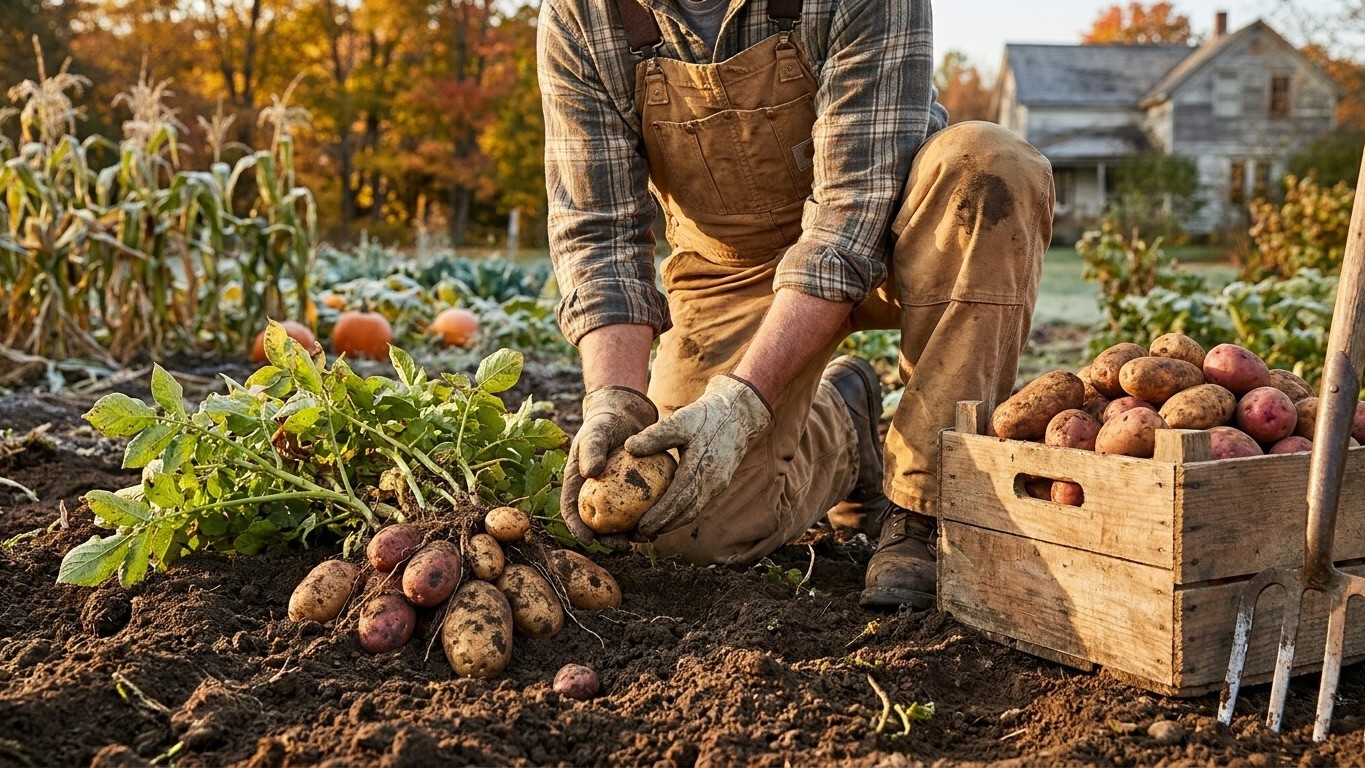

Minnesota gardeners should dig potatoes before the ground freezes and the first fall frost settles in, which in the Twin Cities area runs October 11 to October 23. After that, curing needs two to three weeks near 55-60°F, and storage needs to stay in the 38-45°F range all winter. An unheated garage or attached space rarely holds those numbers once outside lows sink toward Minnesota’s coldest-month average minimum of 8.8°F, so most growers need an insulated basement, root cellar, or a space they can actively buffer from the cold.
The short answer
Two numbers set the whole calendar for Minnesota potato growers. The first is the fall frost window: October 11 to October 23, based on NOAA NCEI’s 1991-2020 climate normals for the Minneapolis reference station. The second is the mean minimum temperature of the coldest month, which sits at 8.8°F. That figure isn’t a record low or a monthly average, it’s the typical overnight floor during the depth of winter, and it’s the number that decides whether an unheated structure can hold a food crop at all.
Put those together and the picture is straightforward. Potatoes should come out of the ground before that October frost window closes, ideally with the vines already dead back and the tubers left in dry soil for a short spell to toughen their skins. Waiting past the frost date risks the tops blackening and, if a hard freeze reaches the soil, the tubers themselves suffering cold injury underground. Growers in northern Minnesota need to move that timeline up by two to three weeks, since the far north of the state runs measurably tighter on both ends of the growing season than the Twin Cities.
The second figure, that 8.8°F coldest-month minimum, is the one that trips people up after harvest. A garage that isn’t insulated, or a porch with a single wall between it and the outdoors, will track close to outdoor air on the coldest nights. That means a space sitting comfortably in the 40s in October can be well below freezing by January. Potatoes stored in a spot like that don’t just get chilly, they freeze solid, and a frozen potato turns soft, sweet-tasting, and unusable once it thaws. An unheated space in Minnesota only holds the 40-45°F storage target if it’s buffered somehow, by earth contact, by insulation, or by its position inside a heated building’s envelope.
None of this means storage is impossible here. It means the space has to be chosen deliberately, not assumed. A basement corner near a foundation wall, an insulated root cellar dug into a slope, or a specifically built cold room inside an unheated structure will usually work. A bare garage shelf, a porch, or an uninsulated shed almost never will once the coldest month arrives.
Curing, and where
Curing is the step between digging and long-term storage, and Utah State University Extension is specific about the conditions it needs: 55-60°F with high humidity, held for two to three weeks. That range doesn’t happen outdoors in Minnesota in mid-to-late October, when daytime highs are already sliding and nights are closing in on freezing. The trick is finding an indoor space that happens to sit in that range without any heating input, since a basement or interior room in early fall is often naturally close to it.
- Dig on a dry day, ahead of the frost window. Lift tubers before October 11-23 in the Twin Cities area, earlier farther north, and let them sit on the soil surface for an hour or two to dry off, out of direct sun.
- Brush off soil, don’t wash. Washing adds moisture that works against curing; a soft brush or dry cloth removes the bulk of the dirt while keeping the skin dry.
- Move them to a space near 55-60°F. A basement, an interior mudroom, or an attached garage that shares a wall with the heated house often sits in that band during October before winter cold sets in. A detached, unheated garage or an open porch is usually too cold by the time frost has already threatened the crop.
- Hold humidity high without wetting the tubers. Loosely covered crates, burlap, or cardboard boxes with the flaps open a crack keep moisture around the potatoes without trapping condensation directly on the skin.
- Give it two to three weeks before moving to storage. USU Extension’s timeline is not flexible in either direction; cutting it short leaves skins thin and prone to bruising and rot, and there’s no benefit to running it longer.
The basement is the most reliable curing spot for most Minnesota households, simply because it tracks close to that 55-60°F range through the fall shoulder season without any extra heating. A detached shed or garage can work only in the early part of the window, before nighttime lows start dropping toward the 30s, which in most of the state happens right around the same time as that first frost date.
Storing through this winter
Once cured, potatoes need a different environment: dark, and somewhere between 38°F and 45°F depending on which extension source you follow. Utah State University Extension gives a working range of 40-45°F, while the University of Maine Cooperative Extension is more precise, recommending 38°F at 95% humidity for the longest storage life. Both agree on the essentials, cold, humid, and away from light, which causes greening and a bitter taste in the tubers.
The challenge in Minnesota isn’t reaching that range in November. It’s holding it through January and February, when the coldest month’s mean minimum sits at 8.8°F. A root cellar dug into earth, or a basement corner insulated from the rest of the house, tends to stay buffered by the surrounding ground and can hold close to 40°F even when outdoor air is deep in single digits or below zero. A space with more exposure to outside walls or an unheated crawl space attached to the house exterior is a different story; it can easily drop below freezing on the coldest nights of January, and there’s no coming back for a potato that’s frozen solid.
The opposite failure matters just as much. A storage spot that’s too warm, closer to 50°F or higher, won’t freeze the crop, but it will let potatoes sprout early and lose firmness well before spring. A furnace room, a heated basement, or anywhere near a water heater or dryer vent runs too warm for long-term storage even though it never approaches freezing.
Practically, that means most Minnesota households do best with a dedicated cold space, insulated from both the house’s heating and the outdoor extremes: an unheated but insulated basement room, a purpose-built root cellar, or an insulated cooler kept in an attached but unheated area that never sees direct exterior exposure. Checking the space with a simple thermometer over a cold snap, rather than assuming a “cool spot” will hold, is the only way to know it’s actually tracking that 38-45°F band through the coldest weeks rather than drifting to one extreme or the other.
What goes wrong here
- Digging after the frost window closes. Waiting past October 11-23 in the Twin Cities area, or later in northern Minnesota, risks a hard freeze reaching tubers still in the ground. Dig on schedule, watching local forecasts as the window opens rather than a fixed calendar date.
- Curing in a space too cold for the job. An unheated garage or porch in late October in Minnesota often sits well below the 55-60°F that Utah State University Extension calls for. Move the crop to a basement or interior room instead, where that range is easier to hold naturally.
- Storage space freezing in deep winter. With a coldest-month mean minimum of 8.8°F, any storage area with real exposure to outside air, a detached shed, an exterior wall without insulation, will drop below freezing on the hardest nights and ruin the crop. Choose a space buffered by earth or by the heated house’s envelope, and check it with a thermometer during a cold snap.
- Storage space too warm from house heating. A furnace room or a spot too close to living space stays well above 45°F all winter, which lets tubers sprout and soften early. Keep storage physically separated from heated rooms, even if that means partitioning off a basement corner.
- Skipping the drying-off step before curing. Bringing wet, soil-caked tubers straight into a curing space introduces rot risk before curing even begins. Let them dry briefly on the surface after digging, and brush rather than wash off soil.
- Storing in light. A shelf near a basement window or under a bare bulb left on will green the skins over weeks of storage. Keep the storage area genuinely dark, covering crates if the space isn’t windowless.
Common questions
How early should northern Minnesota growers dig compared to the Twin Cities?
Northern Minnesota runs two to three weeks tighter at both ends of the season than the Twin Cities’ October 11-23 window, so growers there should plan to dig correspondingly earlier and watch local frost forecasts rather than relying on the Twin Cities dates.
Can potatoes be cured outdoors in Minnesota?
Only briefly, for drying right after digging. The full two-to-three-week curing period at 55-60°F called for by Utah State University Extension generally requires an indoor space like a basement, since outdoor temperatures in Minnesota by late October are already trending too cool and too variable.
What’s the difference between the two storage temperature recommendations?
Utah State University Extension recommends 40-45°F for storage, while the University of Maine Cooperative Extension specifies 38°F at 95% humidity for maximum storage life. Both fall within the same general cold, humid range; the Maine figure is simply more precise about the exact temperature and humidity combination.
Will an insulated cooler in a garage work for winter storage?
It depends entirely on how buffered that garage is from outdoor air during the coldest month, when Minnesota’s mean minimum runs 8.8°F. A well-insulated cooler in an attached, moderately insulated garage may hold the target range; a cooler in a detached, uninsulated garage is at high risk of freezing on the coldest nights regardless of the cooler itself.