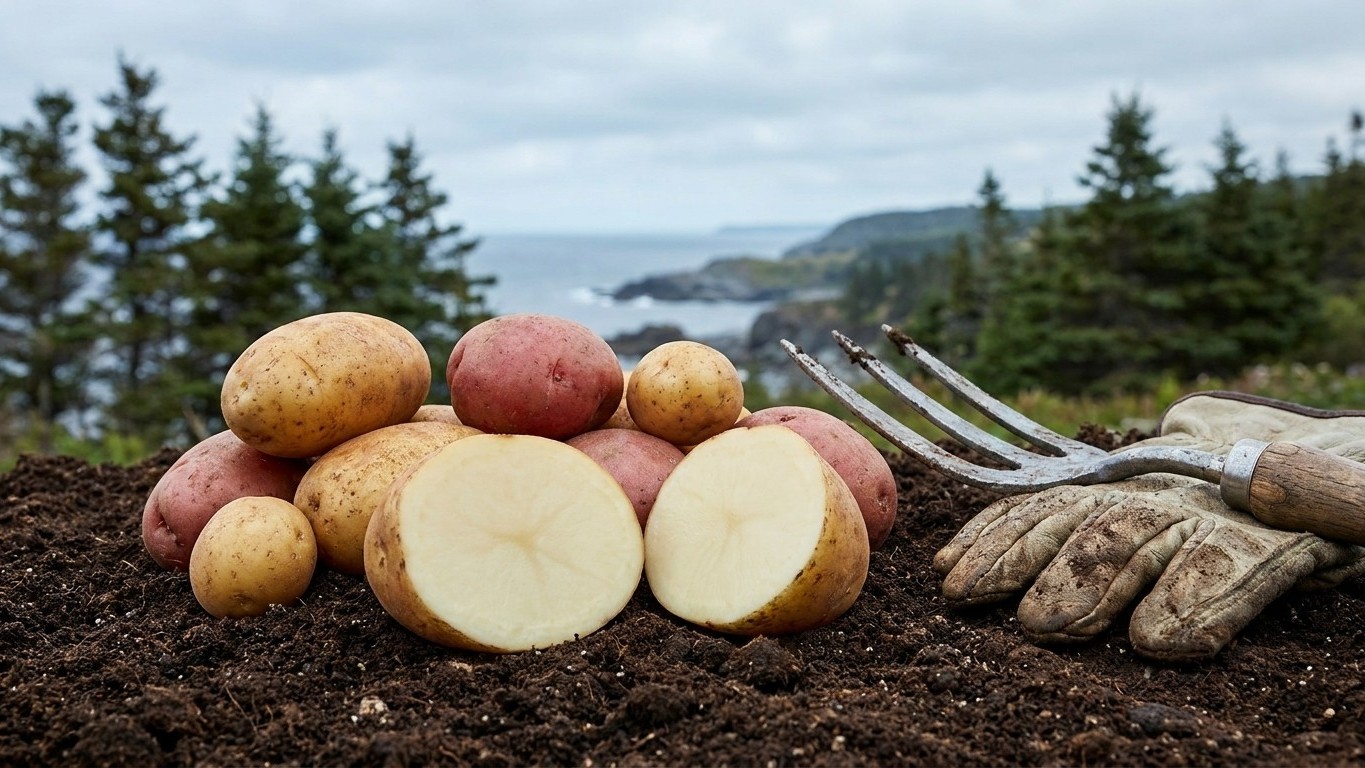

Early and mid-season varieties are the practical choice for Newfoundland and Labrador, chosen for boiling and baking rather than for a long summer in the ground. The reason traces back to one number: the mean last spring frost lands around May 30 at the ST JOHN’S A station, according to Environment and Climate Change Canada’s Canadian Climate Normals for 1981-2010. That single date reshapes almost every planting decision on the island and in Labrador.
The short answer
Environment and Climate Change Canada puts the average last spring frost at St. John’s at May 30, drawn from the Canadian Climate Normals 1981-2010 for the ST JOHN’S A station. That date is a mean, not a guarantee, so in roughly half of all years frost arrives later than that. For a gardener choosing potato varieties, this single fact does most of the work: it sets a short, cool window between soil warm enough to plant and the point where a crop needs to finish sizing before fall.
Given that window, early-season and mid-season potatoes, the ones University of Maine Cooperative Extension and Utah State University Extension classify for boiling or baking rather than for extended storage crops, fit the province better than late-season types. Early varieties reach usable size before the short window closes. Mid-season varieties can work on the Avalon Peninsula and other milder coastal pockets where the growing stretch runs a little longer, but they carry more risk the further inland or north a garden sits.
Late-season potatoes are not impossible in Newfoundland and Labrador, but they ask the season to do more than it reliably offers. Utah State University Extension notes that tuber set and fill slow down once soil temperatures climb above 90 F, and University of Maine Cooperative Extension’s Bulletin #2077 confirms the same ceiling. That threshold almost never comes into play here. The province’s limiting factor is not excess heat, it is a short, cool season bookended by a frost date that averages May 30 and can easily run later.
So the short answer has two parts. First, pick varieties published as early or mid-season, described by their use (baking, boiling) rather than by a days-to-maturity number that neither Utah State nor Maine’s Extension actually publishes for named varieties. Second, plant them around certified seed, not saved tubers, because virus carried in uncertified stock will undercut whatever the season allows.
What actually decides it
Two thresholds govern potato timing everywhere, and Newfoundland and Labrador sits at an unusual point relative to both of them. Understanding the mechanism, rather than memorizing a date, lets a gardener adjust for a specific yard, valley, or Labrador community.
Soil temperature, not the calendar
Utah State University Extension and University of Maine Cooperative Extension both tie planting to soil temperature, not to a date on a calendar. Potatoes go in once soil reaches 50 F, and that point typically falls 14 to 21 days before the last frost date for a given area. In Newfoundland and Labrador, with a mean last frost of May 30 at the St. John’s station, that arithmetic pushes ideal planting into the second or third week of May in a typical year at that reference point, earlier on sheltered south-facing ground, later in low spots or inland valleys that hold cold air.
The heat ceiling that rarely shows up here
The other threshold is the one that limits potatoes across much of the continental United States: soil above 90 F stops tuber set and fill, and no amount of watering reverses it once it happens. Newfoundland and Labrador’s cool maritime summers rarely push soil into that range, even in a warm stretch. That is a genuine advantage. It means a gardener here is not managing around heat stress the way a grower in a hot inland state must. The trade-off is that the province’s constraint sits at the other end of the thermometer: not too much summer heat, but not enough season length.
| Threshold | Effect on tubers | Relevance in Newfoundland and Labrador |
|---|---|---|
| Soil at 50 F | Signals safe planting, 14-21 days before last frost | Central driver of the planting date; arrives late relative to warmer regions |
| Soil above 90 F | Tuber set and fill inhibited | Rarely reached; not the limiting factor here |
Why the frost date is a midpoint, not a promise
Because the May 30 figure is a mean drawn from the 1981-2010 normals at one station, treating it as a safe cutoff misreads what the number means. In close to half of the years in that record, frost came after May 30 at that same station. A garden a few miles inland, at higher elevation, or further up the coast toward Labrador will typically lag well behind St. John’s on top of that. The mechanism a gardener should carry forward is this: find the local equivalent of that mean date, then still hold back protection for a stretch afterward, because the mean is a midpoint of a spread, not an edge of it.
How to do it
- Source certified seed potatoes in an early or mid-season class described for boiling or baking use, since neither Utah State University Extension nor University of Maine Cooperative Extension publishes a days-to-maturity figure for named varieties, only the season class and intended use.
- Check soil temperature at planting depth with a soil thermometer rather than relying on the date on a calendar; wait until it reads 50 F before putting seed potatoes in the ground.
- Count backward from the local last-frost expectation, keeping in mind that the mean at the ST JOHN’S A station is May 30 and that inland or northern ground typically runs behind it; planting generally falls 14 to 21 days ahead of that expected frost date.
- Keep row cover or another frost protection on hand through the weeks after planting, since a mean date means frost can and does arrive later in roughly half of all years.
- Monitor the crop through summer for size and vigor rather than watching for heat stress; the 90 F soil ceiling that limits potatoes elsewhere is not the typical constraint in this climate.
- Harvest according to the variety’s published season class and the visible dieback of foliage, not by a fixed calendar date, since the short local season is the factor to work around, not a maturity countdown.
What goes wrong
- Planting by the calendar instead of the soil. A grower plants on a fixed date because that is when a neighboring garden or a different region plants, then loses the crop to cold, wet soil that never reached 50 F. The fix is a soil thermometer at planting depth, checked over several days, not a date circled in advance.
- Treating May 30 as a safe cutoff. Because that figure from Environment and Climate Change Canada’s 1981-2010 normals at ST JOHN’S A is a mean, frost after that date is common, not rare. The fix is to keep frost cover ready into June and to expect the real safe window to sit later than the mean in many years.
- Using saved seed potatoes from a previous crop. Uncertified seed carries virus that certified stock is bred and tested to avoid, and a virus-carrying tuber undercuts yield regardless of how well the season cooperates. The fix is certified seed, purchased fresh, every season.
- Choosing a late-season variety expecting a long American growing season. The short window here rarely lets a late-season type finish sizing. The fix is to choose from varieties published as early or mid-season and matched to boiling or baking use.
- Worrying about the 90 F heat ceiling in a climate that almost never reaches it. Some gardeners import advice meant for hot inland states and manage for heat stress that never arrives here. The fix is to redirect that attention toward the real constraint, which is season length and frost timing, not soil overheating.
- Assuming one frost date applies to the whole province. The May 30 mean comes from a single station at St. John’s; a garden further inland, at higher ground, or further north or into Labrador typically sees frost persist weeks longer. The fix is to treat the St. John’s figure as a starting reference, then adjust later for a specific local site.
Common questions
Can I grow late-season potatoes in Newfoundland and Labrador?
It is possible in a sheltered, favorable spot, but the short cool season works against late-season types more than it works against early or mid-season ones. Neither Utah State University Extension nor University of Maine Cooperative Extension publishes a maturity countdown for named varieties, so the safer approach is to favor varieties published as early or mid-season for this climate.
Does the heat ceiling affect potato growing in NL?
Rarely. The 90 F soil threshold that stalls tuber set and fill, documented by Utah State University Extension and University of Maine Cooperative Extension, is a limiting factor in hotter climates. Newfoundland and Labrador’s cool maritime summers seldom reach that mark, which removes one common stress that gardeners elsewhere have to manage.
What’s the safest planting date for potatoes in St. John’s?
There is no single safe date published here, only a mean. Environment and Climate Change Canada’s Canadian Climate Normals 1981-2010 put the average last frost at the ST JOHN’S A station at May 30, and planting is generally timed 14 to 21 days before the expected last frost once soil hits 50 F, per Utah State University Extension and University of Maine Cooperative Extension. Because that frost date is a midpoint, frost protection should stay available well into the weeks after planting.
Why does certified seed matter more here than variety choice?
A short season already limits how much a crop can compensate for setbacks. Uncertified seed potatoes can carry virus that reduces vigor and yield regardless of which variety or season class is planted, so certified seed protects the limited growing window this climate already provides rather than adding an extra safeguard on top of it.