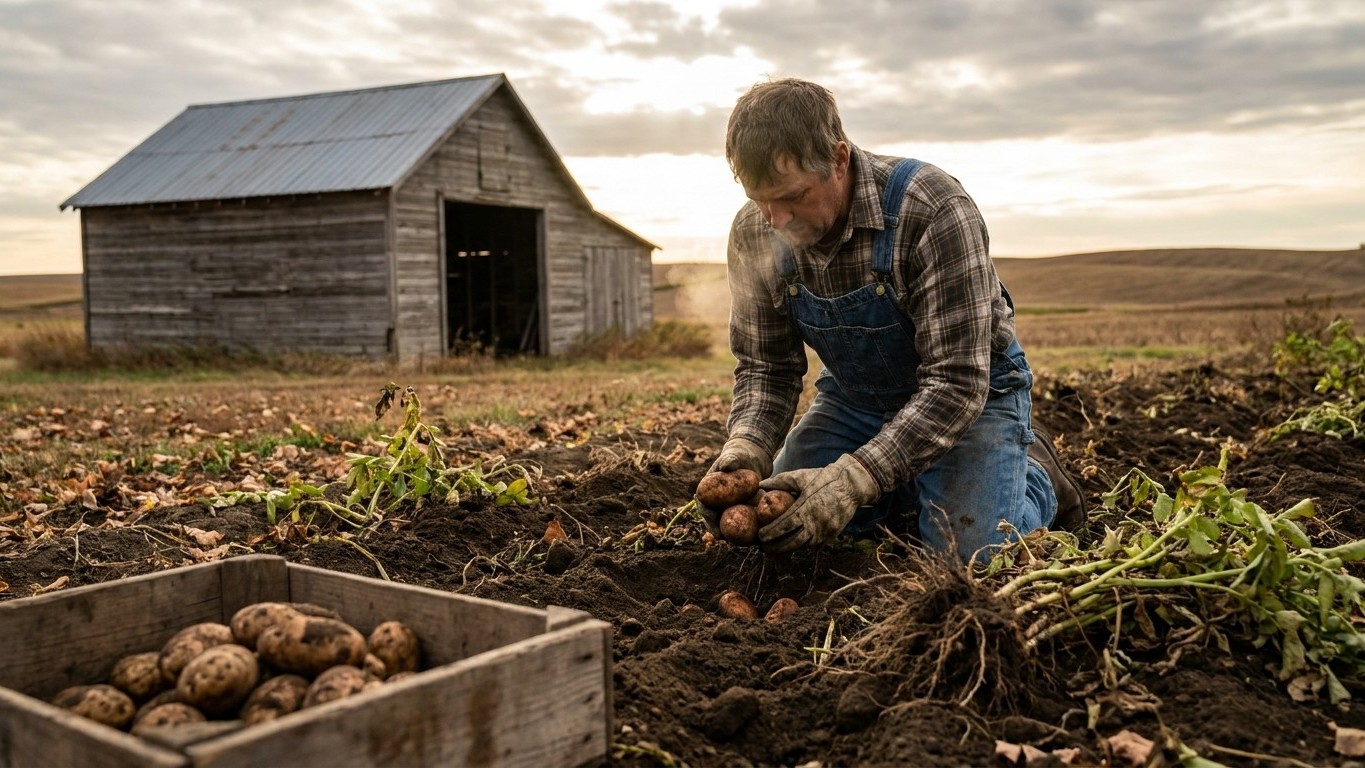

In North Dakota, potatoes typically come out of the ground before the first fall frost window of September 25 to October 5 hits, and they go into a space that can hold steady at 40-45 F. An unheated garage or shed won’t do that through a full winter here, since the coldest month averages a nightly low of just 0.2 F. That single fact decides more about a North Dakota potato harvest than anything else.
The short answer
Two numbers frame everything. The first fall frost window at the reference weather station runs September 25 to October 5 (NOAA NCEI, 1991-2020 Climate Normals). The coldest month of the year averages a mean daily minimum of 0.2 F. Those aren’t record lows or oddball cold snaps. They’re the normal, expected pattern, which means any storage plan has to be built around them, not hoped around them.
For harvest timing, that frost window is the trigger. Potato vines die back on their own as the plant matures, but if frost kills the foliage first, that’s fine, and even useful, since it signals the tubers have stopped bulking and it’s time to dig. What matters is getting the crop out of the ground before the soil itself starts flirting with freezing, which follows not far behind that first frost. Waiting past early October in most of the state is a gamble on soil temperature, not air temperature.
For storage, the 0.2 F figure is the real warning. That’s not the temperature of a bad night. That’s the average low across an entire month. Any space without insulation, heating, or thermal mass from the ground (an attached garage with no heat source, a garden shed, an uninsulated porch) will spend weeks at or below freezing during that stretch. Potatoes held there don’t just get cold; the starches convert to sugar, the flesh turns translucent, and eventually the cell walls rupture and the tubers rot or turn to mush once they thaw. A space needs some combination of insulation, below-grade construction, or a heat source to hold 40-45 F when outdoor lows are sitting at 0.2 F on average.
This is also why the frost date matters as a planning marker, not a guarantee. It comes from a single airport weather station, and NOAA’s own data shows a 30 to 70 percent probability band around that date, which means a given rural garden, especially at higher elevation or in a low-lying frost pocket, can see its first fall frost run a week or two earlier than the reference figure. Anyone gardening outside the immediate reference area should treat September 25 to October 5 as a starting point and watch their own local conditions, not a fixed calendar date.
Curing, and where
Curing is the step that turns a freshly dug potato, with thin, easily nicked skin, into one that can survive months of storage. Utah State University Extension specifies 55-60 F with high humidity for two to three weeks. In North Dakota, that window falls right at the point when outdoor conditions are sliding toward that first frost, which limits where curing can actually happen.
- Dig the potatoes on a dry day, before or right around the frost window, and shake off loose soil without washing the tubers or scrubbing the skin.
- Move them out of direct sun immediately. Sun exposure during curing causes greening, which isn’t a temperature problem but ruins the crop just as fast.
- Find a space holding 55-60 F with high humidity. In this climate, that’s rarely a shaded porch by early October, since overnight temperatures are already dropping toward the frost mark and porches track outdoor air closely. A basement, especially an unheated or minimally heated one, tends to sit in that range naturally at this time of year and is the more reliable choice statewide.
- Spread the tubers in a single layer, or in shallow crates, so air moves around each one rather than trapping heat and moisture in a pile.
- Hold them there for two to three weeks, checking periodically for soft spots or rot and pulling any damaged tubers before they spread moisture to the rest.
- Once the skins have set (they stop tearing or scuffing under light thumb pressure), move the batch to its winter storage location before overnight lows outside start regularly threatening the curing space itself.
A garage is the riskier option for this step in North Dakota. Unlike a basement, an attached or detached garage cools fast once nightly temperatures start dropping, and by the tail end of the curing window it may already be running colder than the 55-60 F target, especially overnight. If a basement isn’t available, a garage can work only in the earliest part of the curing period, with a plan to move the crop somewhere warmer before the cold sets in for good.
Storing through this winter
Once cured, potatoes want darkness and a steady 40-45 F, per Utah State University Extension, or 38 F at 95 percent humidity, per the University of Maine Cooperative Extension. Those two figures aren’t in conflict; they represent a slightly different balance point, but both sit well below room temperature and well above freezing. That middle ground is exactly what’s hard to find naturally in North Dakota once the coldest month arrives with a 0.2 F average low.
| Storage location | Typical winter temperature | Fit for potato storage |
|---|---|---|
| Insulated basement, interior room | Often 45-55 F without added heat | Usually workable, sometimes needs venting to cool further |
| Uninsulated basement corner, near exterior wall | Can drop close to freezing in deep cold | Riskier; move bins toward the interior |
| Attached, unheated garage | Tracks outdoor lows closely; often below freezing for weeks | Unsafe for the coldest months without added insulation or heat |
| Detached shed or unheated porch | Similar to outdoor air; regularly below 0 F | Unsafe for winter-long storage |
A basement interior room, away from exterior walls and any furnace or water heater, is generally the best bet across the state, since below-grade construction buffers against the swings that above-grade spaces experience. Where a basement runs warmer than 45 F, cracking a window briefly on the coldest nights, or venting to an unheated stairwell, can pull the temperature down into range without risking a freeze. Where no basement exists, an insulated root cellar dug into a slope, or an insulated storage box inside an otherwise unheated structure, can substitute, but it needs enough thermal mass or added insulation to avoid tracking that 0.2 F outdoor average once deep winter sets in.
Humidity matters just as much as temperature. A bone-dry basement, common with forced-air heating running nearby, will shrivel potatoes even at a perfect temperature. A loosely closed paper bag, a lightly damp burlap sack, or a covered bin with a few ventilation holes helps hold moisture near the tubers without trapping so much that rot sets in.
What goes wrong here
- Digging after a hard freeze reaches the soil. Waiting past the first fall frost window without checking soil conditions risks tubers freezing in the ground, which turns them soft and unusable. Dig as soon as vines die back or frost is forecast, and don’t leave the crop in the ground to “cure” outdoors.
- Curing in a space that’s already too cold. A porch or garage in early October can undercut the 55-60 F target within days as nightly lows fall. Check the space with an actual thermometer rather than assuming it’s warm enough, and move to a basement if it’s tracking outdoor temperatures.
- Storing in an unheated garage through deep winter. With a coldest-month average low of 0.2 F, an uninsulated garage will freeze the crop repeatedly, not just once. Reserve garages for short-term storage only, in the shoulder weeks before the hardest cold sets in.
- Ignoring humidity in a dry basement. Forced-air heat nearby can dry a basement enough to shrivel stored tubers even at the right temperature. Use a loosely covered container or damp sacking to hold moisture without trapping excess condensation.
- Storing damaged or diseased tubers alongside healthy ones. Any tuber nicked during digging or showing rot from the field should be set aside and used first, not stored long-term, since it can spread moisture and decay through an entire bin. Where field disease pressure was an issue during the growing season, an appropriate fungicide applied earlier in the season, or an appropriate insecticide against pests that spread disease, is a growing-season fix, not a storage-season one.
Common questions
When should potatoes be dug in North Dakota?
Around the first fall frost window, which the NOAA NCEI Climate Normals set at September 25 to October 5 for the reference station. Local gardens, especially in low spots or at elevation, can see frost arrive earlier, so it’s worth watching individual conditions rather than relying on that date alone.
Can potatoes be stored in an unheated garage all winter?
Not reliably in this state. With a coldest-month average low of 0.2 F, an uninsulated garage will spend extended periods below freezing, which ruins stored potatoes. A garage can work for short stretches in fall but not through the deep-winter months.
What temperature is best for long-term potato storage?
Utah State University Extension recommends 40-45 F in a dark space; the University of Maine Cooperative Extension specifies 38 F at 95 percent humidity as an alternative target. Both are well below room temperature and well above freezing, which is why an insulated basement typically works better than an attached garage or shed in North Dakota’s climate.
How long does curing take before storage?
Two to three weeks at 55-60 F with high humidity, per Utah State University Extension. In North Dakota, that window usually needs to happen indoors, most reliably in a basement, since outdoor temperatures at harvest time are already trending toward the first fall frost.